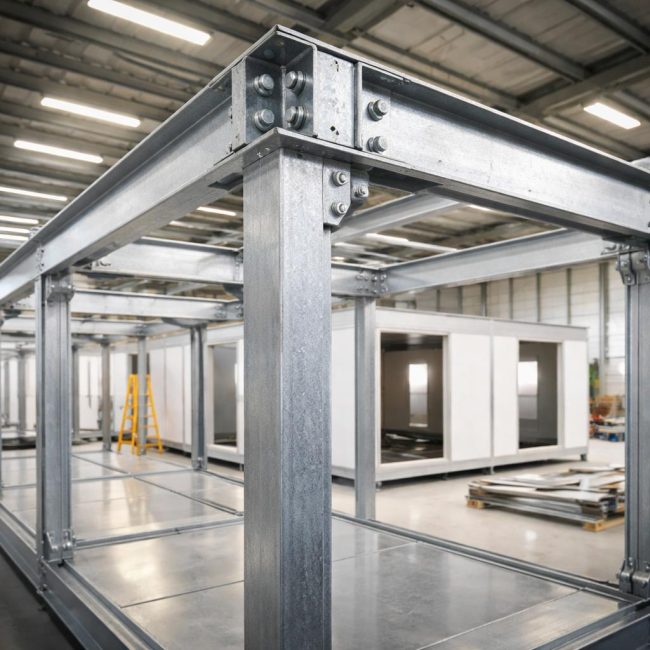
Modular buildings are increasingly viewed not as a temporary solution, but as a fully-fledged alternative to traditional construction. They are used for offices, dormitories, medical facilities, schools, industrial, and administrative buildings. The frame remains the key element, directly affecting the durability, safety, and performance of such a building.
The experience of a metal structure manufacturer in Yekaterinburg shows that most problems with modular buildings are not related to finishing or utility systems, but to errors in the design and manufacture of the supporting frame. To understand what truly determines its reliability, it's necessary to consider the issue holistically—from design to operating conditions.
- The design scheme as the basis for reliability
- Accuracy of design and calculations
- Metal quality and choice of sections
- Connection nodes - a weak point or a point of reliability
- Production discipline and quality control
- Anti-corrosion protection and service life
- Operating conditions and usage scenarios
- Conclusion
The design scheme as the basis for reliability
The frame of a modular building is not simply a collection of metal elements, but a well-designed spatial system. The chosen design determines how the loads are distributed among the elements and components.
The most common are:
- frame schemes;
- frame-braced structures;
- spatial frames with rigid nodes.
A mistake is to directly copy the designs used in prefabricated buildings without taking modularity into account. In modular buildings, each block is an independent, rigid unit that must maintain its geometry not only during operation, but also during transportation, lifting, and installation. If the design doesn't take these steps into account, the reliability of the structure is compromised even before it's in use.
Accuracy of design and calculations
In modular construction, tolerances play a critical role. While in traditional construction, some errors can be compensated for on-site, in modular buildings this is virtually impossible.
The reliability of the frame directly depends on:
- correct calculations of loads (permanent, temporary, wind, snow);
- taking into account dynamic loads during transportation;
- calculation of the rigidity of nodes, and not just the strength of elements;
- consistency of design solutions between the frame, enclosing structures and engineering systems.
Even minor errors in calculations can lead to module misalignment, problems with docking, and accelerated wear of connections.
Metal quality and choice of sections
A common misconception is that the reliability of a frame is determined solely by the thickness of the metal. In practice, choosing the right profile and steel grade for specific loads is far more important.
Factors affecting reliability:
- compliance of the steel grade with operating conditions;
- profile resistance to shape loss;
- the ratio of the weight of the structure to its rigidity;
- safety margin without adding excessive weight.
Excess metal doesn't always make a frame more reliable. On the contrary, increasing the module's weight complicates transportation and installation, placing additional stress on the components and foundation.
Connection nodes - a weak point or a point of reliability
If we consider the actual causes of deformations and damage to modular buildings, they are most often associated with the connection nodes.
Key requirements for nodes:
- maintaining rigidity under repeated loads;
- absence of stress concentration;
- manufacturing precision;
- resistance to vibration and temperature deformations.
Particular attention is paid to corner and connecting joints, which transfer loads between modules. Underestimating these elements can undermine the quality of the entire frame, even if the main components are flawless.
Production discipline and quality control
The reliability of a frame is determined not only at the design stage but also in the workshop. Even a perfectly designed structure will lose its properties if the manufacturing process is not followed.
Critically important:
- cutting and drilling accuracy;
- maintaining geometry during welding;
- weld inspection;
- protection of metal from corrosion at the production stage.
Modular construction is unforgiving of deviations. If one module is built with a geometric deviation, it affects the entire assembly chain.
Anti-corrosion protection and service life
The modular building frame often operates in conditions of high humidity, temperature fluctuations, and limited ventilation within the structure. Therefore, reliability is directly linked to the quality of corrosion protection.
It is important to consider here:
- type of coating and its compatibility with operating conditions;
- quality of surface preparation;
- protection of hidden cavities and nodes;
- service life of the coating without maintenance.
Insufficient protection does not always lead to problems immediately, but after several years of use it can significantly reduce the load-bearing capacity of the frame.
Operating conditions and usage scenarios
The reliability of a structure cannot be assessed without understanding how the building will be used. Temporary staff accommodation and year-round operation are fundamentally different operating modes for a structure.
Operating factors:
- loading and unloading cycles;
- possible redevelopment;
- temperature conditions;
- transportation and re-installation.
A frame that is not designed for repeated movement may lose rigidity after just one dismantling cycle.
Conclusion
The reliability of a modular building's frame is the result of a combination of decisions, not a single factor. It is determined by the intersection of design, calculations, production, and an understanding of real-world operating conditions. It's a mistake to view the frame as a secondary element: it is the frame that determines whether the building will retain its properties in 5, 10, or 20 years.
Modular buildings require a more rigorous engineering approach than many traditional structures. And the earlier this understanding is incorporated into the design, the greater the overall reliability of the entire system.