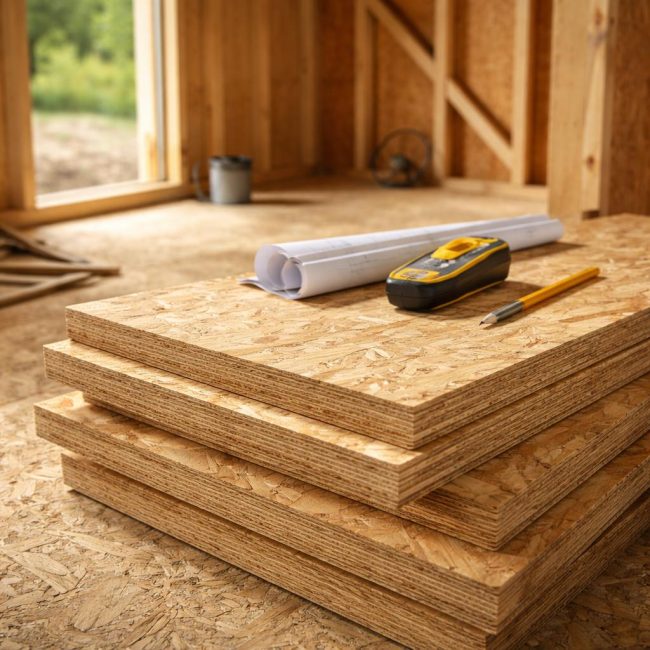
OSB (Oriented Strand Board) is a popular building material often used in various construction and renovation applications due to its strength, affordability, and ease of processing. One of the most important criteria when selecting OSB is its emission class, which characterizes the level of emissions from the board into the environment. This indicator is particularly important for assessing the environmental friendliness and safety of the material in various conditions. In this article, we will examine in detail what OSB emission class 3 is, where and how this material is used, and what limitations and features are important to consider when using it.
What is OSB emission class 3?
OSB emission class 3 designates a material that has been tested for the release of various substances during use. In the case of OSB class 3, these boards are considered safe for use in high-humidity areas and even in outdoor structures, and they do not emit toxic substances in quantities hazardous to humans.
The emission class of materials is determined according to European standards that assess the level of emissions of volatile organic compounds (VOCs), formaldehyde, and other components that impact the atmosphere and human health. OSB emission class 3 is a medium level, indicating compliance with strict environmental standards that set permissible emission levels.
How does the emission class work in practice?
OSB production uses wood chips bound with resins and adhesives. These components can release various substances into the atmosphere. The purpose of the emission class is to ensure that these emissions remain at safe levels when the material is used indoors or outdoors.
- Application in constructionOSB 3 is ideal for constructing structures subject to moisture fluctuations, such as walls, ceilings, roofs, and floors in moderate to humid climates. It is used in residential and non-residential buildings, as well as in the construction of temporary and permanent structures.
- Impact on health: Thanks to the strict standards of OSB emission class 3, the use of such boards is safe for humans, since the levels of chemicals emitted comply with the permissible limits.
Limitations and nuances
Although OSB 3 is a material with good performance characteristics for use in humid conditions, it has its limitations:
- Not for continuous contact with moistureOSB 3 boards are not suitable for prolonged exposure to water, such as in conditions of constant flooding. Although the material is moisture-resistant, prolonged exposure can cause swelling and loss of strength.
- Not suitable for extreme temperatures: Although OSB 3 retains its shape well at moderate temperatures, too high or low temperatures can negatively affect its properties.
- Cannot be used in critical structures: For some types of structures, such as those requiring increased fire safety or high loads, it is better to use more specialized boards such as OSB 4.
Common misconceptions
- OSB 3 can be used anywhere where moisture resistance is required.Some believe that OSB 3 is suitable for all high-humidity environments. However, for areas with constant or intense humidity, such as saunas or bathrooms, more durable materials should be used.
- All OSBs are the sameIt's important to remember that materials can vary significantly in their environmental performance depending on their emission class and adhesive type. OSB emission class 3 guarantees that the material is safe for standard use, but other classes may be required for specific needs.
Conclusion
OSB emission class 3 is an important criterion to consider when selecting boards for construction. This material is suitable for use in high-humidity conditions and does not emit hazardous substances into the atmosphere. However, it is important to remember its limitations, such as its unsuitability for extreme humidity or high temperatures. By following these guidelines, OSB 3 can be effectively used to create various structures, ensuring the durability and safety of all components.