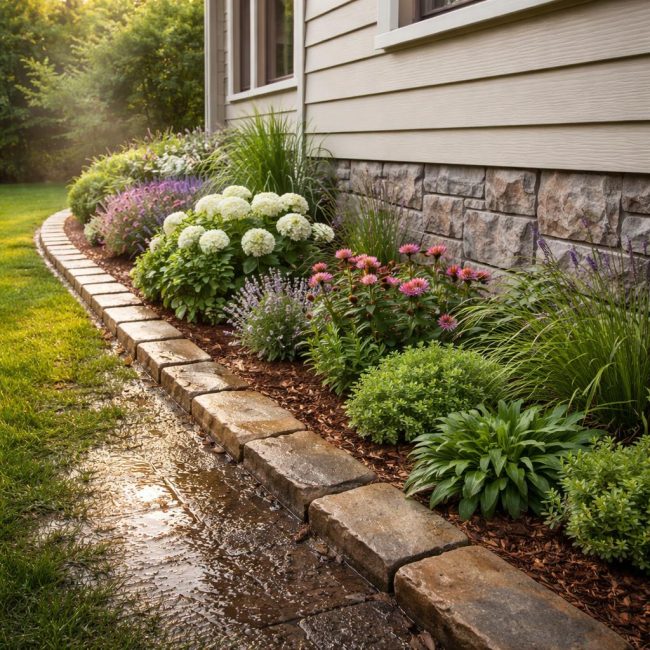
A flowerbed along a foundation is a topic that's often considered not for purely aesthetic reasons, but rather for practical reasons. The house is built, the grounds are tidied up, the façade is finished—and suddenly it becomes noticeable that the line where the building meets the ground appears heavy, interrupting the overall appearance. In other cases, the issue arises after rain, when splashes from the concrete pavement stain the walls, or when a narrow strip of land alongside the house remains inconvenient and unused. It's here that a flowerbed is perceived as a possible solution, but almost immediately raises doubts: is it safe for the foundation, will moisture damage it, and will the decorative idea become the source of hidden problems?
The crux of the matter isn't the flowers themselves or their decorative appeal, but rather how the space around the building's foundation is arranged and the processes that occur within it. A foundation flowerbed is always an interaction of three factors: the building's structure, water, and soil. If viewed solely as a landscaping element, it's easy to miss important nuances that can make a seemingly successful solution work against the house itself over time.
The area around the foundation is a sensitive area. It's where surface water converges, where the pavement ends or the lawn begins, and where the brunt of rain and snowmelt falls. In its natural state, this strip either diverts water away from the building or, conversely, traps it. Any intervention—including the installation of a flowerbed—alters this balance. Therefore, it's important to understand that a flowerbed along the foundation isn't a neutral element: it always enhances or detracts from the overall performance of the site.
At the fundamental level, everything is quite logical. The foundation requires dryness and stability. This doesn't mean absolute protection from water—modern structures are designed to withstand moisture—but it does imply a controlled environment. A flowerbed, by its very nature, keeps the soil loose, rich in organic matter, and moisture. It is this difference that becomes the source of controversy. On the one hand, the topsoil moderates temperature fluctuations, protects from direct solar heat, and visually grounds the house. On the other hand, it changes the behavior of water near the walls and can create long-term moisture in the adjacent area.
In reality, things aren't as straightforward as often imagined. A flowerbed itself doesn't "damage the foundation" and isn't a mistake. Problems arise when it becomes a substitute for engineering solutions or masks defects. For example, if the blind area is poorly designed or the slope is incorrect, decorative planting along the wall may conceal the symptoms but not eliminate the cause. Moisture will still leak toward the house, but it will now be less noticeable.
Experience shows that flowerbeds along a foundation most often serve one of three functions. In the first scenario, they serve as a visual transition between the house and the property, softening the sharp boundary. In the second, they act as a protective zone, absorbing dirt and splashes. In the third, they are used as a necessary solution for narrow strips of land where it is impossible to place anything else. In each of these cases, the expectations of the flowerbed are different, and therefore the requirements for it also differ.
Seasonal behavior is also important to consider. A flowerbed may appear well-kept and dry in the summer, but become a damp zone in the spring or fall. The soil near the foundation warms up slowly, retains water longer, and is less well-ventilated. This isn't critical in itself, but it becomes significant when several factors combine: dense shade from the house, lack of wind, and an excess of organic matter. Then, the flowerbed ceases to be a decorative element and begins to act like a sponge.
There's a downside, too. In some cases, a flowerbed actually stabilizes the situation. Plants with extensive root systems can structure the soil, reduce erosion, and even partially redistribute moisture. Furthermore, a layer of mulch or vegetation reduces sudden temperature fluctuations in the adjacent area, which is especially noticeable on south-facing facades. This is where the typical contrast emerges: on paper, a flowerbed appears to be a risk, but in practice, with proper management, it can reduce the load on the structure.
This solution does have its limitations, however, and they stem not from the plants themselves, but from the house's architecture and the condition of the foundation. A flowerbed along the foundation is not intended to compensate for design or construction errors. If waterproofing is poorly implemented, or if a well-thought-out drainage system is lacking, decorative design will not remedy the situation. Moreover, it may delay the moment the problem becomes noticeable, complicating subsequent intervention.
The idea of a foundation flowerbed is often oversimplified: either "it's possible, and it's beautiful," or "it's not, because it's dangerous." Both approaches are one-sided. In reality, we're talking about the interaction of the site's elements, where each additional layer—soil, plants, and decorative materials—affects the moisture and air conditions. Understanding this interaction is more important than choosing specific shapes or plants.
One common misconception is the idea that leaving a narrow strip of soil will automatically make it safe. In fact, narrow flowerbeds are often the worst performers: they dry out faster at the top but retain moisture longer near the wall, creating a "pocket" effect. Another common myth is the belief that the higher the flowerbed, the more decorative and reliable it is. Raising the ground level near the foundation without taking into account the structural features of the house can alter the distribution of water and the load on the foundation.
There's also a misconception of the opposite kind: that any vegetation near the house is harmful. This view is usually formed based on unfortunate examples where a flowerbed actually became the source of dampness or damage. However, in such cases, the cause almost always lies deeper than the plantings themselves. A flowerbed merely exposes weaknesses in the system, rather than creating them from scratch.
In a broader sense, the theme of a foundation flowerbed extends beyond a specific solution. It forces us to view the house not as an isolated object, but as part of the site, integrated into natural processes. Here, it becomes clear that landscaping is not just about appearance but also about harmonizing decorative and structural objectives. A successful foundation flowerbed is not an accent or decoration, but a calm, almost unnoticeable element that works alongside the house, not in its place.
When this understanding becomes the foundation, the need for universal prohibitions or permissions disappears. A flowerbed along the foundation ceases to be a risky experiment and becomes a meaningful part of the environment, where aesthetics and technical logic do not conflict, but complement each other.