In the engineering world, accuracy is not just a requirement, but the foundation of any project. From construction drawings to electrical schematics, from factory floor plans to machine assembly diagrams, the slightest deviation in data can result in costly errors. This is why high-precision project scanning has become an integral part of the modern engineering process.
It's not just about converting paper documents into digital format. Modern scanning technologies make it possible restore the geometry of an object with an accuracy of tenths of a millimeter, analyze relationships between elements, and integrate data directly into CAD and PLM systems. Design and manufacturing companies are gradually moving from traditional copying to intelligent digitization—where every pixel carries engineering meaning.
- Why scanning accuracy has become critical
- What is high-precision project scanning?
- The Impact of Accuracy on the Quality of Engineering Data
- Application in various industries
- Construction and architecture
- Mechanical engineering
- Energy and industrial infrastructure
- Research and development and defense
- Equipment and technologies
- Integration with CAD and PLM
- Common mistakes and how to avoid them
- The economic benefits of accurate scanning
- Prospects for technology development
- Conclusion
Why scanning accuracy has become critical
Traditional digitalization methods—simple scanning and subsequent image storage—no longer meet modern requirements. In the era of digital twins, automation, and 3D modeling data should not only be visible, but also measurable.
In engineering fields, the consequences of inaccuracies can be enormous:
- in construction — an error in scale leads to misalignment of the supporting structures;
- in mechanical engineering — a deviation of even a fraction of a millimeter can cause misalignment of parts and increased wear of mechanisms;
- in the energy sector - Inaccurate pipeline or electrical grid diagrams increase the risk of accidents.
Therefore, scanning of projects today is not considered as an auxiliary operation, but as a key element of the design information quality control system.
What is high-precision project scanning?
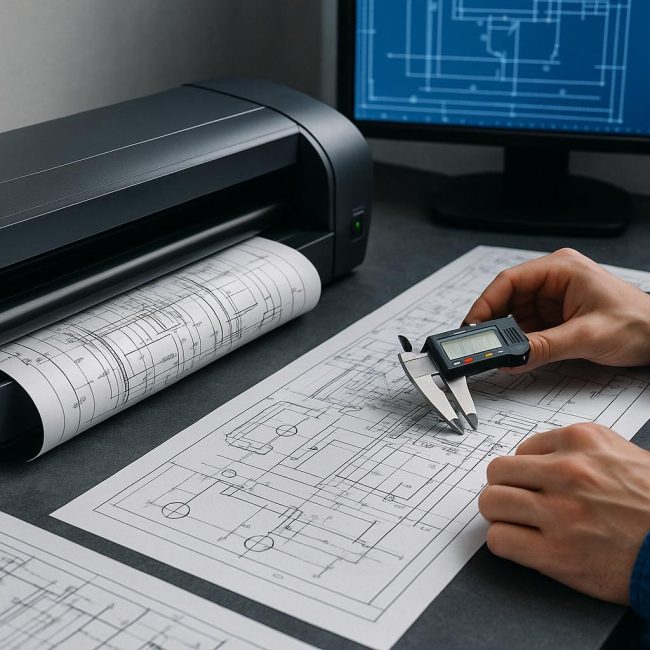
High-precision scanning is the process of converting paper, film, or raster documents into digital form while maintaining metric accuracy. Specialized scanning equipment is used for this purpose. engineering scanners, which are capable of reading images with an accuracy of up to 0.05 mm and without geometric distortion.
The technology includes several stages:
- Preparation of originals — cleaning, alignment, control of paper deformations.
- Scanning with scale calibration — adjustment of optics taking into account the thickness of the media.
- Digital correction — correction of distortions, stitching of large format fragments.
- Geometric accuracy control — automatic comparison with reference dimensions or coordinate grid.
- Vectorization and analysis — converting lines, designations and symbols into editable objects.
The result is a digital copy that is fully consistent with the original, suitable for precise measurements and integration into engineering systems.
The Impact of Accuracy on the Quality of Engineering Data
When design documentation is stored in paper form, it loses its shape over time: sheets become warped, fade, and out of scale. When scanned without metrological control, a distorted plan can become a source of errors.
High-precision scanning solves this problem:
- the original scale is preserved - lines and dimensions are not deformed;
- coordinates of elements can be used to construct 3D models;
- Drawings can be easily overlaid on top of each other to analyze changes.
For example, during the reconstruction of an industrial facility, an engineer can compare an old scan with a new laser measurement and identify discrepancies—down to the millimeter. This allows make decisions based on hard data, not visual guesses.
Application in various industries
Construction and architecture
High-precision scanning is used to digitize master plans, facades, and utility systems. It helps designers verify data is up-to-date and create digital building models where every line matters.
Mechanical engineering
Factories and design bureaus scan old drawings to integrate them into modern CAD systems. This is especially relevant for equipment that's been in production for decades: the design can be updated without having to recreate it from scratch.
Energy and industrial infrastructure
Scanning electrical wiring diagrams, gas pipelines, and instrumentation systems allows complex paper archives to be converted into digital form and synchronized with real-world objects. Each circuit maintains its scale and coordinates.
Research and development and defense
In these areas, accuracy is especially important. Scanning ensures the preservation of critical data from older designs, where even one incorrect symbol can change the meaning of the circuit.
Equipment and technologies
Modern systems for scanning projects are divided into several types:
- Flatbed scanners — for working with A3–A0 sheets; ensure high optical accuracy.
- Roll scanners — convenient for long drawings and maps; have automatic feed and uniform calibration.
- Photogrammetric systems — allow you to scan large-sized objects while maintaining metric reference.
- Intelligent systems with AI — are able to recognize line types, texts, symbols and automatically structure data.
Modern image processing algorithms eliminate distortions, bends, uneven lighting, and even “understand” the structure of a drawing—distinguishing where the outline of a part is, and where hatching or text is.
Integration with CAD and PLM
The main value of scanning is revealed when the result can be use in work, and not just store it in an archive.
After digitization, the data is converted into a vector format (DWG, DXF, SVG), suitable for loading into CAD systems (AutoCAD, SolidWorks, Kompas, Revit, etc.).
Thanks to this, the engineer can:
- edit lines and objects as in the original project;
- carry out measurements and calculations;
- combine old and new data into a single model;
- use scanned drawings as a basis for digital twin equipment or structure.
Integration with PLM/PDM platforms enables document version tracking and automated change management—an essential element of digital manufacturing.
Common mistakes and how to avoid them
Even with modern equipment, errors can occur if proper procedures are not followed. The most common problems are:
- loss of scale when scanning through uncalibrated devices;
- geometric distortions due to paper bends;
- incorrect resolution - too low makes the lines fuzzy, too high creates redundant data;
- vectorization errors, when the algorithm "confuses" lines or symbols.
A comprehensive approach helps avoid them: control of the scale grid, adjustment of optical parameters, perspective correction, and subsequent metrological verification.
The economic benefits of accurate scanning
At first glance, it might seem that high-precision scanning is excessive. However, experience shows otherwise.
Companies that have implemented professional scanning systems receive tangible benefits:
- reduction of the time required to prepare design documentation by 30–50%;
- reducing the number of errors during reconstruction or installation;
- savings on repeated measurements and specialist visits;
- Increased security through data reliability.
The effect is particularly noticeable in large organizations, where thousands of drawings are stored in various formats and on various media. Digitizing them creates a unified digital archive, increasing the efficiency of the entire engineering infrastructure.
Prospects for technology development
The future of scanning lies in artificial intelligence and machine learning. Systems are already emerging that recognize the logical structure of the project: understand which lines belong to electrical circuits, which to hydraulic ones, and which to room layout.
The next step is - automatic semantic processing, when the system not only scans, but also interprets the document: determines the type of equipment, reads the designations and creates a digital database of components.
Thus, scanning becomes not just a storage method, but a tool digital analysis and design of the future.
Conclusion
High-precision project scanning is a bridge between the past and the future of engineering. It allows us to preserve decades of accumulated experience, integrate it into modern digital processes, and avoid errors that cost millions.
In an environment where precision determines safety, productivity and efficiency, a millimeter really does decide everythingAnd the more advanced scanning technologies become, the closer the engineering world is to ensuring that every line in a drawing corresponds to reality with impeccable accuracy.