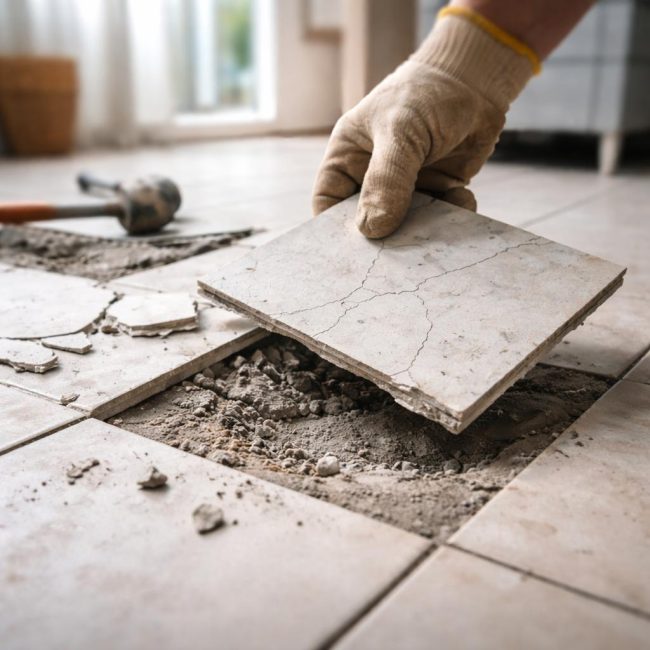
The phrase "I don't care about the thickness of the slabs" sounds like a simplistic statement—usually uttered when one wants to make a quick decision without delving into details. But behind this calmness often lies a very specific, practical question:Under what conditions does the thickness of the tile material really not play a decisive role, and where indifference to it leads to cracks, distortions, and repeated repairs?This is precisely the question that should be considered when it comes to home renovations or improvements.
Thickness isn't a standalone characteristic or a universal indicator of "strength." It only comes into play when combined with the substrate, loads, slab format, and how they're used. When this combination works well, thickness fades into the background. When it doesn't, it becomes a source of frustration, something rarely associated with it.
- Why does the thickness of the slabs cease to be critical in some places?
- Where the illusion of security arises
- How thickness relates to surface behavior over time
- Format and size as a hidden amplifier of the thickness value
- Why conversations about thickness often reach a dead end
- Typical distortions of understanding
- Where a relaxed attitude towards thickness is justified
- When indifference to thickness becomes a mistake
- A broader view of the issue
Why does the thickness of the slabs cease to be critical in some places?
There are scenarios in which the slab is perceived not as a load-bearing element, but as a cladding, a "skin" for the surface. In such cases, the foundation takes on the main work: it is rigid, stable, and does not deform under load. The slab here does not distribute the weight, but merely transfers it downwards into the structure.
This is especially evident in interiors. A floor that doesn't "play," doesn't flex, and isn't subject to point loads allows for the use of materials of varying thicknesses without noticeable differences in the final result. Visually and tactilely, such surfaces behave identically: they don't jingle, don't spring, and don't feel fragile. In this context, thickness truly becomes irrelevant—because it doesn't play a role in key processes.
A similar logic applies where the load is distributed evenly and remains predictable. If the surface isn't subject to impact, temperature fluctuations, or active traffic, a slab of any reasonable thickness will perform reliably. In such conditions, the quality of installation, adhesion, and evenness of the subfloor are more important than millimeters.
Where the illusion of security arises
Problems arise when the "thickness doesn't matter" approach is transferred from quiet environments to areas where the slab is already contributing to the structure. The illusion arises from superficial similarities: visually, tiles in a hallway, on a terrace, or in a utility area may look identical. However, the loads they bear are fundamentally different.
People rarely perceive weight and dynamic movement as stress. A step seems trivial, furniture is static, and an accidental impact is an exception. In reality, it is precisely these forces that create stress within the slab material. If the thickness is insufficient for these scenarios, the slab begins to bend, a force it was not designed to withstand.
It's important to understand: a slab fails not because it's "thin," but because it's the only element forced to compensate for the weaknesses of the foundation or unaccounted for loads. At this point, thickness suddenly ceases to be an abstract characteristic and becomes a factor in the pavement's survival.
How thickness relates to surface behavior over time
One of the most common disappointments is when the flooring looks perfect immediately after renovation, but after a season or two, it begins to age unevenly. Microcracks appear, dull sounds appear when walking, and a hollow feeling appears under the slab. Externally, this is often attributed to the house settling, the quality of the adhesive, or a "bad batch."
In fact, thickness here acts as a safety factor over time. A thinner slab reacts more quickly to the slightest changes: thermal expansion, microdeformations of the base, vibrations. While these processes are small, the difference is not noticeable. But over time, the cumulative effect becomes noticeable, especially on thinner materials.
This doesn't mean that thick slabs are "eternal" and thin ones are problematic. The difference lies in how sensitive the coating is to environmental changes. Where changes are inevitable, thickness ceases to be a secondary consideration.
Format and size as a hidden amplifier of the thickness value
Thickness is often discussed separately from slab format, although in practice these parameters are inseparable. A large format visually creates a sense of solidity and strength, but physically such a slab is more complex. The larger its surface area, the higher the rigidity requirements—and the more significantly the thickness influences its behavior.
This is where a paradox arises: a thin, large slab may look more substantial than a thick, small-format one, but it's also more vulnerable. In everyday life, this is perceived as a "strange defect," although the cause lies in a combination of size and operating conditions.
When the format is small, the slab can more easily withstand localized loads—they are distributed among multiple elements. In such cases, thickness may indeed become secondary. But as the size increases, every millimeter begins to matter, even if it isn't immediately apparent at the selection stage.
Why conversations about thickness often reach a dead end
One of the reasons for the confusion is the desire to find a universal answer. People want to hear a simple formula: "this thickness always fits" or "you can ignore it." The reality is more complex, and that's why conversations about thickness often end with the phrase "it's different for everyone."
Thickness is not a recommendation or a standard, but a characteristic that is either incorporated into the system's operation or remains passive. While it remains passive, its importance seems exaggerated. But as soon as conditions change, it begins to determine the outcome.
Adding to the confusion is the fact that problems rarely manifest themselves immediately. A significant amount of time can pass between the decision to "not worry" and the consequences. During this period, the cause-and-effect relationship becomes lost in the mind, and the thickness ceases to be perceived as a possible source of the problem.
Typical distortions of understanding
A common misconception is that thickness is an indicator of "quality in general." In reality, it only tells youhow exactly is the slab capable of supporting the load?, not about how good or bad it is. A thin material can be high-quality and ideal for some conditions, but completely inappropriate for others.
Another misconception is comparing different materials solely by thickness. Ceramics, porcelain tiles, and concrete slabs behave differently even when the dimensions are the same. When these differences are ignored, it creates the impression that thickness "doesn't work," when in fact, it works differently than expected.
Finally, the role of the foundation is often overlooked. Where it bears the main load, thickness is truly secondary. But should the foundation weaken, the slab becomes the first element to signal a problem.
Where a relaxed attitude towards thickness is justified
There are situations where the phrase "slab thickness doesn't matter" is perfectly valid. These are spaces with minimal loads, stable geometry, and predictable conditions. There, the slab serves a decorative function and isn't forced to compensate for structural deficiencies.
In such areas, it's more reasonable to focus on other parameters: texture, color, tactile sensation, and visual integrity. Thickness in this context ceases to be a risk factor and may indeed be irrelevant to the decision.
When indifference to thickness becomes a mistake
As soon as a surface begins to perform functions—bearing weight, resisting impacts, weathering temperature fluctuations, or serving as a bonding element between layers—thickness ceases to be neutral. It begins to determine how long the coating will maintain its appearance and integrity.
The mistake isn't choosing a specific thickness, but failing to consider it at all. In such cases, the problem doesn't manifest itself immediately, but almost always unexpectedly: at a time when changing something is already difficult and expensive.
A broader view of the issue
The thickness of the slabs is an example of how a technical detail becomes a renovation philosophy. As long as everything works, the details seem secondary. But they determine whether the space will withstand time and everyday life.
Whenever you say “I don’t care about the thickness of the slabs,” it’s worth mentally adding the following:because under these conditions it really doesn't participate in the coating's operationIf this continuation is honest, the decision is justified. If not, indifference to thickness becomes not an oversimplification, but a delayed problem that will make itself felt later, without the possibility of "not worrying."