Soil stabilization is rarely considered in advance. The issue arises when the site begins to behave "unsatisfactorily": after rain, the soil softens and gives way underfoot, paths become warped, retaining walls crack, and the slope seems to slowly slide downward. The main practical question here is simple:What are the best ways to strengthen the soil on a site, and what are the signs that a particular method will work and won't create new problems?This is the question this article answers.
- Why does soil lose stability in specific areas, and not in general?
- Compaction and replacement of layers: when the problem is in the structure, not the relief
- Drainage as a hidden fortification: why soil behaves decently without water
- Geosynthetics: Reinforcement without concrete
- Vegetation as an engineering tool, not a decorative element
- Rigid structures: when you really can't do without them
- Common Mistakes in Understanding Soil Strengthening
- How to look at a site to choose not a method, but the logic of the solution
Why does soil lose stability in specific areas, and not in general?
Soil itself is rarely a problem. It becomes a problem when it interacts with water, loads, and changing topography. On a site, these factors almost always converge: rain and meltwater are retained by development, machinery and structures create localized pressure, and artificial slopes disrupt the natural balance. As a result, the soil begins to behave differently than in its natural state: clay liquefies, sand spreads, and fill layers compact unevenly.
It is important to understand that strengthening does not mean “making hard”, butlimit mobility and redistribute the impact of water and loadThis explains the diversity of approaches: the same area can be stabilized using different methods, but with different effects and service life.
Compaction and replacement of layers: when the problem is in the structure, not the relief
The most basic approach is to work with the soil structure. If the soil is loose, heterogeneous, or loose, its stability depends on how the particles and voids between them are distributed. In such cases, stabilization is not a matter of reinforcing the soil, but rather of creating a denser and more predictable layer.
Replacing the top layers with more stable materials or mixing them with inert fractions is often perceived as a universal solution. In practice, it only works whereno active lateral pressure or slopeOn level surfaces for paths, terraces, or blind areas, this approach achieves its effect precisely due to uniformity, not rigidity.
As soon as a slope or water saturation occurs, the compacted layer begins to behave as a single mass—and if it shifts, it shifts as a whole. This limitation is often underestimated, with density often considered synonymous with stability.
Drainage as a hidden fortification: why soil behaves decently without water
In many cases, soil collapses not because of weakness, but because of water. Over-watered soil loses its internal cohesion, even if it appears secure when dry. Therefore, drainage is not a separate engineering system, but ratherpart of the soil stabilization, even if it is not obvious.
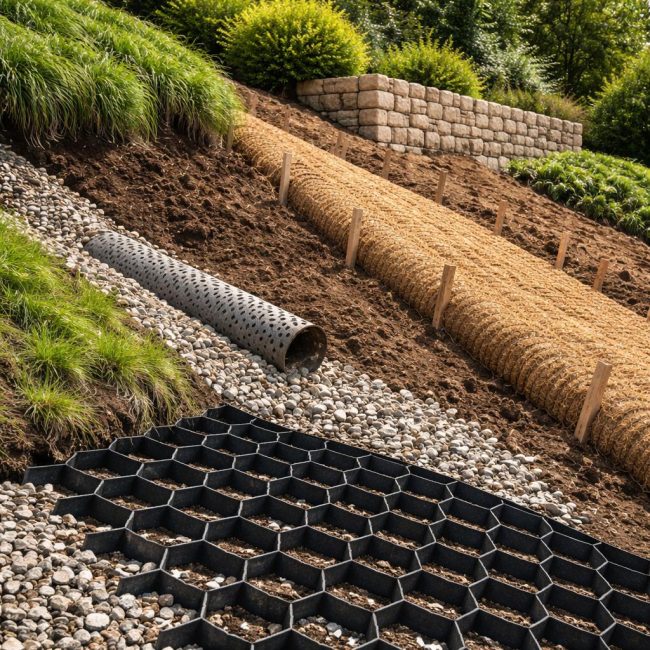
Water drainage reduces soil mobility, minimizes erosion, and prevents frost heaving. This is especially noticeable in clay and loamy soils: without changing the soil composition, but with moisture control, it becomes more stable. In this sense, drainage is the most "gentle" method of soil stabilization: it doesn't hold the soil by force, but rather removes the source of its instability.
There is a limitation here too: if the site is located in an area of constant water inflow or at a low level, drainage alone will not solve the problem, but will only slow down its development.
Geosynthetics: Reinforcement without concrete
When it comes to maintaining the soil's shape, rather than simply improving its properties, geosynthetics come into play. Their purpose isn't to replace the soil, but tolink it into a single systemReinforcement works by redistributing the load: the pressure is not concentrated in one point, but is "spread" over an area.
Such solutions are especially popular on slopes, driveways, and under platforms and paths. Geomaterials do not rigidify the soil; it remains permeable and "living," but loses its tendency to creep. This is a fundamental difference from concrete structures.
The limitations of geosynthetics depend on environmental conditions. If the material operates in a water-saturated environment without proper drainage, its effectiveness is reduced: the reinforcement maintains its shape but does not prevent liquefaction.
Vegetation as an engineering tool, not a decorative element
The plant root system is one of the most underrated means of strengthening. Unlike artificial materials, roots work dynamically: they grow, respond to moisture, and gradually compact the soil, binding it together.
This method is particularly suitable for slopes, embankments, and areas with natural topography, where rigid structures would be excessive. Vegetation does not immediately retain soil, but over time it creates a stable system capable of resisting erosion and surface runoff.
The limitation is obvious: plants are no substitute for engineering solutions where significant loads or landslide risks exist. Their strength lies in prevention and stabilization, not in "saving" problem areas.
Rigid structures: when you really can't do without them
Retaining walls, terracing, and other rigid elements are used when soil needs to be forcibly held back. This is an extreme form of reinforcement because it doesn't address the underlying cause of movement, butphysically restricts movement.
Such solutions are justified on steep slopes, with elevation changes, and in areas where the space is rigidly defined by development. Their reliability is high, but so are the demands on the conditions: without taking into account water and pressure, a rigid structure becomes a source of new cracks and deformations.
It's important to understand that rigid reinforcement is always local. It stabilizes a specific area, but can alter the behavior of the surrounding soil if the area isn't considered as a system.
Common Mistakes in Understanding Soil Strengthening
The most common mistake is searching for the "best" method out of context. Reinforcement doesn't exist in isolation: a method that works well under a path may be useless on a slope, and vice versa. The second mistake is trying to make the ground as hard as possible. Excessive rigidity often leads to cracking and loss of stability when conditions change.
Another misconception is ignoring time. Some solutions produce immediate results, while others take seasons to reveal their full potential. Expecting immediate results from vegetation, or, conversely, eternal stability from temporary measures, is misjudging their nature.
How to look at a site to choose not a method, but the logic of the solution
If we boil it all down to one principle, soil stabilization is always the answer to the question "what exactly is happening to the soil here and why?" Water, load, slope, and structure are the four factors that determine the choice of approach. It's not the method itself that matters, but rather whatwhat problem does it solve and what does it leave unsolved.
This approach allows us to move away from formulaic solutions and perceive strengthening not as a set of techniques, but as working with a living, changing environment. It is this understanding that distinguishes a reliable site from one that must be "repaired" over and over again.