In private homes, expanded clay is often chosen as a "simple and reliable" floor insulation solution—especially where the hassle of slabs, membranes, and complex construction projects is undesirable. But in practice, the results are inconsistent: in one house, the floor becomes noticeably warmer, while in another, it remains virtually unchanged, despite the impressive backfill layer. The main practical question here is:Under what conditions does expanded clay actually work as a floor insulator, and under what conditions is its thermal insulation effect lost?.
- When does the idea of insulating the floor with expanded clay even arise?
- How expanded clay retains heat—and what it can’t do
- Why does the same layer produce different results in different houses?
- Connection of expanded clay with the type of foundation: soil, basement, slab
- Why thickness doesn't solve the problem by itself
- The role of air insulation and layer boundaries
- Why is expanded clay often overvalued in older homes?
- Comparison of expectations and actual effect
- Typical misconceptions when choosing expanded clay
- Where expanded clay remains a smart choice
When does the idea of insulating the floor with expanded clay even arise?
Expanded clay is most often considered in situations where the floor is connected to the ground or a cold crawl space, and the structure is already established: an older house, joists, subflooring, and limited height options. It is chosen for its fire resistance, moisture resistance in the domestic sense, and apparent "simplicity": just pour it in and you're done. However, the logic behind how expanded clay works differs from traditional insulation materials, and this is precisely what causes errors.
How expanded clay retains heat—and what it can’t do
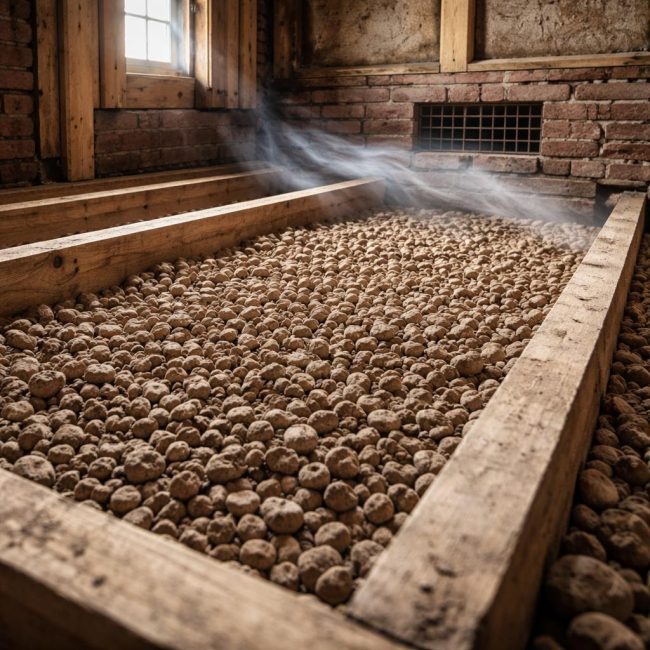
Expanded clay does not work as a continuous thermal insulator, but asbulk medium with air between the granulesThe heat is retained not by the fired ball itself, but by the air spaces. This has two practical consequences.
First, expanded clay is sensitive to compaction. The more it settles and the less "still" air it contains, the closer its heat transfer becomes to that of a standard backfill. Second, expanded clay is extremely dependent on air movement. If a subfloor draft passes through the layer, heat is lost almost as quickly as without insulation.
Why does the same layer produce different results in different houses?
The main reason isconditions around the layer, not the material itself. In a house with a dry, closed crawlspace and minimal ventilation, expanded clay can work reliably for years. In a house with constant cold air circulating under the floor, the effect will be weak, regardless of the backfill thickness.
Another factor is contact with a humid environment. Expanded clay isn't affected by water per se, but in constant damp conditions, its pores partially fill with moisture. Air is displaced, thermal conductivity increases, and the material begins to behave almost like wet crushed stone—heavy and cold.
Connection of expanded clay with the type of foundation: soil, basement, slab
Expanded clay works differently on soil than on empty space. In direct contact with the soil, it is more often used asleveling and buffer layer, and not as a full-fledged insulator. The soil itself stabilizes the temperature, and the purpose of expanded clay here is to reduce the feeling of a cold floor, not to create insulation in the engineering sense.
The situation above the cold crawl space is more challenging. Here, the expanded clay is exposed to constant temperature fluctuations and air movement. Without a barrier underneath, the layer begins to "blow through," and the effect is minimal—the floor remains cold, and the backfill only adds weight to the structure.
Why thickness doesn't solve the problem by itself
A common misconception is that simply adding more is enough. In reality, increasing the layer without changing the conditions onlyincreases inertia, but not efficiency. A thick layer of expanded clay may take longer to cool, but it still loses heat if there are leaks at the bottom or edges.
Furthermore, massive backfill increases the load on the floors and joists. This isn't a regulatory issue, but a purely practical one: the structures begin to operate in a different mode, causing deflections, cracks, and distortions, which indirectly degrade thermal insulation.
The role of air insulation and layer boundaries
Expanded clay does not work well as a standalone element. It is critically important for itwhat it is limited by above and belowIf the top layer is permeable to air, and the lower zone is cold, a slow but constant air movement occurs within the layer. It's unnoticeable, but it's what "carries out" the heat.
Therefore, in houses where expanded clay performs best, there are always clear boundaries: a calm environment below and a sealed layer above. Without this, it becomes a passive mass with no noticeable thermal insulation function.
Why is expanded clay often overvalued in older homes?
In older homes, floor insulation is often done "after the fact": they remove the boards, fill the voids, and replace the flooring. The problem is thatthe main source of cold there is often not in the void, and in ventilated areas, cold bridges along walls, cracks, and joints. Expanded clay doesn't solve these problems, and therefore the difference is barely noticeable.
The illusion arises that the material “doesn’t work,” although in fact it was simply used inappropriately—as an attempt to compensate for systemic heat loss with local backfill.
Comparison of expectations and actual effect
Expanded clay rarely makes a floor "warm" in the domestic sense. Its effect ismoderate decrease in cold sensation, temperature stabilization, and reduction of sudden fluctuations. If you expect results comparable to modern thermal insulation materials, disappointment is almost inevitable.
However, where a non-flammable, moisture-resistant, inert layer is needed without complex technologies, it remains a justified solution – but as part of a system, and not as a universal answer.
Typical misconceptions when choosing expanded clay
Expanded clay is often perceived as a "natural insulator," forgetting that its effectiveness is directly related to the engineering conditions. Another mistake is to consider it moisture-resistant in the thermal engineering sense: the material is not destroyed by water, but its insulating properties suffer.
The impact of settlement over time is also often ignored. The fill material changes its structure, and if the design doesn't take this into account, voids, localized depressions, and cold zones appear.
Where expanded clay remains a smart choice
Expanded clay is justified where requireda compromise between simplicity, fire safety and moderate insulation, rather than maximum energy efficiency. It works well as a supporting layer, as a leveling and stabilizing medium, and as a reconstruction element where other solutions are difficult to implement.
But considering it as a universal floor insulation for a private home without taking into account the environment, air, and moisture is setting unrealistic expectations. Expanded clay isn't about "making a warm floor," but aboutreduce losses where conditions allow him to do so.