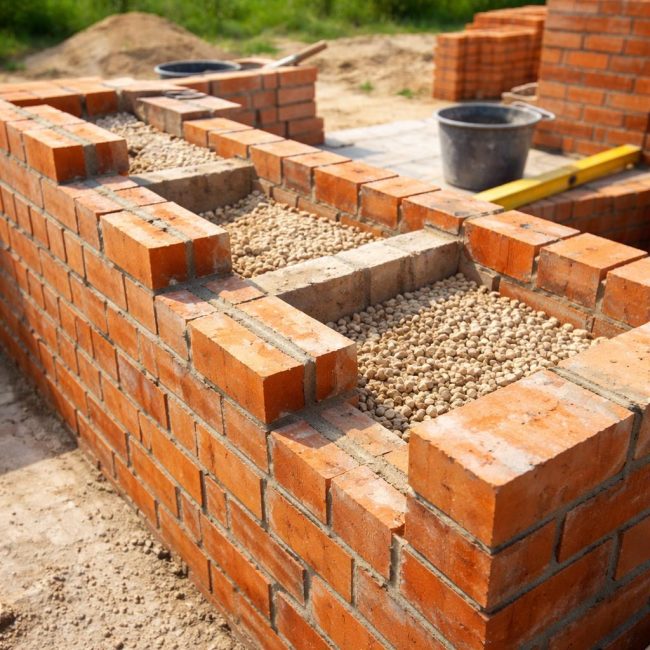
Well masonry is one of the traditional methods of constructing brick walls, focused not so much on decorative effect as on the efficient use of materials and improving the thermal insulation properties of the building envelope. This technique is still used in private home construction and building renovations, although it requires a precise understanding of the operating principles and design constraints.
Unlike a solid brick wall, a well masonry system consists of two parallel rows of walls, with vertical cavities—"wells"—formed between them. These voids can be either air-filled or filled with insulation or lightweight backfill, depending on the project's objectives.
Design diagram and operating principle
The foundation of a well masonry consists of two brick walls, erected parallel at a specified distance from each other. The connection between them is ensured by transverse brick lintels, laid at a specified interval along the height and length of the wall. These lintels form closed cells—wells.
In terms of structural performance, the outer and inner layers bear the load jointly. The lintels transfer forces between the layers, ensuring the wall's spatial rigidity. However, the central part of the wall is not load-bearing in the classic sense: its role is thermal insulation and reducing material consumption.
This distribution of functions distinguishes well masonry from multi-layer walls with suspended insulation, where the load-bearing capacity is concentrated in one layer, while the others perform a supporting role.
Purpose of wells and filling options
Initially, well masonry was used as a way to reduce the use of solid brick without sacrificing strength compared to a thick solid wall. Air pockets reduced the thermal conductivity and weight of the structure.
In modern practice, wells are rarely left empty. The most common filling options include:
- light mineral backfill;
- fine fraction expanded clay;
- mineral wool in slabs or cuts;
- foam glass or similar non-combustible materials.
The choice of infill affects not only the thermal performance but also the wall's moisture conditions. Incorrectly selected material can lead to moisture accumulation within the masonry and accelerated brick deterioration.
Wall thickness and dressing step
The geometry of well masonry is strictly tied to the brick size and masonry module. In practice, the distance between versts (rows) is usually between half and a full brick, allowing for wells 130–250 mm wide.
The lintels between the layers are laid at regular intervals, typically every 3-5 rows. Spacing them too far apart impairs the interaction of the walls and reduces the stability of the structure, especially under uneven loads or foundation movements.
It's important to note that increasing wall thickness by using wider manholes does not always result in a proportional increase in thermal efficiency. Without proper filling, such cavities can act as convection zones, reducing the expected effect.
Thermal engineering features
In terms of heat transfer resistance, well masonry occupies an intermediate position between a solid brick wall and modern multi-layer structures with effective insulation.
An air gap itself reduces heat loss, but only if it remains stationary. If there are any through cracks or defects in the masonry, convective currents arise inside the wells, which significantly degrade the wall's thermal performance.
Filling wells with thermal insulation stabilizes the thermal regime, but requires protection from moisture. Brick remains a vapor-permeable material, so the design must take into account the direction of water vapor diffusion and the possibility of its safe escape.
Impact on strength and durability
Well masonry is not "lightweight" in the sense of reducing calculation requirements. On the contrary, it is sensitive to the quality of execution. Errors in bonding, uneven filling of wells, or the use of the wrong grade of mortar can lead to localized stress concentrations.
Particular attention is paid to the bottom rows of masonry, where the load is greatest. Here, the lintels between the rows should be spaced more closely, and the mortar should ensure a secure bond without voids.
The durability of a structure is largely determined by its moisture protection. Water entering wells without a chance to dry accelerates frost damage to brick and mortar, especially in climates with frequent freezing temperatures.
Typical areas of application
Well masonry has traditionally been used in the exterior walls of low-rise residential and public buildings. Today, it can be found:
- in the reconstruction of historical buildings, where it is important to preserve the characteristic thickness of the walls;
- in individual houses with a limited budget for materials;
- in outbuildings where maximum thermal efficiency is not required.
In multi-story construction, this technique is practically never used due to the difficulty of quality control and its non-compliance with modern energy conservation regulations.
Common misconceptions
One persistent misconception is the idea that well-shaped masonry is a universal insulation method. In practice, without proper calculations and filling, it can be less effective than a thinner wall with modern insulation.
Another mistake is attempting to use manholes for utility lines. This compromises the structural integrity and creates cold and moisture bridges that are difficult to eliminate after the masonry is completed.
The importance of lintel bond is also often underestimated. Visually neat masonry without sufficient lintels may appear secure, but function like two loosely connected walls.
The place of well masonry in modern practice
Well-built brick walls are not an outdated technology, but neither are they a universal solution. They find their niche in areas where solidity, traditional structural design, and moderate heat loss reduction are important without resorting to complex façade systems.
Understanding its logic allows one to make informed choices about this type of wall, rather than viewing it as a default compromise. With proper design and careful execution, well masonry remains a functional and durable structure, but it requires more attention to detail than might initially appear.