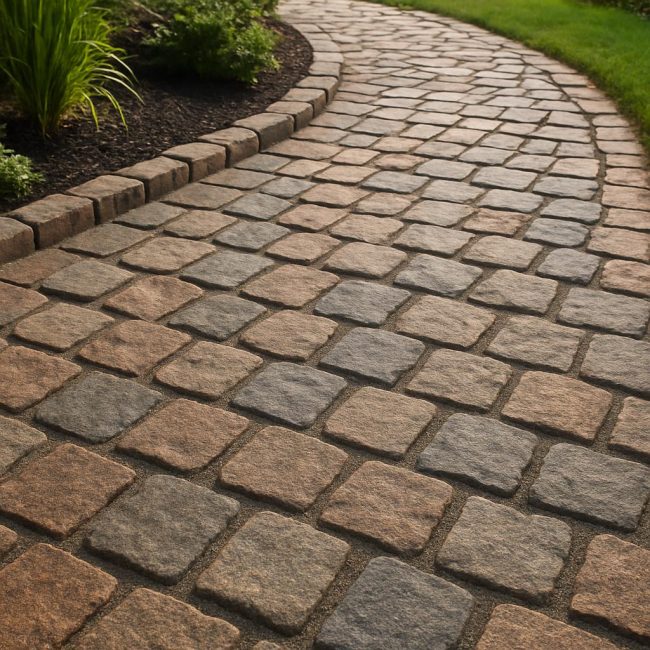
When landscaping their property, homeowners inevitably face the issue of paving—whether it's paths, driveways, or terraces. One of the trends of recent years has been a return to natural materials that combine practicality and aesthetics. This is why chipped paving stones are increasingly becoming a preferred solution among architects and landscape designers. Their appearance evokes ancient pavements, and their characteristics ensure long-lasting durability, even under heavy use.
In this article, we'll explore how chipped paving differs from other types of paving, why it's more relevant than ever, and what nuances should be considered when choosing and installing it.
- What are split paving stones?
- Why do more and more people choose split paving stones?
- Natural and authentic appearance
- Strength and durability
- Eco-friendliness
- Excellent grip on shoes and wheels
- Comparison with other types of paving
- Where and how can it be used?
- What should you pay attention to when choosing?
- Pitfalls: What is important when laying?
- Bottom Line: Should You Choose Split Paving Stones?
What are split paving stones?
Split paving stones are a type of stone slab created by mechanically splitting natural stone, most commonly granite or basalt. Unlike sawn paving stones, the surface of this material retains its natural roughness, while the edges remain uneven. This gives the paving a characteristic "wild" look and texture, making it particularly appealing in projects focused on natural aesthetics.
The material has been widely used in Europe for several centuries, initially for paving city streets where high durability was required. Today, split paving stones have been adapted for private properties, terraces, patios, pool areas, and even rustic interiors.
Why do more and more people choose split paving stones?
The growing interest in split paving stones is explained by several factors:
Natural and authentic appearance
Modern homeowners increasingly want a personalized, living landscape rather than a bland paving solution. Cobblestone paving adds character to a property and evokes the centuries-old history of European streets. Its heterogeneity and visual depth make it stand out from standard paving slabs.
Strength and durability
Stone, especially granite, can withstand enormous loads and can last for decades without losing its appearance. A chipped surface is less susceptible to chips and scratches than a polished one, and it doesn't become slippery in wet weather.
Eco-friendliness
Since we are talking about natural stone, the material does not contain chemical additives, does not fade in the sun, does not emit harmful fumes and can be reused.
Excellent grip on shoes and wheels
The rough texture makes the surface less slippery, especially in rain, snow, or ice. This makes it a safe solution for driveways and stairs.
Comparison with other types of paving
To understand how split paving stones compare to other solutions, it's worth considering their pros and cons in comparison with:
| Type of coating | Strength | Aesthetics | Safety | Price | Eco-friendliness |
|---|---|---|---|---|---|
| crushed paving stones | ★★★★★ | ★★★★★ | ★★★★★ | ★★★☆☆ | ★★★★★ |
| Concrete tiles | ★★★☆☆ | ★★★☆☆ | ★★★☆☆ | ★★★★☆ | ★★☆☆☆ |
| Sawn paving stones | ★★★★★ | ★★★★☆ | ★★☆☆☆ | ★★★★☆ | ★★★★★ |
| Porcelain tiles | ★★★★☆ | ★★★★☆ | ★★★☆☆ | ★★☆☆☆ | ★★★☆☆ |
Split paving stones are superior in most respects, with only one drawback: price. However, this difference is generally justified in terms of service life and aesthetics.
Where and how can it be used?
Paths and trails in the garden
This is where chipped paving stones shine. Their surface not only visually blends into the natural environment but also provides stability when walking, even in wet weather.
Entrance areas and parking
Due to its high strength and abrasion resistance, crushed granite can withstand the weight of cars and does not require regular repairs.
Recreation areas and terraces
Combining different shades of split paving stones allows you to create interesting patterns and highlight different areas of the site.
Framing flower beds, fountains and other decorative objects
The uneven texture of the stone blends seamlessly with greenery, water, wood, and metal, highlighting the natural beauty of the garden's elements.
What should you pay attention to when choosing?
Before purchasing, please consider:
- Fraction (size) of the stone. Small paving stones are suitable for pedestrian paths, large ones for driveways.
- Thickness. For pedestrian areas, 5–6 cm is sufficient, for cars – 8–10 cm.
- Type of stone. The most popular remain granite and basalt - both are durable and resistant to external influences.
- Shades. The stone can have natural gray, pink, red, or black tones. Combinations of different colors look beautiful.
Pitfalls: What is important when laying?
To ensure the coating lasts a long time and doesn't require any alterations, it's important to follow a few rules:
- Prepare the base: a gravel bed and a sand layer with mandatory compaction.
- Use geotextiles to prevent weed growth.
- Calculate the slope correctly to avoid water stagnation.
- Take into account the gaps between the stones - for split paving stones they can be slightly wider than for sawn ones.
- Don't forget about the curb restriction - it will prevent the coating from spreading.
Bottom Line: Should You Choose Split Paving Stones?
If you're looking for a durable, striking, and safe paving solution that blends seamlessly into the surrounding environment, chipped pavers are one of the best options. They add character to a property, highlight the owner's taste, and require minimal maintenance when installed correctly.
Although it may be more expensive than concrete paving, the final result looks noticeably richer and lasts for decades. This means it's an investment not only in landscaping but also in the aesthetics of living.