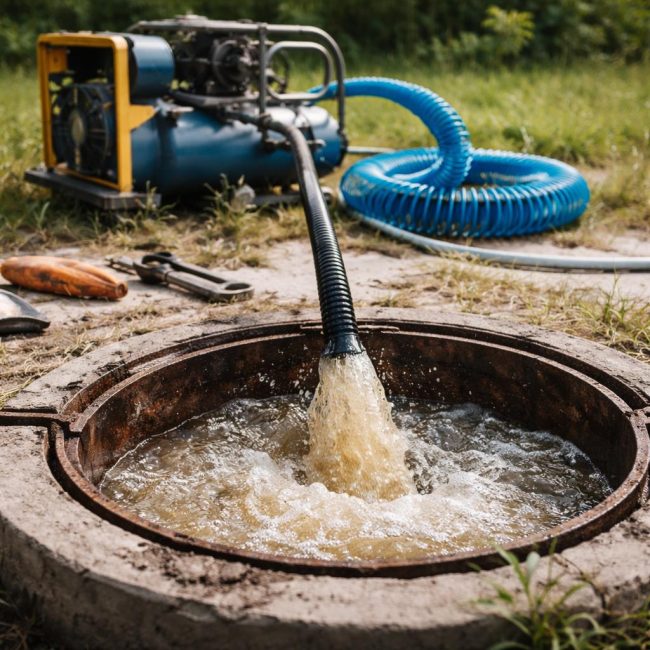
Well pumping is a step that directly affects water quality and the stability of the well. After drilling or prolonged downtime, a suspended sediment of sand, silt, clay, and drill cuttings remains in the wellbore. These particles not only impair water clarity but also accelerate wear on pumping equipment, clog filters, and reduce flow rates. In some cases, a compressor, rather than a pump, is used for cleaning, providing compressed air. This method is well known in the professional community and has its own clear applicability limits.
- What is meant by well pumping?
- The operating principle of a compressor when pumping
- When is it appropriate to use a compressor?
- Limitations and technical scope of the method
- The difference between compressor pumping and pump pumping
- The influence of the compressor on the filter and casing
- Common misconceptions about compressor pumping
- The practical place of the compressor in the well life cycle
- Generalization of the context of application
What is meant by well pumping?
Pumping is not a one-time operation, but a process of removing fine impurities from the filter zone and the wellbore. The water also carries away rock particles left over from drilling or formed during the aquifer's penetration. The goal is not mechanical cleaning, but rather stabilizing the inflow: ensuring that relatively clean water flows from the formation without the constant "sucking" of sand.
Traditionally, submersible or surface pumps are used for this purpose, but under certain conditions a compressor is also used, most often in the so-called airlift method.
The operating principle of a compressor when pumping
The compressor itself doesn't pump water. Its function is to inject compressed air into the water column inside the well. When air enters the water, it forms bubbles, reducing the average density of the column and creating buoyancy. As a result, the air-water mixture rises through the pipe and emerges at the surface, carrying sand and silt with it.
This principle is called airlift. It has long been known and is widely used in hydrogeology, especially in the development and restoration of shallow wells. In this system, the compressor acts as the "driver of the process," not as a direct replacement for the pump.
When is it appropriate to use a compressor?
Using a compressor doesn't make sense in every situation. In practice, it's chosen when:
- the well is shallow and has a relatively large diameter;
- there is intense silting, which the pump copes with poorly;
- there is a risk of damage or rapid wear of pumping equipment;
- active stirring of bottom sediments is required for their subsequent removal.
The compressor is especially effective during the initial pumping of sand wells, where the filter has not yet fully opened and the water flow is unstable. The flow of air bubbles creates turbulence in the filter zone, causing small particles to break away from the walls and be carried out.
Limitations and technical scope of the method
Despite its apparent simplicity, the compressor method has significant limitations. It's poorly suited for deep artesian wells with narrow casing diameters. As depth increases, airlift efficiency drops sharply: increasingly higher pressure is required to lift water, and energy costs increase disproportionately to the result.
Furthermore, excessively intense air supply can lead to formation loosening and increased sand production, which reduces the long-term stability of the well source. For this reason, a compressor is not considered a universal solution, but rather a tool for a specific task and at a limited stage.
The difference between compressor pumping and pump pumping
A pump and a compressor solve the same problem in different ways. A pump creates a directed flow of water at a relatively predictable speed. A compressor, on the other hand, creates a pulsed, uneven flow of the air-water mixture. This makes the method more aggressive toward sediments, but less controllable.
As a result, pumping is better suited for the final stabilization of a well, when clean, impurity-free water is required. Compressor pumping is better suited for the initial stage, when the main goal is to remove loose sediment and access the aquifer.
The influence of the compressor on the filter and casing
When used correctly, a compressor does not damage the well structure. However, improper pressure selection or operating time increases the strain on the filter. Fine-mesh filters are sensitive to sudden pressure changes, and a weak casing may experience vibrations.
For this reason, in professional practice, a compressor must be used with an understanding of the site's geology, filter type, and casing material. Without this information, the method becomes risky and can backfire.
Common misconceptions about compressor pumping
One common misconception is that a compressor is a "more powerful alternative to a pump." In reality, these are different tools. A compressor does not increase flow rate or improve water quality per se. It only helps remove mechanical impurities at a certain stage.
Another mistake is trying to use a compressor for regular well operation. An airlift is not designed for continuous water supply and does not provide a stable water supply.
The practical place of the compressor in the well life cycle
If we consider a well as an engineering structure with its own life cycle, the compressor occupies a secondary but essential role. It is used during startup, recovery from siltation, or when water quality deteriorates, when standard pumping is insufficient.
After completing its task, the compressor gives way to pumping equipment, which operates in a more gentle and predictable mode.
Generalization of the context of application
A well pumping compressor is a specialized tool, not a universal solution. Its effectiveness is based on the physical properties of the air-water mixture and is only appropriate under specific geological and structural conditions. Understanding this role allows one to avoid unrealistic expectations and use the method where it is truly justified, without damaging the source or substituting one process for another.