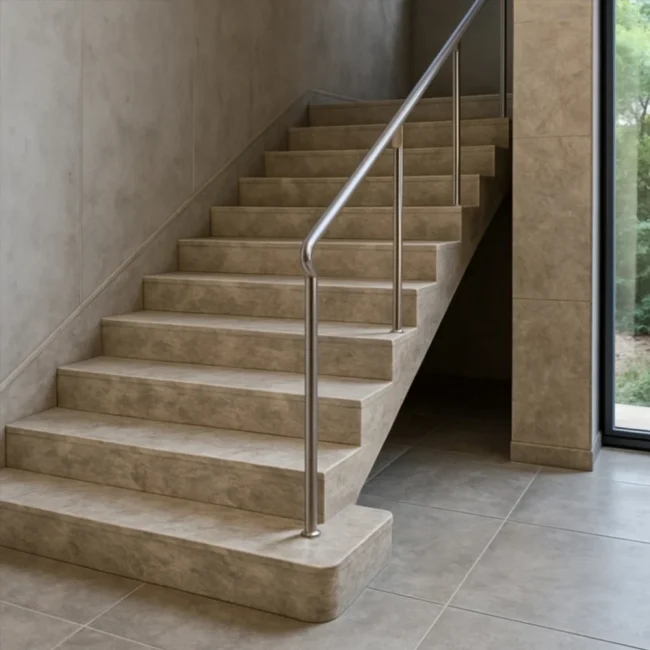
A staircase is not only a functional element of an interior or exterior but also an important design accent. It must be comfortable, durable, safe, and visually appealing. In recent years, staircases made of decorative concrete—a material capable of simultaneously providing architectural expression and load-bearing resistance—have become increasingly popular. In this article, we will examine in detail what decorative concrete is, the advantages it offers in staircase construction, the design, installation, and finishing considerations for such structures, and the technologies used in the manufacture of decorative concrete staircases.
- What is decorative concrete?
- Advantages of decorative concrete stairs
- Scope of application
- Stages of staircase design
- Choosing the type of stairs
- Calculation of dimensions
- Design solution
- Engineering integration
- Making a Staircase from Decorative Concrete: A Step-by-Step Guide
- Step 1: Preparing the base
- Stage 2: Formwork installation
- Step 3: Pouring Concrete
- Step 4: Decorative treatment
- Step 5: Care and Protection
- Decorative finishing options
- Possible disadvantages and limitations
- Care tips
- Conclusion
What is decorative concrete?
Decorative concrete is a special type of structural concrete that emphasizes not only its strength but also the decorative properties of its surface. There are several approaches to decorative concrete design:
- Stamped concrete- when poured, imprints of various textures (stone, brick, wood, etc.) are applied to its surface;
- Concrete with colored additives— adding pigments allows for a uniform coloring of the mass;
- Polished concrete— a glossy surface is achieved through grinding and polishing;
- Concrete with inclusions— use of marble chips, glass, shells and other materials;
- Acid treated concrete for service- chemical coloring and etching create artistic effects.
Thanks to these capabilities, decorative concrete is increasingly used in finishing facades, floors, terraces, retaining walls, and in the manufacture of staircase structures.
Advantages of decorative concrete stairs
The use of decorative concrete in stair structures offers a number of advantages:
- High strength— concrete stairs can withstand significant loads, which is especially important for outdoor and public buildings.
- Durability— a properly constructed concrete staircase can serve for decades without losing its operational properties.
- Aesthetic variability— decorative technologies allow us to imitate natural materials, create original designs and color effects.
- Moisture resistance— especially relevant for external staircases used in conditions of precipitation, dampness, and temperature changes.
- Minimal maintenance— the surfaces are easy to clean, resistant to abrasion, and do not require regular restoration.
- Flexibility of forms— the possibility of implementing both straight and spiral, winder or multi-level staircases with smooth curves.
Scope of application
Decorative concrete stairs are used in both private homes and public or commercial buildings:
- External porches and entrance stairs;
- Internal marches in halls and rooms;
- Stairs to terraces, balconies, verandas;
- Staircases in multi-level gardens;
- Outdoor staircases leading down to the property or to the water.
Stages of staircase design
Creating a decorative concrete staircase requires careful preparation and design. Let's look at the key steps:
Choosing the type of stairs
The first step is to determine the design type: straight, rotary, spiral, with or without landings. The choice depends on the building's architecture and the available space.
Calculation of dimensions
It is important to maintain comfortable parameters:
- lifting height (usually 150–180 mm),
- tread width (at least 250–300 mm),
- flight width (from 900 mm and more).
The calculation is based on the total height from the bottom to the top level.
Design solution
The support method is determined: monolithic staircase on stringers, cantilever, on formwork, etc. Reinforcement and load are also calculated.
Engineering integration
Areas for fastening to walls, the possibility of installing lighting, providing waterproofing, etc. are planned.
Making a Staircase from Decorative Concrete: A Step-by-Step Guide
Let's take a step-by-step look at how to make a staircase from decorative concrete, using the example of an external entrance staircase with straight flights.
Step 1: Preparing the base
- The soil layer is removed down to a solid base;
- The sand and gravel cushion is compacted and laid;
- Waterproofing is carried out (roofing felt, bitumen mastics);
- The reinforcing mesh is installed with gaps from the edges of at least 30 mm.
Stage 2: Formwork installation
- The formwork is formed taking into account the future decor;
- Laminated plywood or thick plastic are used;
- Particular attention is paid to the geometry of the steps and the evenness of the surface;
- In the case of stamped concrete, recesses are created for future texture.
Step 3: Pouring Concrete
- Concrete grade M300 and higher with additives for plasticity is used;
- Concrete is poured in layers with mandatory vibration;
- The surface is leveled with a trowel, paying attention to the corners and edges;
- After partial setting, a decorative layer is applied (colored pigments, stamps, etching, texture, etc.).
Step 4: Decorative treatment
- If necessary, stamps are applied;
- In case of acid staining, a special reagent is used;
- You can use inclusions (pebbles, glass, marble chips);
- After complete drying, grinding or polishing is performed;
- To enhance the effect, finishing coatings are applied - varnishes, water repellents.
Step 5: Care and Protection
- The surface is treated with UV and moisture protection agents;
- For outdoor use, an anti-slip coating is used;
- After 28 days the staircase is completely ready for use.
Decorative finishing options
The most popular technologies for decorative design of concrete stairs:
- Punching— using silicone or polyurethane forms, a relief is created (stonework, wood, slate).
- Mass dyeing— pigments are added to the concrete before pouring, which makes the color resistant to fading.
- Acid etching- creates marble streaks and deep shades.
- Microcement and topping— a thin decorative layer is applied to the surface after hardening.
- Polishing and grinding- used for internal staircases, allows to achieve a mirror effect.
Possible disadvantages and limitations
Despite a number of advantages, concrete stairs also have some limitations:
- Heavy weight- requires a solid foundation, not suitable for lightweight structures;
- Slow editing— requires time to set and gain strength;
- The need for professionalism- errors in reinforcement or pouring can lead to cracking;
- Repair restrictions— if damaged, it is difficult to restore a homogeneous structure.
Care tips
To extend the lifespan and maintain the aesthetics of your decorative concrete staircase:
- Periodically clean the surface from dirt and ice;
- Renew protective coatings every 2-3 years;
- Do not use harsh abrasives when cleaning;
- In winter, use gentle anti-icing agents.
Conclusion
A decorative concrete staircase combines strength, individual design, and resistance to external influences. Thanks to the wide range of decorative finishes, these stairs can imitate expensive materials while remaining affordable. With proper design, high-quality construction, and regular maintenance, they will become a striking and reliable feature of your home or property for decades to come.