2D lidars remain the basic sensor for navigating mobile robots, collision avoidance systems, zone monitoring, and industrial automation. While devices may have identical "flat" scanning geometry, they can differ radically in design, and therefore in their performance in real-world conditions. Even at the initial product lineup review stage, for example in 2D lidar catalogs, it's clear that the primary design distinction lies between mechanical and solid-state solutions.
Below is a detailed analysis of what exactly this difference is and how it manifests itself in operation, not just in specifications.
- What is a mechanical 2D lidar?
- Key design features
- What is 2D solid-state lidar?
- Key design features
- Reliability and wear: what happens over time
- Mechanical lidars
- Solid-state lidars
- Resistance to external environment
- Vibrations and shocks
- Dust and dirt
- Scanning nature and data
- Uniformity of view
- Refresh rate and latency
- Dimensions and integration
- Mechanical lidars
- Solid-state lidars
- Maintenance and operating costs
- Where mechanical lidar remains the best choice
- Where solid-state lidar wins
- Result
What is a mechanical 2D lidar?
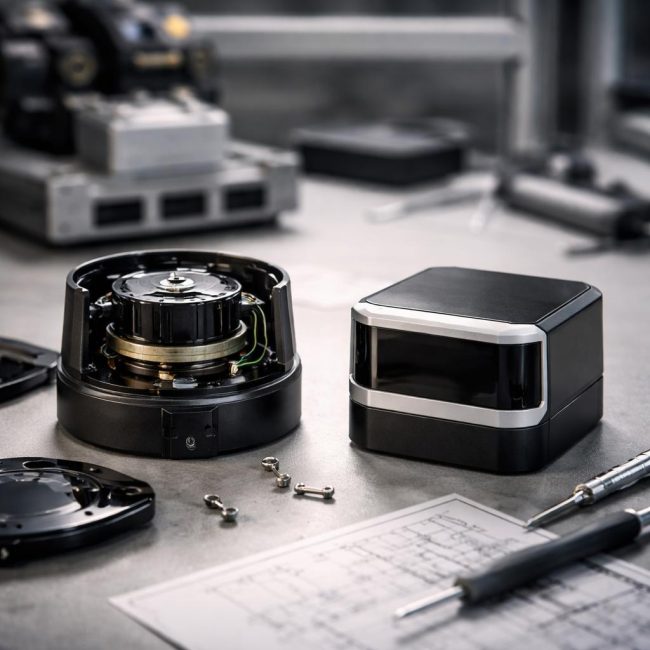
A mechanical 2D lidar uses a rotating optical unit. Inside the housing is a motor that drives the mirror or the entire optical unit. The laser beam sequentially "combs" the space in a single plane, creating a viewing angle of tens to hundreds of degrees.
Key design features
- presence of moving elements (engine, bearings);
- stable scanning geometry across the entire viewing angle;
- physical rotation as a source of sweep.
This particular scheme has long been the standard for mobile robotics and security systems.
What is 2D solid-state lidar?
A solid-state 2D lidar has no mechanical rotation. The scanning angle is generated by electronically controlling the emitters, micromirrors (MEMS), or phased optical arrays, depending on the specific implementation.
Key design features
- absence of classic rotating parts;
- electronic beam direction control;
- more compact and hermetic architecture.
Despite the common name, "solid-state" can cover different technological approaches, but they are united by the rejection of the classic engine.
Reliability and wear: what happens over time
Mechanical lidars
In real-world use, wear is a major factor to consider. Bearings and motors operate continuously, sometimes 24/7. Over time, this can lead to:
- increase in backlash;
- increase in noise;
- decrease in rotational stability;
- the need for routine replacement of components.
Under correct conditions and if installation recommendations are followed, the service life can be quite long, but it is still finite.
Solid-state lidars
The absence of rotating parts significantly reduces mechanical wear. Such devices:
- tolerate vibrations better;
- work more stably with frequent switching on/off;
- less sensitive to tilt and orientation of the body.
At the same time, durability shifts towards electronics and thermal performance.
Resistance to external environment
Vibrations and shocks
- Mechanical The models are more sensitive to constant vibration, especially when installed on moving platforms with rigid suspension.
- Solid-state solutions usually demonstrate better stability, since there is nothing to “loose”.
Dust and dirt
Both designs require clean optics, but:
- In mechanical lidars, contamination can affect the rotational balance;
- in solid-state - mainly on the signal quality, without affecting the mechanics.
Scanning nature and data
Uniformity of view
Mechanical lidar provides uniform angular resolution across the entire field of view. This is especially important for:
- SLAM algorithms;
- precise determination of the shape of objects;
- predictability of data.
Solid-state lidars can have:
- uneven density of dots;
- fixed sectors with different resolutions;
- limitations on the maximum viewing angle.
This is not a disadvantage, but a feature that needs to be taken into account when designing a system.
Refresh rate and latency
Mechanical lidars often operate at a fixed rotational speed. This provides:
- stable data flow;
- predictable delay;
- clear synchronization with navigation algorithms.
Solid state solutions can:
- dynamically change scanning modes;
- redistribute frequency between sectors;
- optimized for a specific scenario.
In simple tasks the difference is unnoticeable, but in high-speed navigation it can be critical.
Dimensions and integration
Mechanical lidars
- usually higher up the body;
- require taking into account the rotation zone;
- may impose restrictions on the design of a robot or machine.
Solid-state lidars
- more compact;
- easier to integrate into flat panels;
- are easier to place in protective casings.
It is for this reason that solid-state solutions are often chosen for production devices with strict form factor requirements.
Maintenance and operating costs
| Parameter | Mechanical | Solid state |
|---|---|---|
| Routine maintenance | Possible | Minimum |
| Sensitivity to editing | Average | Low |
| Wear | Present | Almost absent |
| Stability over time | May decrease | More even |
Where mechanical lidar remains the best choice
- navigation in large spaces;
- projects with a long history and well-established algorithms;
- systems where uniform data density is important;
- cases when service and replacement of components are acceptable.
Where solid-state lidar wins
- compact mobile platforms;
- outdoor equipment with vibration;
- serial products with strict reliability requirements;
- projects where minimizing maintenance is critical.
Result
The difference between mechanical and solid-state 2D lidar isn't just the presence or absence of a motor. It's a difference in design philosophy, long-term performance, and integration approach. Mechanical models produce predictable and familiar data, while solid-state models offer stability and resilience to environmental conditions.
Making the right choice starts not with the type of lidar, but with understanding the operating conditions, data requirements, and acceptable operational tradeoffs.