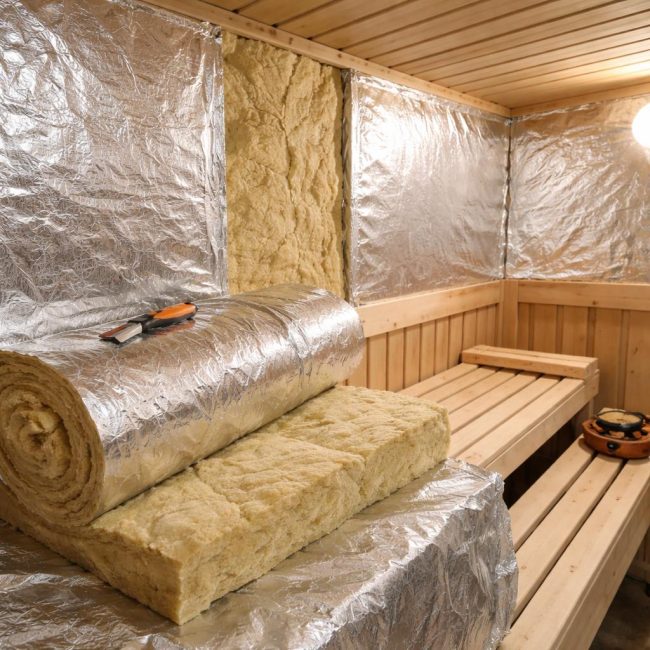
A sauna is a rare type of residential building, experiencing high temperatures, saturated steam, and sudden changes in humidity. Under these conditions, the building envelope experiences stresses that conventional insulation and standard thermal insulation systems are not designed to withstand. Foil-faced mineral wool is used specifically as a solution to this complex of factors, not as a universal "improved" material. Understanding its role and application limits helps avoid common mistakes that often become apparent in saunas.
- Why do they combine insulation and foil in a bathhouse?
- The operating principle of the foil layer under steam conditions
- Features of mineral wool in bath structures
- Where in a bathhouse is it appropriate to use foil-clad mineral wool?
- Insulation thickness and its relationship to the sauna mode
- Vapor barrier and tightness of the foil layer
- Temperature resistance and material safety
- Interaction with wooden structures
- Common mistakes when using foil-faced mineral wool
- Durability and behavior over time
- Limitations and cases where the material is not justified
- The role of foil-clad mineral wool in the overall sauna system
Why do they combine insulation and foil in a bathhouse?
In steam rooms and washrooms, heat is lost not only through the thermal conductivity of the walls and ceiling but also through intense infrared radiation from heated surfaces. The foil layer acts as a reflector of this radiation, returning it back into the room. Mineral wool, meanwhile, remains the primary thermal insulator, retaining heat within the structure.
This combination solves two problems at once. First, it reduces heat loss during steam room heating, reducing the load on the stove and speeding up the warm-up time. Second, the foil acts as a vapor barrier, limiting the penetration of hot, moist air into the insulation and supporting elements.
The operating principle of the foil layer under steam conditions
In a sauna, foil acts not as a decorative covering, but as a functional membrane. Its reflective properties are only apparent when there is an air gap between the foil and the interior finish. If the foil is pressed tightly against the paneling or other cladding, the reflection of thermal radiation virtually disappears, and the layer becomes merely a vapor-impermeable film.
When properly assembled, the reflected infrared heat is returned to the room, and the temperature inside the steam room becomes more uniform. This is especially noticeable in the ceiling area, where, without a reflective layer, heat escapes most quickly.
Features of mineral wool in bath structures
Mineral wool is valued in saunas for more than just its thermal insulation properties. Its key qualities in this context are fire resistance and resistance to high temperatures. Unlike polymer insulation, it does not soften or release decomposition products when heated, which is crucial near stoves and chimneys.
Mineral wool itself is sensitive to moisture. When wet, it loses its thermal insulation properties and can become a source of prolonged moisture accumulation within the structure. The foil layer is designed to minimize this risk, but it does not eliminate the need for proper ventilation and protection against condensation.
Where in a bathhouse is it appropriate to use foil-clad mineral wool?
In practice, foil-clad mineral wool is primarily used in steam rooms and washrooms, areas with the highest temperatures and humidity. In anterooms and relaxation rooms, such material is often unnecessary, as they lack intense infrared radiation and constant steam generation.
The most critical areas are the ceiling and upper walls. The ceiling in a sauna bears the brunt of the heat load, and this is where the reflective layer is most effective. In the walls, foil insulation works in conjunction with the finish and ventilation gaps to reduce heat loss and protect the structure from vapor saturation.
Insulation thickness and its relationship to the sauna mode
The foil layer doesn't replace the thickness of the insulation, but merely supplements it. A common misconception is that the foil layer allows for a thinner mineral wool layer without consequences. In practice, heat reflection improves temperature retention but doesn't compensate for inadequate thermal insulation of the building envelope.
The thickness of the mineral wool is selected based on the climatic conditions and the sauna's design. In this case, the foil acts as an additional element, enhancing the effectiveness of an already sufficient insulation layer, rather than as a means of "correcting" material savings.
Vapor barrier and tightness of the foil layer
The foil layer only functions as a vapor barrier if it is airtight. All joints between the sheets must be sealed with heat-resistant aluminum tape. Unsealed seams and damaged foil render the vapor barrier a mere formality: vapor penetrates the insulation in a localized, but systematic manner.
A key feature of saunas is that even small steam leaks, when used regularly, lead to moisture accumulation. As a result, the mineral wool becomes unevenly moistened, and problems become apparent months or years later, requiring partial dismantling of the finish to fix them.
Temperature resistance and material safety
Not all mineral wool is equally suitable for saunas. Not only the stated thermal insulation properties are important, but also the operating temperature range of the binder used in the fibers. At high temperatures, low-quality binders can lose strength, leading to shrinkage of the insulation.
The foil layer must also be rated for high temperatures. Sauna heaters use aluminum foil materials, not metallized films, which are visually similar but lose their properties when heated.
Interaction with wooden structures
Wood in a sauna constantly undergoes a cycle of moisture and drying. Foiled mineral wool alters the thermal and moisture balance of the structure, so it's especially important to consider the wood's drying capabilities. Complete sealing without ventilation gaps can lead to moisture accumulation in the wooden elements, even if the insulation remains dry.
A properly assembled structure requires gaps for air movement and the ability to release residual moisture. In this case, the foil restricts the flow of steam from the steam room but does not block the natural drying of the structure between fires.
Common mistakes when using foil-faced mineral wool
One common mistake is installing the foil layer backwards, with the reflective side facing the insulation. In this case, the foil does not reflect heat back into the room and is no longer useful as a heat-reflecting element.
Another common mistake is failing to leave an air gap between the foil and the interior finish. Without a gap, the reflective effect is minimal, and the foil acts only as a rigid vapor barrier, which worsens thermal performance and can increase condensation.
Durability and behavior over time
When properly installed, foil-clad mineral wool can last for decades without noticeable degradation. The main risks are not related to the material itself, but to the foil's leakage and moisture penetration.
In saunas that are used regularly, the structure undergoes heating and cooling cycles. This gradually reveals weaknesses in the vapor barrier. Therefore, the longevity of the system is determined not so much by the quality of the insulation, but by the precision of all joints and connections.
Limitations and cases where the material is not justified
Foiled mineral wool isn't a universal solution for all sauna rooms. In areas with moderate temperatures and low humidity, its use doesn't produce a noticeable effect, but it complicates the design and increases installation requirements.
Furthermore, in saunas with a different heating principle, where there is no pronounced infrared radiation or alternative thermal insulation systems are used, the reflective layer may play a secondary role. In such cases, ensuring stable thermal insulation and proper moisture exchange is more important than striving for maximum heat reflection.
The role of foil-clad mineral wool in the overall sauna system
Foiled mineral wool is not a stand-alone solution, but rather an integral part of a comprehensive design. It only works effectively when combined with the correct insulation thickness, ventilation gaps, thoughtful finishing, and proper sauna operation.
As a result, its use is justified in areas where heat retention, infrared reflection, and steam restriction are simultaneously required. When these conditions are met, the material truly improves the sauna's thermal conditions and enhances comfort without creating any hidden structural issues.