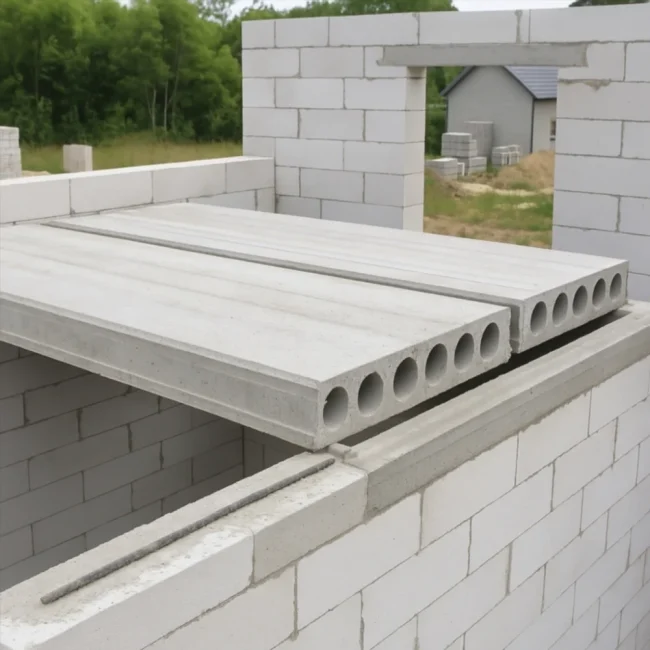
Modern construction actively uses aerated concrete blocks as the primary wall material due to their light weight, strength, ease of installation, and excellent thermal insulation properties. However, when constructing interfloor or attic floors, an important question arises: can reinforced concrete floor slabs be installed on aerated concrete blocks, and if so, how to do it correctly? In this article, we'll take a detailed look at the specifics of installing floor slabs on aerated concrete walls, including preparation, calculations, material selection, and a step-by-step process.
- Why does aerated concrete require a special approach when installing a floor?
- Suitable types of floor slabs
- Preparing aerated concrete walls for laying slabs
- Alignment of the upper wall chord
- Armored belt device
- Calculation and planning of slabs
- Technology for installing floor slabs on aerated concrete blocks
- Delivery and pick-up
- Checking the level of the reinforced concrete belt
- Lining mortar
- Laying slabs
- Securing the slabs
- Insulation and soundproofing
- Mistakes to Avoid
- Alternatives to floor slabs
- Conclusion
Why does aerated concrete require a special approach when installing a floor?
Aerated concrete blocks are porous artificial stone with low density and weight. Their structure provides excellent thermal insulation properties, but the material also has relatively low flexural and compressive strength under point loads. This means that simply laying heavy floor slabs on these blocks without proper consideration can lead to cracks, displacement, wall deformation, and ultimately, a loss of the structural load-bearing capacity.
To avoid such consequences, it is necessary to strictly adhere to building codes and recommendations from block and slab manufacturers, as well as take into account the weight of all structural elements, the foundation features, and the number of storeys of the building.
Suitable types of floor slabs
The following types of floor slabs are used for aerated concrete walls:
- Hollow-core reinforced concrete slabs
The most common type. These slabs have round or oval voids inside, reducing the overall weight of the structure without significantly compromising strength.
- Monolithic reinforced concrete slabs
They are used in cases where increased strength is required, for example, for large spans or complex building configurations.
- Precast monolithic floors (slabs + pouring)
A combination of pre-laid beams or blocks followed by a concrete screed. Provides excellent strength and load distribution.
- Slabs made of lightweight concrete or reinforced aerated concrete
They are used less frequently, but may be appropriate when it is necessary to minimize the load on load-bearing walls.
Preparing aerated concrete walls for laying slabs
Before starting installation, it is necessary to carry out preparatory work:
Alignment of the upper wall chord
Aerated concrete blocks are often laid with height deviations, especially when working with large volumes of masonry. The surface on which the slab will rest must be perfectly horizontal. To achieve this, a leveling screed or reinforced concrete belt is installed.
Armored belt device
The reinforced concrete belt is a monolithic reinforced concrete strip laid along the entire perimeter of the building on the top row of blocks. It serves several purposes:
- evenly distributes the load from the floor slabs;
- enhances the geometry of the building;
- prevents cracking and displacement of gas blocks.
The reinforced concrete belt is formed in formwork, reinforced with 3-4 rebars with a diameter of 10 to 14 mm, and poured with concrete of at least grade M200. The height of the reinforced concrete belt is typically 200-250 mm.
Calculation and planning of slabs
Before purchasing and laying the slabs, it is necessary to coordinate the design dimensions of the slabs, openings, and wall configurations:
- Spans between load-bearing walls— must not exceed the length of the slab.
- Width of slabs— typically a multiple of 600 mm. The design should take into account the minimum amount of cutting or additional elements.
- The protrusion of the slabs onto the walls— must be at least 120 mm on each side (preferably 150 mm).
- Openings and partitions— are taken into account in advance so as not to damage the integrity of the slabs.
It is also necessary to take into account the presence of ventilation, utility and chimney shafts, if they pass through the ceiling.
Technology for installing floor slabs on aerated concrete blocks
The process of laying floor slabs includes several key stages:
Delivery and pick-up
Reinforced concrete slabs are heavy, so a truck crane will be required for their delivery and installation. The site must be prepared in advance, with an accessible access road and a level surface.
Checking the level of the reinforced concrete belt
Before laying, check the plane of the reinforced concrete belt using a level or laser. The permissible deviation is no more than 5 mm over the entire span.
Lining mortar
A layer of cement-sand mortar (M100-M150) is applied to the surface of the reinforced belt, which acts as a compensator for unevenness and evenly distributes the load.
Laying slabs
Using a crane, the slabs are carefully moved and lowered into the mortar. Workers level each slab, checking its position with a spirit level. The slabs must fit tightly together, without any gaps.
Securing the slabs
After installation, the slabs must be anchored, especially if the building is located in a seismically active area or has more than one floor. The slabs are connected to the reinforced concrete belt using embedded elements or reinforcement loops, which are then filled with concrete.
Insulation and soundproofing
A ceiling can serve not only as a load-bearing element but also as a barrier between warm and cold spaces (for example, between the ground floor and a cold attic). Therefore, it's important to provide thermal and sound insulation:
- Soundproofing— laying mineral wool, fiberglass or sound-insulating mats between the slabs and on the surface.
- Insulation— if necessary, especially in the attic, insulation is carried out from above using polystyrene foam, ecowool or expanded clay.
Mistakes to Avoid
- Refusal from the armored belt— one of the most common and critical mistakes. Without it, aerated concrete will not be able to withstand point loads, and the wall will crack.
- Low slab support— if the slab lies on the gas block less than 100 mm, there is a high risk of it sliding and collapsing.
- Mismatch between the sizes of the slabs and the openings— leads to the need for cutting and additional costs, or a violation of the strength of the structure.
- Incorrect placement of mortar- lack of a lining layer leads to uneven loading.
- Ignoring anchor fastening— especially important for buildings with more than one floor.
Alternatives to floor slabs
If laying prefabricated slabs is not possible (for example, due to lack of access roads or a limited budget), alternatives can be considered:
- Wooden floor beams- suitable for small spans, attics and single-story houses.
- Precast monolithic floor— includes laying blocks or permanent formwork followed by pouring.
- Polystyrene concrete or expanded clay concrete— lightweight monolithic floors with insulation.
Conclusion
Installing floor slabs on aerated concrete blocks is a critical and technologically complex construction stage, requiring compliance with a number of conditions. The primary objective is to protect the aerated concrete walls from damage and redistribute the load so that the entire structure operates reliably and for a long time.
A properly executed reinforced concrete belt, correctly selected and installed slabs, precise calculations, and compliance with SNiP standards are the key to ensuring your aerated concrete home will last for decades without cracks, deformations, or unnecessary repairs.