A screw foundation is a popular foundation option, increasingly used for private homes, summer cottages, and various small buildings. Its ease of installation, high speed, and relative cost-effectiveness have made it popular. However, the issue of insulating such a foundation raises debate among many landowners and builders. Is it necessary to insulate a screw foundation, and what factors should be considered when making this decision? Let's explore why this issue is important, discuss the practical aspects of insulation, and discuss the potential consequences.
- The essence of the problem of insulating a screw foundation
- The influence of climate on the decision to insulate
- How to insulate a screw foundation: materials and methods
- Principles of selection and practical application of insulation
- Possible consequences of choosing an uninsulated foundation
- Common misconceptions about screw foundation insulation
- Conclusion
The essence of the problem of insulating a screw foundation
When we discuss insulating a screw foundation, we primarily mean protecting the base from freezing and maintaining a stable temperature in the underground portion of the structure. Like other types of foundations, screw foundations are susceptible to external temperature factors. If the ground freezes in winter, this can lead to uneven expansion of the ground, which places stress on the structure. This phenomenon is especially critical in regions with harsh winters and deep soil freezing.
However, not all situations require insulation. The need for screw foundation insulation should not be considered universally, but rather depends on a number of factors.
The influence of climate on the decision to insulate
One key aspect to consider is the region's climate. In warmer regions, where temperatures don't drop below -10°C, insulation may not be necessary, as the risk of ground freezing is low. However, in northern areas or regions with severe frosts, where soil freezing depths can reach several meters, insulation becomes essential.
In such areas, screw piles may be exposed to freezing soil, causing the foundation to rise and shift in position. This can lead to deformations not only of the foundation but also of the entire structure, as the load distribution becomes uneven. In such cases, insulation helps prevent such consequences.
How to insulate a screw foundation: materials and methods
If you've decided to insulate a screw foundation, you need to understand which materials and insulation methods are preferable. In practice, several materials are used for foundation insulation:
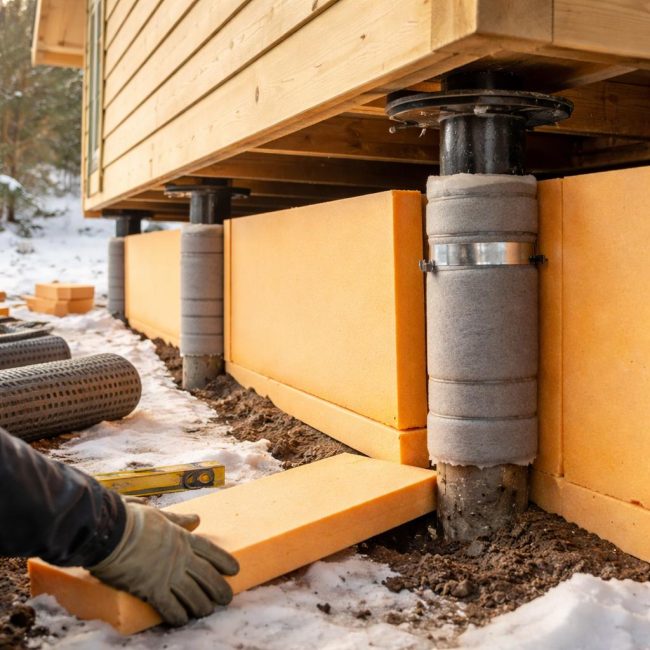
- Foam and extruded polystyrene (XPS)— is a popular option for foundation insulation. It retains heat well, is moisture-resistant, and is durable. The materials are laid along the foundation, preventing cold from penetrating into the underground parts of the structure.
- Mineral woolMineral wool is another common insulation option. It has good thermal insulation properties and is used to protect against cold. However, mineral wool requires additional protection from moisture, as it can lose its insulating properties when wet.
- Polyurethane foamThis material also performs excellent thermal insulation, and thanks to its elasticity and water-repellent properties, it can be used in a wide variety of climatic conditions.
- Geotextile— sometimes used in combination with other insulation materials to improve protection of the foundation from freezing.
Along with choosing the material, it's important to consider the method of attaching the insulation. Most often, special tiles are used for this purpose, which are laid on the surface of the piles or wrapped around them.
Principles of selection and practical application of insulation
Insulating a screw foundation depends on several factors. The first is the soil type on the site. If the soil is sandy or clayey, insulation may not be necessary. But in the case of marshy or wet soils, where the risk of freezing is much higher, insulation is essential.
The second important consideration is the building's design. For example, if a building with a basement is planned, foundation insulation is essential, as the basement can be exposed to cold temperatures and pose challenges maintaining the optimal temperature. For buildings without a basement, insulation may be less important, but in some cases, such as garages or saunas, it can also be beneficial.
Possible consequences of choosing an uninsulated foundation
Failure to insulate a building can have varying consequences depending on the region. If the ground freezes too deeply during winter, the following consequences are possible:
- Foundation lifting— the soil can expand when it freezes, causing piles to rise and the foundation to deform. This phenomenon is especially relevant for lightweight structures and houses that do not bear additional loads.
- Uneven load distribution— in the case of freezing, the piles may begin to “float”, which will lead to the destruction of the foundation and damage to the walls.
- Moistening the foundation— in some cases, a situation may arise where warm air from inside the building condenses on the cold surface of the foundation, which will lead to the formation of moisture and possible destruction of materials.
Common misconceptions about screw foundation insulation
One common misconception is that insulating a foundation always improves its durability and efficiency. In fact, insulation is only necessary in certain cases. It's important to consider that excessive insulation can have negative consequences: for example, an additional layer of insulation can impede natural drainage, which in some cases can lead to water accumulation in the underground parts of the structure.
Another misconception is that insulating a screw foundation is always expensive. Depending on the materials and insulation methods, you can choose affordable solutions that will provide the necessary level of protection from the cold.
Conclusion
The need for insulating a screw foundation depends on a number of factors: climate conditions, soil type, the building's purpose, and the depth of frost penetration. In regions with harsh winters, insulation is essential to avoid problems with foundation heave and deformation. However, in warmer climates, insulation may not be necessary, and the issue is more likely to focus on improving the thermal insulation of the interior spaces.