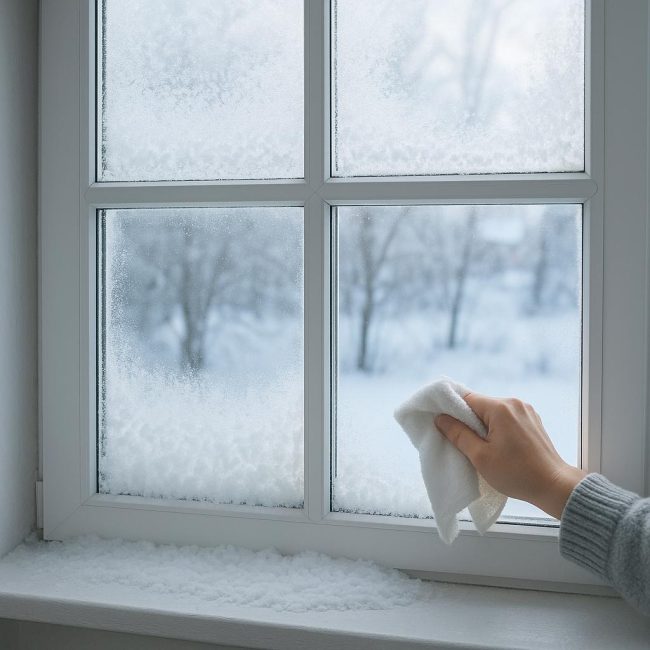
Ice on glass and window frames in winter doesn't just spoil the appearance. It leads to mold, swelling of window frames, corrosion of hardware, and heat loss. If you need professional diagnostics and hardware adjustments, service centers like these can advise you on what to do with your specific window. Below is a detailed analysis of the causes of ice buildup and how to remove it yourself.
- Where does ice come from: A simple explanation of complex issues
- Moisture in the air and the dew point
- Cold zones and cold bridges
- Everyday causes that are often overlooked
- How to quickly remove ice without damaging the glass or profile
- Safe methods
- Prevention: How to Stop Fighting Ice Every Morning
- Ventilation mode and humidity
- Warm glass and correct installation
- When you need a professional: signs that the problem is in the window, not in your habits
Where does ice come from: A simple explanation of complex issues
Moisture in the air and the dew point
Ice is simply water that has "found" a spot on a window that's colder than the dew point, first condensed, and then frozen. When we breathe, cook, and dry clothes indoors, the air becomes saturated with moisture. At 22°C and 50% humidity, the dew point is approximately 11°C: if the inside surface of the glass cools below this threshold, condensation forms. When the surface temperature drops below 0°C, the moisture turns to ice.
The goal is to keep the inner surface of the glass unit as warm as possible while simultaneously reducing humidity to a comfortable 40–50%. This will keep the glass above the dew point and prevent ice buildup.
Cold zones and cold bridges
Even a high-quality double-glazed window can freeze at the edges. This is where the spacer frame runs—traditionally aluminum, which conducts cold better than glass. This creates an "icy edge" around the perimeter. Other "cold bridges" can also exacerbate the effect: poorly foamed seams, thin, uninsulated window slopes, cold window sills, and metal fasteners without thermal breaks.
With plastic windows, there's the added stress of pressure and seals. Hardened rubber, a hardware "winter" clamp that's not engaged, a sagging sash—and a thin stream of frosty air blows against the glass from the inside. This area quickly cools, and moisture "sticks" there.
A worn-out double-glazed window is a different story. If the seal is broken, the dehumidifier in the spacer stops working, and fog forms between the panes. Condensation can freeze inside the window, and there's no way to eliminate it from the outside—the only way is to replace the window.
Everyday causes that are often overlooked
Even perfect windows will flood with water if the room has tropical humidity. Sources of moisture are nearby:
- drying clothes in the rooms, humidifiers without control, dozens of plants by the window, an aquarium without a lid;
- intensive cooking without a hood, long hot showers, closed ventilation grilles;
- the radiator under the window is covered by a wide windowsill, thick curtains or a decorative screen - warm air does not wash the glass;
- a sealed apartment without air intake: the air intake is blocked, and the exhaust hood is not working well—moisture gets stuck.
Add frost outside, and you'll have ice by morning. This can be controlled by removing excess moisture and warming the glass.
How to quickly remove ice without damaging the glass or profile
Once the ice is in place, you'll want to remove everything right then and there. You need to proceed carefully: glass isn't like ice on a porch; any rough handling will leave scratches, and a sudden temperature change can cause cracks.
Safe methods
- Turn on gentle, localized heat. Direct a warm (not hot) stream of hair dryer at the lowest setting at an angle toward the frame, not directly onto the glass. Slowly warm the area, allowing the ice to dissipate.
- Remove the melted water. A microfiber or absorbent cloth is your best friend. Blot, don't smear. A dry surface is harder to refreeze.
- Wipe with an alcohol solution. A weak solution of isopropyl alcohol reduces surface tension and helps water evaporate faster. Apply to a cloth, not directly to the glass.
- Improve warm air circulation. Unclog the radiator, raise the blinds, and draw the curtains to allow convection currents to reach the glass.
- Turn on the dehumidifier. A portable dehumidifier or air conditioner set to "dry" mode will reduce humidity within an hour or two and prevent re-freezing.
Instantaneous cleaning tools—scrapers, blades, hot water—damage windows. Mechanical tools leave microscopic scratches; dirt quickly accumulates in them, causing visible scratches. Boiling water creates thermal shock: the edge of the glass is cold, but the center is heated—microcracks and chips appear at the difference in temperature, especially in older glass units. Harsh chemicals containing ammonia damage seals and cloud the decorative elements of the profile.
If the ice returns the same day, it's not a one-off issue. Look for a systemic cause: moisture, pressure, or cold leaks.
Prevention: How to Stop Fighting Ice Every Morning
The winter strategy is to keep the glass warm and the air moderately dry. Only a combination of measures works: a single "life hack" rarely saves.
Ventilation mode and humidity
Maintain relative humidity at 40–50%. This can be accomplished with simple habits and a couple of inexpensive devices.
- Install a hygrometer. Without numbers, perceptions are deceiving: at 22°C, 65% humidity already guarantees condensation on slightly cooled glass.
- Use micro-ventilation. A 2–4 mm gap allows air flow without freezing the room. Ventilate briefly but intensely: 5–7 minutes of cross-ventilation is better than an hour with the window open.
- Provide an air supply. A wall-mounted air supply valve or a valve in the door will ensure a steady supply of fresh air, and the exhaust hood in the bathroom and kitchen will have something to exhaust.
- Reduce the steam load. It's simple, but effective: turn on the range hood when cooking, dry laundry in the bathroom (with a range hood) or on the balcony, and cover the aquarium.
- Allow the radiator to "see" the glass. Shorten any windowsills that are too wide, and open the blinds. Heated air should rise freely along the glass.
If, despite this, humidity remains off the charts, consider using a dehumidifier. Modern models consume little power and quickly stabilize the climate.
Warm glass and correct installation
When frost appears consistently around the perimeter of the glass, work on the window structure and adjacent areas.
- Check the clamping force and fittings. Winter clamping force (eccentrics) increases the seal's tightness and reduces drafts. Clean and lubricate the fittings once a year, and adjust the sash's height and clamping force.
- Replace the seals. Flexible EPDM seals grip the sash better in cold weather. If the rubber has hardened, drafts leak through the windows and the glass temperature drops.
- Insulate the slopes and installation joints. On the outside, seal the joints, and on the inside, apply a vapor barrier and thermal insulation to the slopes. Leaky joints and empty slopes act like a refrigerator.
- Upgrade your double-glazed windows. Low-e coating (i-glass), warm spacers, and double- or triple-glazed units significantly increase the temperature of the inner pane. In a typical room, upgrading from standard double-glazed windows to double-glazed windows with i-glass eliminates condensation in 8 out of 10 cases.
- Create a "warm windowsill." Convectors or simply an open radiator under the window create a thermal curtain. Radiators covered with decorative screens negate the effect.
If there's fog and streaks inside the glass unit, it's not condensation in the room—the seal has been compromised. Defrosting, adhesives, and sealants on the outside won't help: the glass unit itself needs to be replaced.
When you need a professional: signs that the problem is in the window, not in your habits
Sometimes, even though you've maintained proper ventilation, controlled humidity, and removed sources of steam, the ice still returns. These are reasons to call a professional:
- There is a cold draft around the perimeter of the sash, you can hear the air “squeaking” in the wind - the pressure is weak, the seals are tired, the sash is sagging;
- on one area of the profile or impost there are persistent ice patterns, the rest of the window is dry; a “cold bridge” or a void in the slope is likely;
- There is frost along the edge of the glass in moderate frost, although the humidity is normal; the base frame is cold, a warm spacer or a new package will help;
- There is fogging between the glass panes that does not clear, disappears periodically and returns; the glass unit has lost its seal and needs to be replaced;
- The sash doesn't switch to winter mode, the handle is jammed, the hinges are creaking—the fittings need adjustment and service.
A technician will use a device to check heat loss, detect drafts, assess the condition of the seals, and determine where the window is losing heat: in the sash, along the seam, in the slope, or in the double-glazed window. Often, adjusting and replacing the seals is sufficient; sometimes, a new window or proper installation of the slopes with thermal insulation is required.
Window freezing is always a combination of factors. Remove excess moisture from the equation, warm the glass, and close the cold bridges—and those morning "Morozko patterns" will be a thing of the past, a memory from childhood.