Drainage systems play a vital role in protecting foundations and basements from excess moisture, especially in regions with high groundwater levels or significant rainfall. One of the key components of such a system is a drainage pump, installed in a specially equipped drainage well. Choosing the right pump will ensure reliable water drainage, a long-lasting system, and avoid unnecessary repair and maintenance costs. In this article, we'll cover in detail how to choose the right pump for a drainage well, the different types of such devices, the parameters to consider, and provide practical operating tips.
- What is a drainage well and why is there a pump in it?
- The main types of pumps for drainage wells
- Surface pumps
- Submersible pumps
- Fecal pumps
- Key characteristics to consider when choosing
- Performance
- Pressure
- Acceptable particle size
- Body material
- The presence of a float switch
- Dry running protection
- Popular brands and models
- How to install a pump in a drainage well
- Operating tips
- Common mistakes when choosing
- Conclusion
What is a drainage well and why is there a pump in it?
A drainage well is part of a drainage system designed to collect water from pipes laid around the perimeter of a house or property. A well can serve as a storage well or as an intermediate point before the water is discharged into a storm drain, ditch, or natural body of water.
To prevent water from stagnating in the well and to ensure prompt removal, a special pump is installed. It is activated automatically or manually when a certain volume of liquid accumulates and pumps it to the desired location. Without a pump, the system loses its effectiveness, especially in cases where gravity drainage is impossible due to the site's topography or the distance from the drain.
The main types of pumps for drainage wells
Before choosing a device, you need to decide on its type. Drainage pumps are divided into several categories:
Surface pumps
They are installed outside the well, on the ground surface. They draw water through a hose lowered into the well. However, they have limitations: their suction depth is up to 8 meters, and they are not designed for heavily polluted water. They are most often used in systems with relatively clean water and small volumes.
Pros:
- Easy to maintain;
- Ease of replacement;
- Does not require immersion.
Cons:
- Limited depth;
- Not suitable for muddy water with sand.
Submersible pumps
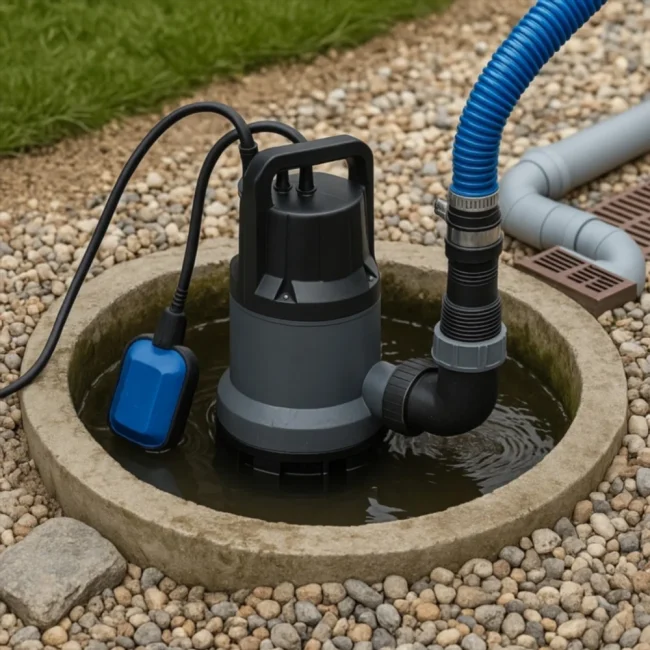
They are lowered directly into the water. This is the most popular option for drainage wells, especially if the water contains impurities (sand, silt, clay). They are durable, watertight, and can operate at depths of over 8 meters.
Pros:
- High performance;
- Pollution resistance;
- Automatic operation.
Cons:
- Complexity of maintenance;
- A reliable electrical supply is required.
Fecal pumps
These devices are most often used for pumping wastewater, but in some cases they are also suitable for drainage wells, especially if the water is heavily polluted. They are equipped with a grinder and can handle large particles.
Key characteristics to consider when choosing
Let's look at what to look for when buying a drainage pump:
Performance
Measured in liters per minute or cubic meters per hour, it's selected based on the volume of incoming water and the desired pumping speed. For a typical private home, 5–10 m³/h is sufficient. If the property is prone to flooding, it's worth choosing a higher flow rate.
Pressure
This indicates the height and distance to which the pump can lift water. It takes into account not only the well's depth but also the length of the pipe to the discharge point. For drainage purposes, a pressure of 5–10 meters is sufficient.
Acceptable particle size
If the water is contaminated with sand or silt, you need to choose a pump designed to handle solids up to 30–40 mm.
Body material
For aggressive environments (such as those containing chemicals or wastewater), it's best to choose models with a stainless steel or durable polymer housing. This will increase the device's lifespan.
The presence of a float switch
Allows the pump to turn on and off automatically at a certain water level. A convenient and energy-saving solution, especially if the pump operates unattended.
Dry running protection
A feature that prevents pump failure when there's no water in the well. Very useful in automated systems.
Popular brands and models
The following manufacturers have established themselves well on the Russian market:
- Grundfos- high quality, reliability, but also high price;
- Pedrollo- Italian pumps, tolerate contaminated water well;
- DAB- balanced price-quality ratio;
- Whirlwind, Caliber, Jileks— domestic brands with affordable prices, suitable for household use.
How to install a pump in a drainage well
- Preparing the well.Make sure the well is clear of construction debris and has a stable bottom.
- Pump installation.The submersible pump is lowered to the desired depth using a strong rope. The float should not touch the walls.
- Connection to the power grid.Be sure to use RCDs and waterproof connectors.
- Hose outlet.The pipe or hose is led towards the water drainage point (sewer, ditch, storm drain).
- Checking the work.After starting, check the tightness of the connections, the absence of overheating and the stability of the pump.
Operating tips
- Check the pump at least once a season.Especially before the rainy season or in spring.
- Clean the well.Accumulated silt and sand can quickly disable even the most durable unit.
- Do not allow to freeze.If the pump is used seasonally, be sure to dismantle it for the winter.
- Change filters and screens.Some models are equipped with protective mesh that needs to be cleaned periodically.
- Keep the instructions.Useful for troubleshooting or maintenance.
Common mistakes when choosing
- Incorrect depth calculation.At depths greater than 8 meters, many surface models lose their effectiveness.
- Ignoring water pollution.If there are particles in the water and the pump is not designed for this, it will quickly fail.
- Lack of automation.Manual activation may cause flooding if water suddenly enters.
- Buying on a whim.It's better to pay a little extra for a pump that meets the appropriate specifications than to later face breakdowns and reworking the entire system.
Conclusion
Choosing a pump for a drainage well is a crucial step, directly impacting the efficiency of the entire drainage system. The ideal option can be selected based on the terrain, the volume of water draining, the well depth, and the degree of contamination of the water. A submersible pump with automatic control and high resistance to impurities is the optimal choice for most private homes. Proper installation and regular maintenance will ensure its trouble-free operation for many years, freeing owners from problems with dampness, flooding, and foundation damage.