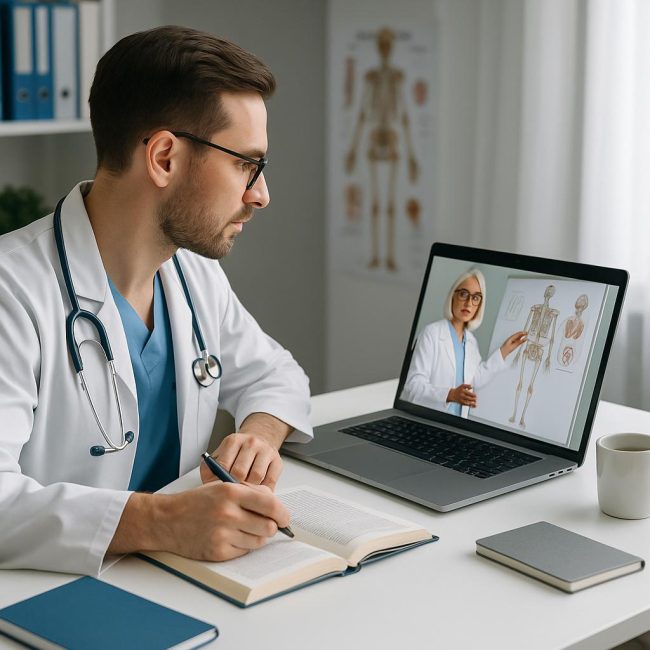
Modern medicine is advancing at an incredible pace. New diagnostic methods, innovative drugs, robotic systems, and digital technologies are changing approaches to disease treatment and prevention. Under these circumstances, continuing medical education is becoming not only a professional obligation but also a key tool for maintaining a high level of competence. Today, continuing education goes beyond traditional lectures and seminars: it is evolving into a flexible system that takes into account the interests of specialists, patient needs, and global healthcare challenges.
- Why do doctors need continuous training?
- Traditional forms of education
- New opportunities for professional growth
- Online courses and webinars
- Simulation centers
- Telemedicine and digital platforms
- International internships and exchange of experience
- Personalized educational trajectories
- The role of digital technologies
- Problems and challenges
- Conclusion
Why do doctors need continuous training?
Continuing education in medicine is more than just a way to earn a certificate or fulfill formal requirements. It reflects the profession's philosophy: physicians are obligated to engage in lifelong learning to provide patients with the most modern and safe care.
The main reasons why training becomes necessary are:
- Quick update of knowledge. According to research, every 5–7 years, half of the information in medical textbooks becomes outdated.
- New technologies. The emergence of digital diagnostic systems, telemedicine, and genetic testing requires additional skills.
- International standards. To work according to modern protocols, a physician must understand and implement recommendations from the WHO and leading professional associations.
- Patient expectations. Today, people are becoming more informed and asking doctors questions that require up-to-date knowledge.
Traditional forms of education
Previously, advanced training in medicine was based on classical methods:
- Courses at medical universities — short-term programs that doctors completed once every few years.
- Scientific conferences — platforms for exchanging experiences and learning about new research.
- Publications in journals — reading articles was an important source of information.
These forms remain relevant, but no longer fully meet the needs of the physician who is faced with dynamically changing clinical practice.
New opportunities for professional growth
Online courses and webinars
The COVID-19 pandemic has accelerated the digitalization of medicine. Today, doctors can study remotely, choosing courses from leading universities and associations. Online learning allows them to combine practical training and study, gaining knowledge at a convenient time and without geographical restrictions.
Simulation centers
Modern centers are equipped with mannequins, robotic patients, and virtual simulators. Here, doctors practice their skills in conditions as close to reality as possible, without risking the patient's health. This is especially important for surgeons, anesthesiologists, and emergency care specialists.
Telemedicine and digital platforms
New training modalities include working with electronic medical records, data analysis using artificial intelligence, and mastering remote consultation services. This not only expands physician capabilities but also makes their practice more in-demand.
International internships and exchange of experience
Thanks to online formats, participation in international conferences has become more accessible. Doctors can learn from the experience of colleagues in Europe, the US, or Asia without leaving their home country, and, if desired, complete an internship at a foreign clinic.
Personalized educational trajectories
New platforms allow doctors to select topics that are most relevant to their specialty. A cardiologist can study the latest arrhythmia treatment protocols, while a dermatologist can explore laser therapy methods, creating a personalized development plan.
The role of digital technologies
Digitalization has become a key factor in the transformation of medical education. Today, the following are used:
- Virtual and augmented reality. Surgeons can "rehearse" operations in 3D mode.
- Mobile applications. Reference books and training programs are always at hand.
- Artificial intelligence. It helps not only in diagnostics, but also in the analysis of the physician’s educational trajectories.
- Gamification. Learning through game-based methods increases engagement and accelerates learning.
Problems and challenges
Despite its wide range of opportunities, lifelong learning faces a number of challenges:
- Lack of time. Doctors are overloaded with practical work, and it is not always possible to allocate hours for study.
- Financial costs. Internships and courses can be expensive, especially international ones.
- Inequality of access. Doctors from the regions often lack access to modern educational centers and digital resources.
- Quality of content. Not all courses and programs undergo rigorous accreditation, which reduces their value.
Conclusion
Continuous education is not an abstract requirement, but a key to the development of the medical field. In a world where medical knowledge is updated faster than new textbooks can be printed, it is the continued professional development of physicians that ensures patient trust, reduces the risk of errors, and paves the way for innovation.
Today, medical professionals have unique opportunities: from online courses and international conferences to simulation centers and digital technologies. Using these resources allows doctors to be prepared for the challenges of the future and build a healthcare system based on knowledge, experience, and trust.