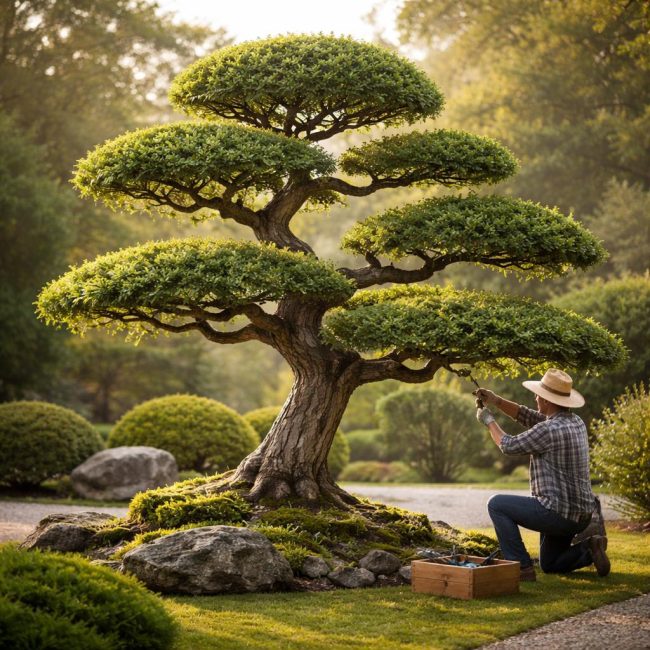
Gardeners and landscape design enthusiasts often strive to incorporate elements of Japanese aesthetics into their properties. Japanese plants and design styles, such as niwaki, attract attention with their unique harmony and minimalism. Niwaki is a distinctive style of shaping trees and shrubs, in which plants are transformed into living sculptures, lending the garden a Japanese-inspired feel. For those looking to create this style themselves, oak is a popular choice—a powerful and durable tree that can serve as the basis for original niwaki designs.
What is niwaki?
Niwaki, translated from Japanese, means "clipped tree." This style requires skillful pruning to create beautiful, harmonious, and often asymmetrical shapes. Historically, niwaki were used in Japanese gardens to create the effect of a miniature landscape within a small space. The Japanese attached symbolic meaning to trees, and each niwaki tree told its own story. It's important to note that when creating niwaki, the tree was always considered a living and evolving object, not a static sculpture.
Why oak?
Oak, like many other trees, is suitable for creating niwaki, but its unique characteristics make it particularly appealing. This tree's durable wood allows for the creation of compositions that retain their shape and beauty for decades. Oak also tolerates pruning well and recovers well afterward, which is important when creating complex shapes.
One of the oak's characteristics is its slow growth. This allows for careful and deliberate management of the tree's shape, creating not just a garden composition, but a true living sculpture.
The principles of making oak niwaki
Creating a niwaki from oak requires patience and attention to detail. It all starts with choosing the right tree. A young oak with a strong trunk and a good root system is ideal. Tree placement is also important: it should be in an open, well-lit area to ensure the tree develops to its full potential.
When shaping an oak tree, pruning will be the primary tool. It's important to remember that this procedure must be carried out carefully and according to a specific pattern. Pruning should not be excessive, otherwise the natural development of the tree can be disrupted. When pruning, it's important to consider the basic elements of Japanese gardening, such as choosing symmetrical and asymmetrical shapes, emphasizing negative space, and creating visual balance.
How does this work in practice?
In practice, creating a niwaki from oak is a multi-stage process that includes several steps. The first step is selecting a suitable sapling and planting it. After that, regular pruning begins, which will continue for many years, as oak grows slowly and its shape can be adjusted gradually.
Particular attention should be paid to the main directions of the branches, which should be positioned so that the tree is not only aesthetically pleasing but also stable. At this stage, it's important to remember that creating niwaki is not simply a matter of pruning branches, but also a process of shaping the tree, like a living sculpture.
Application scenarios and consequences of different approaches
There are various approaches to creating a niwaki, each with its own consequences. For example, one can emphasize strict symmetry, which is suitable for those who appreciate traditional Japanese style. In this case, it is important to ensure that the tree develops evenly and its branches are balanced on both sides.
Another approach is to use asymmetrical shapes, which adds dynamism and naturalness. This style is suitable for those who want to create a more picturesque and less formal garden that blends with the surrounding nature. In this case, care must be taken not to disrupt the plant's harmony, leaving sufficient space between branches.
Limitations and nuances
One of the main limitations of creating niwaki from oak is the tree's slow growth rate. This can mean that the process of shaping the sculptural forms can take many years. However, for many gardeners, this isn't a drawback; rather, it offers an opportunity to create a unique work of art over a long period of time.
It's also worth keeping in mind that oak requires regular care. Niwaki requires careful pruning, protection from diseases and pests, and providing the tree with the necessary conditions for growth.
Common misconceptions
One of the most common misconceptions is that creating a niwaki is an extremely complex and labor-intensive process. In fact, with patience and understanding, even novice gardeners can create attractive and harmonious compositions. The key is to start with simple shapes and gradually increase their complexity as the tree grows.
Another common misconception is that oak is unsuitable for making niwaki due to its dense and hard wood. However, this is actually an added advantage, as oak can withstand even the most demanding manipulations, and its wood retains its shape for a long time.
Conclusion
Creating a niwaki from oak is a wonderful way to add a unique touch to your garden, incorporate elements of Japanese aesthetics, and create a living sculpture that will delight the eye for years to come. The key is patience, attention to detail, and skill in woodworking. With the right approach, oak can become a beautiful focal point of your garden, not only enhancing the area but also serving as a living reminder of harmony and natural beauty.