A thickness planer is a tool that's often used in a workshop "on a continuous basis": planing workpieces in batches, aligning boards for panels, and sizing materials to a uniform size. This is why the issue of blades arises not in the abstract, but at a very specific moment—when the surface quality begins to change, the feed force increases, and the working sound changes. For owners of the 2012NB model, this issue is especially noticeable: the machine is compact, precise, designed for fine machining, and any changes in the blades' condition quickly become apparent in the results.
The 2012NB model is produced by the companyMakitaIt's long been used in both private workshops and small production facilities. Despite its "household" appearance, it's a fully-fledged surface planer, sensitive to the condition of the cutting tool. The blades here aren't just a "just in case" consumable, but a key element that directly determines the final product.
- What are the blades in the Makita 2012NB?
- How knives work in practice, not "on paper"
- Knife lifespan and what it really depends on
- Original and compatible knives: where is the line drawn?
- How does knife wear affect the machine itself?
- Limitations that are often forgotten
- Common Misconceptions About 2012NB Knives
- In an expanding context
What are the blades in the Makita 2012NB?
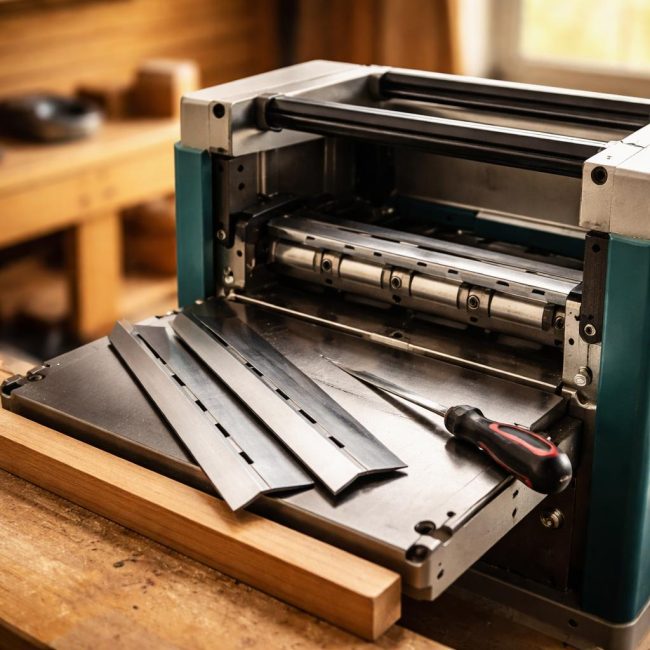
Structurally, the knives for this planer are long, straight blades made of tool steel, working in pairs. They are mounted in the planer's cutterhead and remove a thin layer of wood with each pass. Unlike massive industrial planers, there's no significant inertia reserve: cut quality depends more on the sharpness and uniformity of the cutting edge.
In practice, this means that knives are perceived not as "just metal," but as a finely tuned element of a system. Their geometry, steel hardness, and edge condition directly influence how smooth the surface will be, whether longitudinal stripes will appear, and whether the wood will fray or chip along the grain.
It's also important that the knives in this model are designed for a specific operating mode: moderate cutting depth and uniform feed. Attempts to compensate for wear by increasing the load usually lead to worse results rather than faster cutting.
How knives work in practice, not "on paper"
In theory, a sharp knife simply cuts the fibers. In practice, however, things are more complicated. Wood is not uniform, the grain direction changes, and there are resinous patches and dense annual rings. The 2012NB planer's blades operate at a high speed, and it is the cleanliness of the edge that determines whether the cut is truly a cut and not micro-chipping.
While the blades are new or well-maintained, the machine operates smoothly: the workpiece enters smoothly, the sound is even, and the surface after each pass resembles a polished finish. But as they wear, the picture changes. The edge loses its "confidence," and the fibers begin to lift and tear rather than cut. This is especially noticeable on softwoods and woods with alternating grain direction.
Interestingly, knife wear is rarely noticeable suddenly. More often, it's a gradual process that the craftsman gets used to. This is why many work for long periods with knives that no longer produce the quality the machine is capable of, attributing the result to the "characteristics of the wood."
Knife lifespan and what it really depends on
The blade life of the Makita 2012NB is not fixed. It depends heavily on the material being worked with. Dry planed lumber and green construction lumber made from the same species place different strains on the edge. The presence of hidden inclusions—sand, small mineral particles, and bark debris—has an even greater impact.
The operating mode is also important. With gentle passes and light material removal, the blades wear evenly, maintaining the edge's geometry. Attempting to remove too much material in one pass causes the load to increase abruptly: the edge overheats, creating micro-jams that can no longer be removed automatically.
There's also a less obvious factor: the cleanliness of the workpiece. Even a visually clean board that's been sitting outside often carries dust on its surface, which acts as an abrasive for knives. In this sense, a planer "senses" the preparation of the material much more strongly than it seems.
Original and compatible knives: where is the line drawn?
The question of origin often arises around knives for the 2012NB. On the one hand, there are original components, on the other, there are compatible replacements. While they may technically be identical in size, differences in operation are still evident.
The main difference noticed in practice is edge stability. Higher-quality steel retains its shape longer, and wears evenly, without sudden quality drops. Less-successful alternatives may initially perform well, but then suddenly lose cutting precision, even though the knife still appears intact.
That's not to say that any non-original knife is automatically bad. Rather, it's a question of quality variability. For editorial purposes, something else is important: in a compact planer like the 2012NB, knives aren't the place for extreme experimentation. Any deviation quickly becomes apparent in the final product.
How does knife wear affect the machine itself?
Worn blades aren't just a problem on the wood surface. They alter the load on the entire mechanism. Cutting resistance increases, feed force increases, and the shaft experiences additional vibration. This may appear to be "the machine is getting heavier to pull," when in fact, the problem lies in the cutting element.
Prolonged use with dull knives accelerates wear on the feed rollers and increases the load on the motor. This isn't an emergency, but a cumulative effect that reduces the lifespan of the components. Therefore, in reality, knives are not only a consumable but also a protective element for the machine itself from excessive loads.
Limitations that are often forgotten
The Makita 2012NB isn't an industrial planer, and its blades are designed for a specific class of tasks. Attempts to use it for rough cutting on uneven, bark-covered, or dirty workpieces almost always result in damage to the blades. They are the first to suffer from a misuse scenario.
Another limitation is related to expectations. Sometimes, a compact machine is expected to deliver results comparable to heavy-duty shop equipment. In this comparison, the knives are often the ones at fault, although in reality, they're simply operating within the constraints of their intended design.
Common Misconceptions About 2012NB Knives
One common misconception is that knives are "still sharp if they cut." In practice, cutting and producing a clean surface are two different things. The machine may continue to remove material, but the quality will be compromised.
Another misconception is that knives wear symmetrically and predictably. In reality, wear is often uneven, especially when working on workpieces of varying widths. This results in localized marks on the surface that are difficult to explain without understanding how knives work.
Finally, it's often believed that planing quality is determined solely by the knives. But in a thickness planer, everything is interconnected: the condition of the table, the feed rollers, and the clamping elements. The knives are central, but not the only, participants in the process.
In an expanding context
The blades for the Makita 2012NB are a good example of how, in a compact tool, a small detail determines the overall result. They don't require complex solutions, but they do require attention. Understanding how they wear and how they affect the surface and the machine itself allows you to take a different look at the overall performance of the planer.
When knives are perceived not as consumables "until the last minute," but as a working element with its own lifespan and character, the machine begins to reveal the very qualities for which it is chosen: stability, accuracy, and predictable results on wood.