Siding an old house has long ceased to be seen as a purely cosmetic measure. As buildings age, this intervention affects several levels—from the condition of the load-bearing walls to humidity and heat loss. While seemingly simple, the solution is technically multi-layered: the siding doesn't "replace" the façade, but creates a new shell that works in tandem with the existing structure. It is this interaction that determines the outcome—both positive and challenging.
- What exactly changes when cladding an old house?
- The condition of the walls as a starting point
- The influence of siding on humidity conditions
- Insulation and its hidden consequences
- Lathing as a load-bearing element of the system
- Aesthetics and distortion of home perception
- Common Misconceptions When Choosing Siding for an Old House
- When is cladding justified and when is it risky?
- Sheathing as a change, not an update
What exactly changes when cladding an old house?
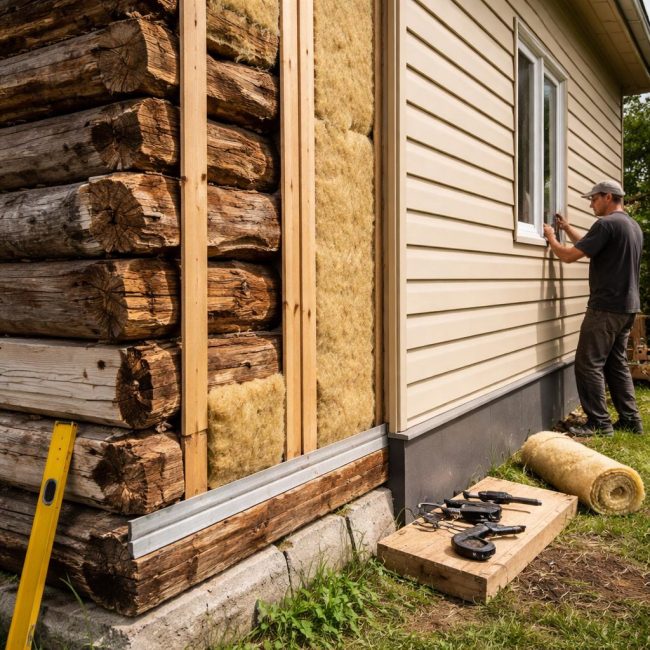
Siding forms a ventilated shell that is not in direct contact with the wall. A gap, sometimes filled with insulation, appears between the cladding and the base. As a result, external influences—precipitation, ultraviolet radiation, temperature fluctuations—are absorbed by the curtain wall system, not the wall itself.
This is crucial for older buildings: many were built without consideration for modern climate conditions, and wall materials lose their density and uniformity over time. Siding slows the rate of surface deterioration, but it doesn't stop the processes occurring within the wall. It doesn't repair cracks, restore masonry, or strengthen the foundation—it merely changes the conditions in which all of these exist.
The condition of the walls as a starting point
The original condition of the walls remains a key factor. Wooden houses, brick structures, and cinder block buildings react differently to the addition of a curtain wall.
Old wooden houses often exhibit uneven shrinkage, rotted lower logs, and insect damage. Covering such walls with siding without understanding their actual condition leads to a "defect preservation" effect: deterioration continues but becomes invisible. Furthermore, poor wood ventilation can accelerate decay if proper air gaps aren't provided.
Brick and stone walls, on the other hand, often benefit from protection. However, the integrity of the masonry and joints is crucial. Weakened mortar, voids, and microcracks do not disappear under the cladding and, over time, can lead to localized deformations of the lathing.
The influence of siding on humidity conditions
One of the main reasons older houses are covered with siding is to combat moisture and drafts. However, the success of this siding directly depends on how the moisture is drained.
Siding itself isn't a sealed covering. It's designed to allow air and water to penetrate, followed by moisture removal through a ventilation gap. If this gap is missing or covered with non-vapor-permeable insulation, moisture begins to accumulate near the wall. This is especially critical for older buildings without horizontal waterproofing: capillary moisture from the foundation can linger in the wall longer than before.
A properly installed façade, on the other hand, accelerates wall drying and reduces seasonal humidity fluctuations. In this case, the siding acts as a screen, not a "film."
Insulation and its hidden consequences
Siding an old house is often accompanied by insulation. This is a logical step, but it's also where the most misconceptions arise. Insulation changes the wall's temperature profile: the dew point shifts closer to the outer surface or inside the insulation layer.
For walls designed to withstand freezing and subsequent drying, this can be a significant change. For example, brickwork that has been exposed to seasonal freezing for decades can begin to accumulate moisture within the wall if improperly insulated. While the façade may appear renewed, the internal deterioration process will accelerate.
For this reason, in older buildings, it's especially important that the insulation be vapor-permeable and combined with a ventilated gap. Otherwise, the heat-saving effect may be accompanied by a loss of durability.
Lathing as a load-bearing element of the system
The perception of siding as lightweight cladding often underestimates the role of the sheathing. It transfers the load to the walls and compensates for their unevenness. In older houses, the geometry is rarely perfect: vertical deviations and undulations are common.
In such conditions, the sheathing serves two functions: it aligns the façade and creates distance from the wall. However, excessive alignment can lead to increased overhang and windage. In windy regions, this becomes a risk factor, especially if the wall's foundation is weakened by age.
Aesthetics and distortion of home perception
After installing siding, an old house often loses its visual signs of age. This is perceived as a positive, but it also has a downside. The architectural proportions, the depth of the slopes, the shadows from the eaves—all of this changes. The house can appear "flat" or disproportionate, especially if it originally had massive walls.
Furthermore, siding imposes a modularity that doesn't always mesh with historic or traditional architecture. As a result, the updated façade may look neat but lose the character for which the house was originally built.
Common Misconceptions When Choosing Siding for an Old House
The common perception of siding as a one-size-fits-all solution leads to false expectations. It doesn't reinforce the structure, doesn't solve foundation problems, and isn't a substitute for wall repairs. Its role is to protect and stabilize operating conditions.
Another misconception concerns durability. Siding itself can last for decades, but the lifespan of the entire system is determined by its weakest element—the wall, sheathing, or fasteners. In an older house, these elements require the most attention, even though they become invisible after siding is installed.
When is cladding justified and when is it risky?
Siding an old house is justified if the structure is structurally sound and the problems are limited to external wear, drafts, and heat loss. In such cases, siding truly extends the lifespan of the façade and improves user comfort.
The risk arises when siding is used as a way to "hide" systemic defects—settlement, cracks, rot, and joint failure. In these situations, siding delays the appearance of problems, but makes their consequences more unexpected and difficult to correct.
Sheathing as a change, not an update
In the context of an older home, siding should be viewed not as an upgrade, but as a change in the building's operating mode. It alters how the walls interact with air, moisture, and temperature. Understanding these processes makes siding a tool for extending its lifespan. Without such understanding, it's merely a visual mask, behind which the same deterioration continues.
That's why, in older buildings, the siding issue goes beyond just choosing a color or profile. It touches on the very logic of the building's existence, which has already served a significant portion of its lifespan and requires not only a neat exterior but also respect for its own limitations.