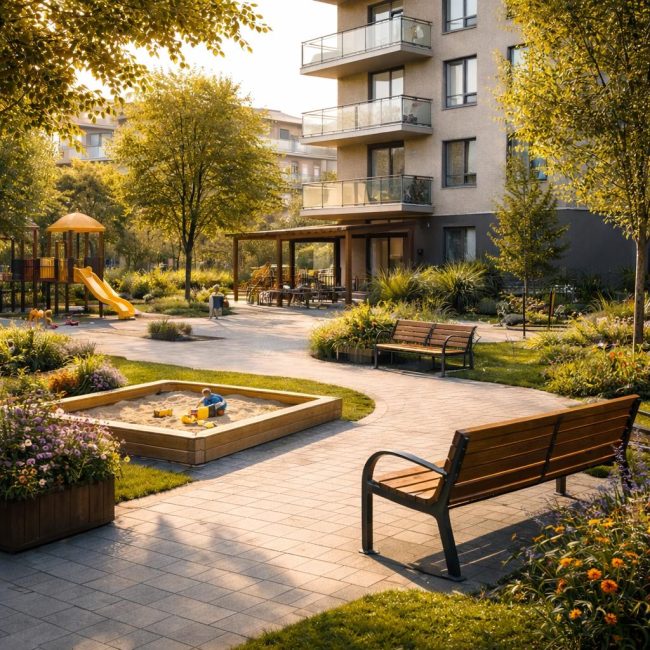
The courtyard has long ceased to be simply "the space around the house." Today, it's an extension of the living environment, a place for neighbors to socialize, children to play, quiet relaxation, and short breaks from the daily hustle and bustle. A well-managed courtyard directly impacts living comfort, safety, and even the market appeal of a property. While landscaping was once limited to asphalt and a few flowerbeds, today's approach has become much deeper and more systematic.
One of the basic elements that creates a courtyard's atmosphere are outdoor benches, the designs of which can be found here. They create focal points, allowing seniors to rest during walks, and parents to keep an eye on their children. But installing benches isn't the end of the garden's design. It's important to consider a whole range of factors, from functional zoning to the choice of materials and lighting.
- Functional zoning: the basis of a comfortable courtyard
- Main zones:
- Safety is priority #1
- Lighting
- Visibility
- Coatings
- Ergonomics and convenience: details that decide everything
- Height and location of small forms
- Availability of armrests
- Sun protection
- Materials: Durability and climate resistance
- Metal
- Tree
- Composite materials
- Greening: not only beauty, but also microclimate
- The social function of the courtyard
- Inclusiveness and accessibility
- Taking into account the interests of different age groups
- Maintenance and operation
- Ecological approach
- Results
Functional zoning: the basis of a comfortable courtyard
The first step in landscaping a home's surroundings is properly zoning the space. Without a clear structure, even a large yard will appear chaotic and awkward.
Main zones:
- Playground - must be safe, away from traffic and parking.
- Quiet recreation area — a place for the elderly, parents with strollers, and quiet communication.
- Sports area — exercise machines, horizontal bars, workout areas.
- Hiking routes - a well-thought-out network of paths with comfortable surfaces.
- Parking spaces - separated from pedestrian and play areas.
It's important not just to place these elements, but to create logical flow patterns so that people can walk through the courtyard, sit down to rest, chat, or watch their children without crossing paths with cars.
Safety is priority #1
Comfort is impossible without a sense of security. When designing a courtyard, it's important to consider:
Lighting
Uniform lighting of paths, entrances, and seating areas reduces the risk of injury and increases a sense of security. Energy-saving, vandal-resistant light fixtures are recommended.
Visibility
Hedges and decorative elements should not create "blind spots." The space should be clearly visible.
Coatings
Rubberized surfaces or a sand base are suitable for playgrounds. Pedestrian paths are best made of tiles with a non-slip surface.
Ergonomics and convenience: details that decide everything
A courtyard isn't a display of decorative elements, but an environment for everyday use. Therefore, it's important to consider ergonomics.
Height and location of small forms
Benches, trash cans, and bicycle racks should be positioned so as not to obstruct passage or create obstacles for people with limited mobility.
Availability of armrests
For older people, armrests on benches make it much easier to get up.
Sun protection
Canopies, trees or pergolas help make the yard comfortable during the hot season.
Materials: Durability and climate resistance
The surrounding area is constantly exposed to precipitation, temperature fluctuations, and mechanical stress. Therefore, the choice of materials is crucial.
Metal
Strong and durable, but requires anti-corrosion treatment.
Tree
Creates a cozy atmosphere, but requires regular protection from moisture and insects.
Composite materials
Resistant to moisture and temperature changes, do not require complex maintenance.
It is important to consider the region's climate: in northern regions, materials that are resistant to frost and reagents are preferable.
Greening: not only beauty, but also microclimate
Green spaces perform several functions simultaneously:
- reduce noise levels;
- purify the air;
- create shadow;
- create visual comfort.
When choosing plants, consider their ease of maintenance and tolerance to urban conditions. Perennial shrubs and trees with extensive root systems are best.
The social function of the courtyard
A modern courtyard is a space for interaction. It's where neighborly bonds are formed, local celebrations are held, and children learn to socialize.
To encourage social activity, it is important to provide:
- comfortable areas for communication;
- board game areas;
- space for temporary events;
- elements that promote informal contact.
Even the correct placement of benches—facing each other rather than in a line—can significantly impact the nature of communication.
Inclusiveness and accessibility
The courtyard should be convenient for all categories of residents:
- people with limited mobility;
- parents with strollers;
- elderly people;
- children of different ages.
This means no high curbs, ramps, sufficiently wide paths and comfortable seating.
Taking into account the interests of different age groups
A common mistake is focusing only on children or only on motorists. Effective landscaping takes into account a balance:
- children - a safe and varied play environment;
- for teenagers - sports areas;
- for adults - comfortable routes and places to rest;
- for the elderly - quiet and shady areas.
If the courtyard meets the interests of all residents, the level of conflict is reduced and the sense of shared responsibility is increased.
Maintenance and operation
Even the most well-thought-out project requires regular maintenance. When planning, it's important to consider:
- convenient access for cleaning equipment;
- ease of replacement of damaged elements;
- resistance of equipment to vandalism.
It is better to choose designs with a modular system - this simplifies repairs and reduces maintenance costs.
Ecological approach
Modern landscaping is increasingly focused on environmental friendliness:
- use of recycled materials;
- installation of rain gardens for natural water drainage;
- energy efficient lighting;
- preservation of existing trees.
This approach not only reduces the burden on the environment, but also fosters a responsible attitude among residents towards their yard.
Results
Landscaping a residential area is a complex task that requires consideration of numerous factors: functionality, safety, durability, the social role of the space, and aesthetics. Simply placing landscaping elements is not enough; it's important to create a harmonious, comfortable, and vibrant environment.
A good courtyard is one you want to linger in. Where children can play safely, seniors can relax peacefully, and neighbors can socialize. It's the thoughtful combination of zones, high-quality materials, landscaping, and convenient small spaces that transforms the ordinary space around the house into a fully-fledged part of a comfortable urban environment.