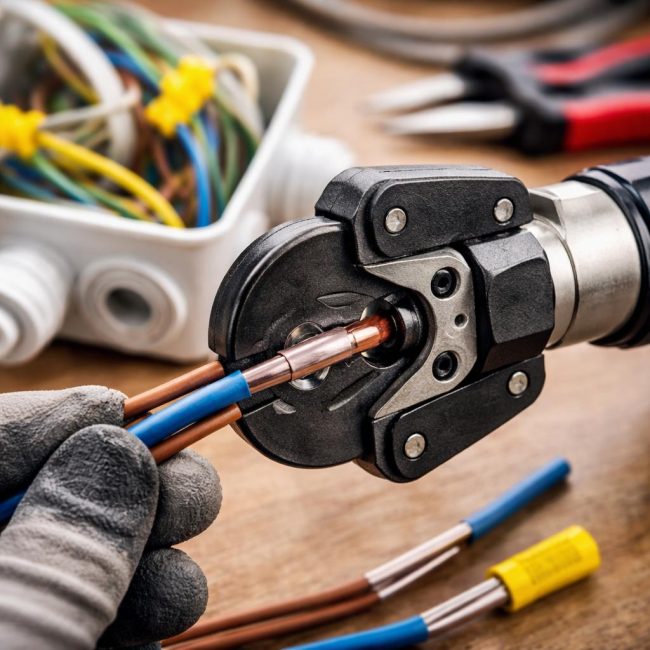
In household and repair electrical work, the topic of crimping tinned copper sleeves (TCS) crops up for good reason. It's used when you need to securely connect wires in a junction box, at the panel's entry point, when replacing a section of a line, or when upgrading old wiring. On the surface, everything looks simple: sleeve, wire, tool—and you're done. But it's precisely this apparent simplicity that raises the most questions. Why does one connection last for years, while another heats up, oxidizes, and starts acting up after just one season? What is considered "correct" crimping, beyond the instructions?
To understand this, it's important to move away from the "do this and everything will work out" formula and look at the crimping of GML as a physical and electrical process with its own conditions, limitations, and typical errors.
- What is GML pressure testing and why is it used?
- The operating principle of a crimped connection
- Why "right" isn't just about compression force
- How does crimping work in real operating conditions?
- Limitations of the method that are often overlooked
- Common misconceptions surrounding the crimping of GML
- Why the topic seems simple but remains problematic
- How to perceive pressure testing in the electrical installation system as a whole
What is GML pressure testing and why is it used?
GML is a tin-plated copper sleeve designed for permanently connecting copper conductors. The purpose of this connection is not to "fasten" but to create a stable electrical contact with minimal contact resistance and a long service life.
Crimping differs from twisting or screw clamping in that the contact is formed not by a pressure point, but by plastic deformation of the metal. The wire and sleeve literally become one piece throughout the entire contact area. Ideally, there is virtually no air between them, meaning there is no room for oxidation or localized heating.
This is why crimping is considered one of the most reliable connection methods in fixed wiring, especially where the connection should not be noticeable for decades after the box is closed.
The operating principle of a crimped connection
If you remove the tools and terminology, the principle of crimping GML is quite clear. During compression, the metal of the sleeve deforms and compresses the wire conductors with such force that they fill the entire internal volume. This creates a tight metal-to-metal contact over a large area.
Importantly, this isn't just mechanical compression. When crimped correctly, cold welding occurs at a microscopic level. The copper surfaces break down each other's oxide films, forming a stable conductive structure. This is what distinguishes a high-quality connection from a nominally "compressed" one.
The tin coating of the sleeve plays a supporting role here. It protects the surface from corrosion during installation and the first years of operation, especially in conditions of high humidity or unstable temperatures.
Why "right" isn't just about compression force
A common misconception is that the key to pressure testing a gas-motorized pipe is to "squeeze it as hard as possible." In practice, either too much or too little pressure is equally harmful.
Too little deformation leaves microgaps inside. Air and moisture gradually penetrate the contact zone, causing oxidation, increasing resistance, and eventually localized heating. The connection may appear neat from the outside, but it is already electrically unstable.
Excessive force also doesn't guarantee success. Excessive deformation can damage the strands, disrupt their structure, or create internal stress in the metal. Over time, such areas become vulnerable to vibration and thermal cycles.
Therefore, proper crimping is a matter of balance. It's determined not by the feeling of "pressing correctly," but by the conformity of the sleeve to the conductor, the nature of the deformation, and the uniformity of contact along the entire length.
How does crimping work in real operating conditions?
On paper, a crimped connection looks ideal: minimal resistance, no moving parts, and protection from oxidation. In reality, conditions vary.
Distribution boxes often experience temperature fluctuations. Electrical panels are subject to continuous current loads. Older buildings experience high humidity. All these factors gradually test the quality of the connection.
A properly performed crimping test of a GML withstands such impacts almost unnoticeably. The contact does not "loosen," the resistance remains stable, and the heating remains within normal limits. Problems, however, almost always point not to the method itself, but to errors in its application: cross-section mismatch, uneven deformation, or attempts to "save" on materials.
Limitations of the method that are often overlooked
Despite its reputation as a universal solution, GML crimping is not suitable for all situations without reservations.
Firstly, it is designed for copper conductors. Attempts to use it for mixed connections or with unsuitable materials lead to accelerated corrosion and poor contact.
Secondly, it's a permanent connection. This is ideal for applications where regular access or circuit changes are not expected. In areas where upgrades or diagnostics are possible, other approaches are sometimes more logical.
Thirdly, crimping requires careful preparation. The method is less forgiving than it seems: if errors are made during the connection stage, they won't just disappear.
Common misconceptions surrounding the crimping of GML
One of the most persistent illusions is that the external appearance of a connection is a reliable indicator of quality. A smooth sleeve and the absence of play do not necessarily mean proper contact inside.
Another common misconception is the belief that one sleeve fits all. In reality, the geometry of the connection plays a key role, and attempts to match one to the other often end in compromise.
The role of insulation after crimping is also often overestimated. Heat shrink or insulating sheathing protects against external factors, but does not correct electrical defects within the connection. If the contact is formed incorrectly, no amount of external protection will make it reliable.
Why the topic seems simple but remains problematic
Crimping of GML is often perceived as a "professional" method that automatically guarantees quality. Because of this, it receives less attention than, for example, twisting or clamping, where errors are more obvious.
In practice, however, it's precisely in pressure testing that minor deviations have a cumulative effect. A connection can operate for months without any signs of problems, only to suddenly malfunction under load. This creates a sense of unpredictability, although the causes usually lie at the very beginning.
How to perceive pressure testing in the electrical installation system as a whole
More broadly, crimping GML is not a "magic bullet," but rather part of the overall logic of reliable electrical engineering. It works well where the principles of material compatibility, reasonable loads, and careful execution are observed.
Understanding how exactly a contact is formed and what influences its durability allows us to evaluate connections not by the formal criterion of "pressurized or not," but by the actual viability of the solution. Then the question of "how to do it right" ceases to be a set of actions and becomes a conscious approach to the quality of the entire system.
It is from this level—understanding the processes and consequences—that pressure testing of gas-moulded pipes ceases to be a source of doubt and becomes a reliable tool for home repair and improvement.