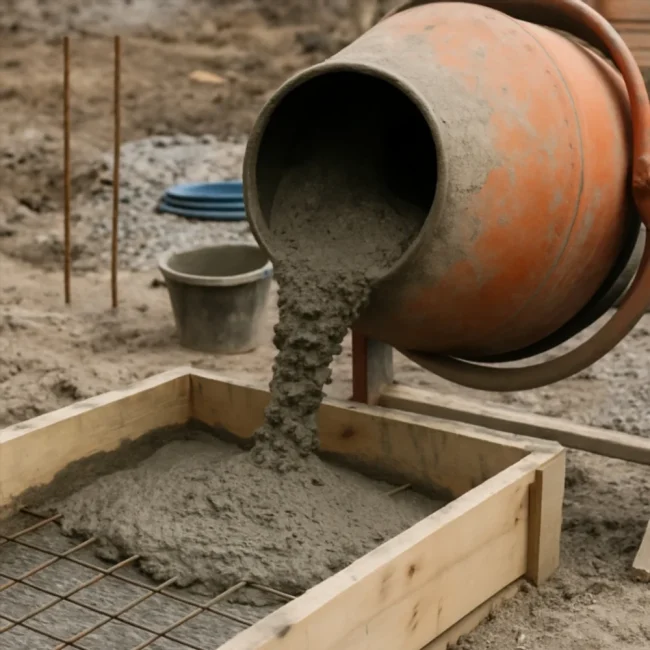
Concrete is one of the most common and versatile building materials. Its strength, durability, and reliability depend largely on the proper selection and proportions of its components. Water is one of the most important components of a concrete mix. While its quantity may seem unimportant at first glance, in practice even a slight deviation from the norm can dramatically alter the material's properties. In this article, we'll discuss the appropriate amount of water to use when preparing concrete, the potential consequences of too much or too little, how to calculate the optimal dosage, and what to consider when mixing.
- What is water-cement ratio (WCR)?
- Why is balance important?
- How to determine the optimal amount of water
- Calculation example
- The influence of excess and lack of water
- How to control the amount of water in practice
- The role of chemical additives
- Features for different types of concrete
- What does the regulatory documentation say?
- Practical advice
- Conclusion
What is water-cement ratio (WCR)?
A key concept when determining the amount of water in concrete is the water-cement ratio (W/C). This is the ratio of the mass of water to the mass of cement in a concrete mix. For example, if 200 kg of water is added to 400 kg of cement, the W/C = 0.5. This indicator has a critical impact on:
- concrete strength,
- water resistance,
- frost resistance,
- mixture mobility,
- setting time,
- shrinkage and cracking.
The lower the water-cement ratio, the higher the strength of the concrete (provided the mixture remains workable).
Why is balance important?
Cement is a hydraulic binder that hardens when exposed to water. For complete hydration, approximately 0.2–0.25 parts of water by weight of cement is sufficient. However, in practice, a larger amount of liquid (0.4–0.6) is used to ensure the workability of the mixture.
Excess water in concrete evaporates during curing, leaving pores. This reduces strength, increases permeability, and leads to material failure during freezing and thawing. On the other hand, insufficient water leads to poor mixing, makes placement difficult, and promotes the formation of voids and defects.
How to determine the optimal amount of water
The optimal amount of water depends on several factors:
- Concrete grade by strength— the higher the required strength, the lower the WCR should be. For M100, a WCR of 0.6 is sufficient, while for M400, it should be around 0.35–0.4.
- Moisture content of aggregates- Crushed stone and sand can contain up to 5% moisture, which must be taken into account when dosing water.
- Type of cement— Portland cement, pozzolanic cement, and slag Portland cement have different water requirements.
- Temperature conditions— at high temperatures, water evaporates faster, so adjustments are sometimes made.
- Laying method— concrete placed by pump or manually requires different mobility indicators, and therefore different amounts of water.
Calculation example
Let's say we need to produce M300 grade concrete. We're using M500 Portland cement. For 1 m³ of concrete, we plan to:
- Cement - 350 kg
- Crushed stone - 1200 kg
- Sand - 650 kg
We adopt a water-cement ratio of 0.45. Calculation of the amount of water:
B = Cement x VCO = 350 x 0.45 = 157.5 kg of water (approximately 157.5 liters)
If sand contains 3% moisture, then 650 kg of sand already contains 19.5 liters of water. Therefore, the water in the calculation should be reduced by this amount:
157.5 – 19.5 = 138 liters of water should be added during mixing
The influence of excess and lack of water
Excess water:
- Reduction in strength by up to 30% or more
- Increased shrinkage during drying
- Probability of microcrack formation
- Reduced frost resistance
- Increasing the setting time
Lack of water:
- Inability to mix evenly
- Difficulties in laying and compacting
- Air voids and caverns
- Peeling and delamination after hardening
- Increased risk of underhydration of cement
How to control the amount of water in practice
- Using dispensers— when preparing concrete mixes by machine at the plant, automatic water dispensers are used.
- Accounting for the moisture content of aggregates— each mixing must be accompanied by monitoring the moisture content of sand and crushed stone.
- Control of mixture mobility— there is a method called the “Abrams cone” that determines the workability of a mixture.
- Plasticizer additives— allow you to reduce the amount of water without losing mobility.
- Visual inspection— experienced concrete workers are able to determine the suitability of the mixture based on its consistency.
The role of chemical additives
Modern technologies allow you to adjust the properties of concrete without increasing the amount of water. The following are used:
- Plasticizers— increase mobility, reducing water requirements by 10–30%.
- Superplasticizers— allow to reduce the VCO to 0.3 without loss of workability.
- Retarders— relevant in hot weather.
- Hardening accelerators- useful in winter conditions or when quick formwork removal is required.
Additives are introduced in strict dosages, usually in an amount of 0.2–2% of the cement mass, depending on the type.
Features for different types of concrete
- Heavy concrete (on crushed stone)— standard VCO 0.4–0.55.
- Lightweight concrete (based on expanded clay)- requires a little more water to coat the porous filler.
- Thin-layer concrete for screeds- needs more mobility, but not over-watering.
- Reinforced concrete- requires a more plastic consistency so that the mixture can easily flow around the reinforcement.
- Fiber-reinforced concrete- sometimes requires more water due to the presence of fibers.
What does the regulatory documentation say?
According to SNiP 5.01.23 and GOST 7473-2010, the amount of water in the concrete mix must be justified based on strength, frost resistance, water resistance, and transportation and placement conditions. The documentation also specifies:
- Recommended values of VCO for different grades of concrete
- Methods of testing concrete mixtures
- Workability standards (slump)
Practical advice
- Don't use water "by eye"- Always calculate the dosage, especially for small-scale work.
- Check the moisture content of the sand- it can change even during the day.
- Avoid "dry" or "wet" formulas- strive for optimal plasticity.
- Add water only before you start mixing.— after the start of kneading, adding water is prohibited.
- Check the water quality— the water must be clean, without oils, acids and salts.
Conclusion
The amount of water in concrete isn't just a matter of mixing convenience; it's a crucial parameter determining the strength, durability, and performance of the future structure. Ignoring regulations or relying on an intuitive approach to dosing can lead to serious problems, from cracking screeds to failure of load-bearing elements. With precise calculations and proper technology, concrete becomes a reliable, durable, and resilient material that lasts for decades.
A rational approach to determining the amount of water and the use of modern additives are the key to a high-quality result in any construction project.