Modern warehouses are complex logistics systems where every second of cargo movement matters. For companies engaged in manufacturing, assembly, or distribution, the key factor in efficiency is not only storage capacity but also the speed of operations. One solution that can significantly improve productivity and ease of operation is jib cranes—compact and versatile devices for lifting and moving cargo within a work area.
Jib cranes are especially useful in warehouses where space is limited and maneuverability and precision are essential. They allow for efficient space management, reduce downtime, and minimize wear and tear on personnel during loading and unloading operations.
- What is a jib crane?
- Why are jib cranes in demand in warehouses?
- How jib cranes help optimize warehouse processes
- Reducing surgery time
- Reducing the physical strain on staff
- Flexibility in organizing space
- Improving positioning accuracy
- Examples of practical application
- Comparison with other types of lifting equipment
- Technical and operational aspects
- Load capacity and range
- Control
- Maintenance and Security
- Economic efficiency
- Prospects and Innovations
- Conclusion
What is a jib crane?
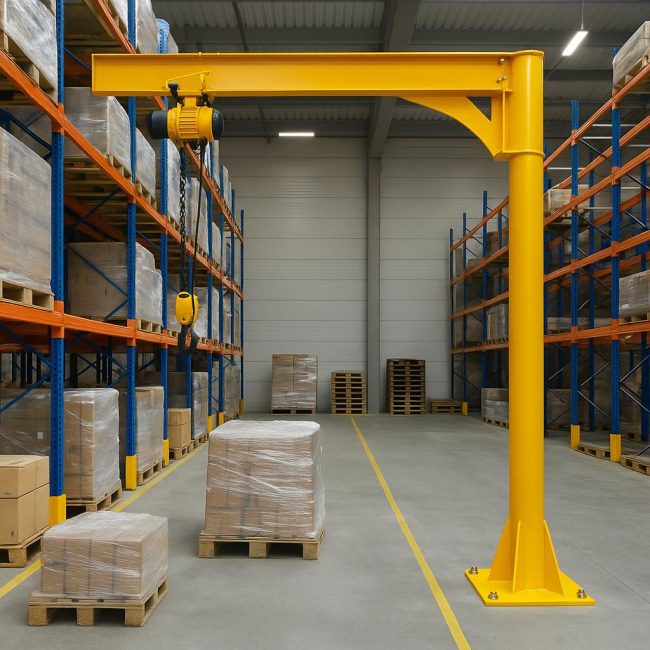
A jib crane is a type of lifting and handling equipment designed to service a confined space. The main structural element is rotating console, secured to a wall, column, or stand. A hoist or electric winch moves along the console, providing vertical and horizontal movement of the load.
There are two main types of such devices:
- Wall-mounted— mounted on columns or building walls. They save space and allow for servicing areas located along production lines or racks.
- Floor-standing (rack-mounted)— are installed on their own support, making them independent of the building's supporting structures. They are especially convenient for organizing work areas where securing to a wall or column is impossible.
Why are jib cranes in demand in warehouses?
Warehouse space management is a balance between storage density and ease of access. Unlike bulky overhead or gantry cranes, jib cranes don't require massive runways or high clearances. Their advantages in a warehouse are obvious:
- Compact and space-saving. The crane serves a strictly limited area without interfering with other processes.
- Ease of installation. Installation does not require major construction work, especially in the case of wall-mounted models.
- Maneuverability. The console rotation (up to 270° or even 360°) allows you to easily move loads within the work area.
- Ease of operation. Management does not require high qualifications - basic instructions are sufficient.
- Improving security. The operator can remain at a safe distance, and the movement of the load can be predictable and controlled.
How jib cranes help optimize warehouse processes
Reducing surgery time
One of the main goals of logistics is to minimize the time it takes to move goods. A jib crane allows for the rapid lifting, movement, and precise placement of loads, which is especially important when unloading pallets, components, or packaging materials.
For example, when working with loads up to 2 tons, the operator can move the goods from the vehicle directly to the rack or sorting area without the use of additional equipment (forklifts, stackers).
Reducing the physical strain on staff
In traditional warehouses, many operations—lifting, carrying, and stacking—are performed manually. This not only reduces productivity but also leads to injuries and fatigue. A jib crane takes on the heavy lifting, leaving the worker with only the task of monitoring the process. This increases productivity. ergonomics workplace and is reduced injury rate.
Flexibility in organizing space
Unlike fixed transport lines, jib cranes are easily adapted to the warehouse's current needs. If the layout changes or the storage area expands, the crane can be dismantled and installed in a new location.
In addition, several taps can be placed around the perimeter of the room, creating local work zones, serving different areas without intersecting traffic paths.
Improving positioning accuracy
Modern jib cranes are equipped with electric hoists with smooth speed control. This is especially important when handling fragile or expensive loads, such as glass, equipment, or electronics. Precise delivery to a rack or container eliminates the risk of damage to the product.
Examples of practical application
- Finished goods warehouses. Jib cranes are used for loading products onto transport and moving packages and pallets.
- Warehouses of components. It is convenient to use wall-mounted cranes for feeding parts to assembly lines.
- Cold storage warehouses. Compact models with electric hoists work well in confined spaces and at low temperatures.
- Small logistics centers. Jib cranes offer an alternative to expensive conveyor systems while maintaining flexibility and ease of maintenance.
Comparison with other types of lifting equipment
| Equipment type | Advantages | Flaws |
|---|---|---|
| Overhead crane | High load capacity, large area coverage | Requires complex installation and high building structure |
| Gantry crane | Possibility of working in open areas | Takes up a lot of space and requires rail tracks |
| Jib crane | Compactness, ease of installation, low operating costs | Limited service area |
| Hydraulic lift | Universal for small loads | Not suitable for frequent movements and heavy weights |
From the table it is clear that cantilever cranes occupy the golden mean between mobility and productivity. They don't require large investments, yet provide significant efficiency gains.
Technical and operational aspects
Load capacity and range
Most jib cranes have lifting capacities ranging from 125 kg to 5 tons, and a reach of 2 to 8 meters. This makes them ideal for loading areas, order picking, and maintenance.
Control
Control can be manual, cable-operated, or remote (using a control panel). Modern electric models allow precise adjustment of the speed and direction of the load.
Maintenance and Security
Regular inspection of components, rope checks, bearing lubrication, and brake testing ensure a long service life and safe operation. With proper maintenance, the equipment's service life exceeds 10 years.
Economic efficiency
The implementation of cantilever cranes quickly pays for itself due to:
- reduction of operation time;
- reducing the need for additional workers;
- reducing the number of cargo damages;
- increasing productivity on site.
For a business with intensive warehouse operations, the return on investment is typically from 6 to 18 months depending on the load and volume of work.
Prospects and Innovations
Modern jib cranes are increasingly being integrated into automated warehouse management systems (WMS)They can be equipped with load sensors, positioning systems, and even Wi-Fi modules for remote monitoring. Technological advances make them part of the concept. smart warehouse, where each piece of equipment transmits data in real time.
Conclusion
Jib cranes are more than just a convenient tool for lifting loads; they're also a crucial element of efficient logistics. Their use helps optimize warehouse processes, increase productivity, improve safety, and utilize space efficiently. Thanks to their flexibility, compact size, and affordability, jib cranes are becoming increasingly popular among both large enterprises and small businesses.