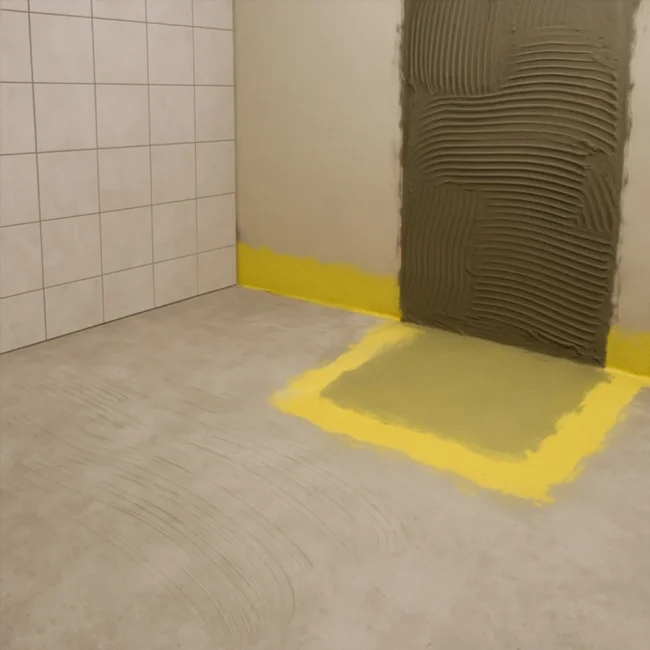
High-quality tiling is impossible without a reliable base. Errors at this stage lead to cracking of the coating, peeling of tiles, and the appearance of voids and unevenness, which significantly reduce the aesthetics and performance of the finish. In this article, we'll take a detailed look at the required base for tiling, the materials and preparation technologies used depending on the surface type and operating conditions, and a step-by-step walkthrough of the base leveling and preparation processes.
- The Importance of a Quality Foundation
- Types of bases for tiles
- Preparation of the base depending on the material
- Concrete screed
- Wooden base
- Drywall and gypsum fiberboard
- Old tiles
- Preparing walls for tiles
- Use of waterproofing
- Self-leveling floor as a leveling method
- Common mistakes when preparing the foundation
- Conclusion
The Importance of a Quality Foundation
Tiles are a durable, water-resistant, and long-lasting material, but only if laid on a properly prepared base. Do not lay tiles on a loose, crumbling, uneven, or unstable base. Such a base will not provide the necessary adhesion, which will ultimately lead to the failure of the entire structure.
A high-quality base for tiles should have the following characteristics:
- Strength- withstand the weight of the tiles and adhesive without breaking.
- Evenness— permissible differences are no more than 2 mm per 2 meters.
- Purity- absence of dust, dirt, oil, paint, plaster residue.
- Dryness— before laying tiles, the base must be completely dry.
- Immobility— elimination of vibrations, deformations and subsidence.
- Compatibility with adhesive composition- to ensure reliable adhesion.
Types of bases for tiles
Depending on the type of room, operating conditions and type of tile, different types of bases can be used:
- Concrete screed— one of the most reliable and widespread options, especially in bathrooms, kitchens, and balconies.
- Cement-sand screed— often used in residential premises, garages, non-residential buildings.
- Gypsum screed- used only in dry rooms.
- Dry prefabricated foundations (gypsum fiberboard, plywood)— applicable for wooden floors and in dry floor systems.
- Plastered walls- suitable for vertical tiling.
- Old tiled flooring— laying over old tiles is possible, subject to certain conditions.
- Waterproofing base— waterproofing of the base is required in bathrooms and on balconies.
Preparation of the base depending on the material
Concrete screed
Preparation of a concrete base includes the following stages:
- Surface cleaning— removal of dust, debris, old paint, and glue residue.
- Test of strength- there should be no dull sounds when tapping.
- Padding— concrete contact or penetrating primer is used depending on the absorbency of the base.
- Alignment— if necessary, a self-leveling floor or thin cement screed is installed.
- Drying— the concrete must dry completely (on average 28 days from the moment of pouring).
Wooden base
Laying tiles on a wooden base is possible subject to a number of conditions:
- The base must be rigid, without any deflections.
- The floor is leveled with sheets of moisture-resistant plywood or gypsum fiber board, laid in two layers with offset seams.
- All sheets are fastened with self-tapping screws at intervals of 15–20 cm.
- The surface is primed and then a layer of elastic tile adhesive is applied.
- It is advisable to use a reinforcing mesh and a waterproofing layer.
Drywall and gypsum fiberboard
You can lay tiles on plasterboard walls if:
- Moisture-resistant gypsum board or gypsum fiber board is used.
- All joints are sealed with reinforcing tape and putty.
- The base is primed twice: the first layer is deeply penetrating, the second is concrete contact.
- Highly elastic tile adhesive is used.
Old tiles
Laying tiles on old ones is possible if the following conditions are met:
- The old coating holds firmly, there are no cracks, peeling, or “voids”.
- The surface is degreased and cleared of plaque.
- It is primed with a special adhesive compound.
- The tiles are laid using strong adhesive for difficult surfaces.
Preparing walls for tiles
Walls under tiles should be:
- Smooth— if necessary, leveled with plaster.
- Durable- loose areas or crumbling surfaces are not allowed.
- Waterproofed— especially in bathrooms, showers, toilets.
- Primed— a universal or adhesion primer is used.
In cases of severe unevenness, it is recommended to level the walls using reinforced cement plaster along benchmarks. After drying, the surface is carefully sanded and primed.
Use of waterproofing
Waterproofing is mandatory in the following areas:
- Bath, shower cabin.
- Bathroom.
- Balcony or loggia.
- Kitchen in the sink area.
- The first floor is located at a high groundwater level.
Types of waterproofing:
- Coating— bitumen mastics, cement-polymer compositions.
- Roll- in combination with surfacing.
- Liquid rubber- a modern option with high elasticity.
The waterproofing coating is applied in at least two layers, with corners and joints being treated. Once dry, the tiles are laid using flexible adhesive.
Self-leveling floor as a leveling method
Self-leveling compound is used:
- For fine alignment (from 1 to 30 mm).
- If necessary, create a perfectly smooth horizontal surface.
- As a finishing layer under tiles with minimal differences.
Technology:
- The base is cleaned and primed.
- The composition is mixed in precise proportions.
- Fill in stripes, starting from the far corner.
- Spread with a needle roller to remove bubbles.
- After complete drying, the tiles are laid directly on the self-leveling floor layer.
Common mistakes when preparing the foundation
- Laying on wet concrete— leads to peeling of tiles.
- Ignoring the primer- weak adhesive adhesion.
- Insufficient foundation strength— the appearance of cracks and the “shooting off” of tiles.
- Laying on paint, oil or bitumen— the tile is coming off.
- Unaccounted for foundation mobility- especially critical for wooden floors.
- Absence of expansion joints— leads to cracking of the coating due to temperature changes.
Conclusion
Preparing the subfloor for tiling is no less important than choosing the tiles or adhesive. A proper approach to preparation ensures a reliable, aesthetically pleasing, and durable surface. Depending on the subfloor conditions and materials, the appropriate technology is selected: leveling, priming, reinforcement, and waterproofing. By following proven recommendations, you can avoid future problems and achieve high-quality tiling that will last for decades without repair.