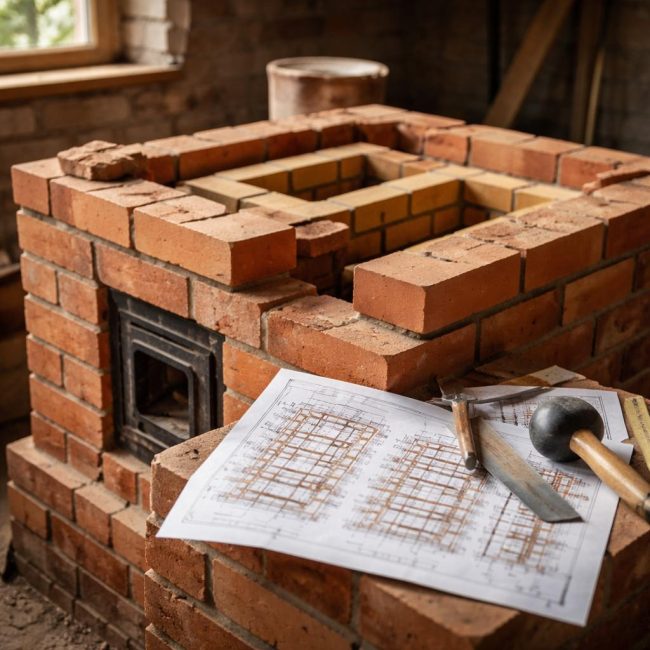
In the tradition of Russian stove-making, many designs bear the names of their creators. Volkov's heating stove is precisely such a solution: it is not an abstract "stove type," but a specific engineering design, developed in the practice of brick stove-building and widely used due to its clear operating logic and predictable thermal conditions. The focus of interest in this design is usually the masonry order—the sequence and interrelationship of the rows of masonry, which determines gas movement, heating of the massif, and stable draft.
Moreover, the order of fire in this type of furnace is not simply a "drawing of rows," but a fixed system of solutions in which each element is subordinated to the overall thermal engineering task. To properly understand what exactly lies behind this term and why the Volkov furnace cannot be considered universal, it is useful to analyze its design and operating principles without oversimplifications or going into instructional detail.
- The design concept of the Volkov stove
- The role of ordering in the operation of the furnace
- Flue gas movement and heat transfer
- Thermal inertia and heating characteristics
- Materials and their relationship with the order
- Limitations of using the Volkov furnace
- Common misconceptions about masonry order
- The place of the Volkov stove in modern practice
The design concept of the Volkov stove
The Volkov stove was designed as a heating stove, not a cooking stove. This means its primary function is to provide uniform and long-lasting heating of the room by accumulating heat within the brickwork. Unlike stoves with an active cooking surface or combination models, there's no need to quickly transfer heat to the stove or oven, so the internal design is designed to maximize the energy from the flue gases.
Structurally, the stove is a compact but rather massive brick structure with a well-developed system of internal channels. These channels are formed strictly within the rows and determine the direction of gas flow from the firebox to the chimney. As a result, hot combustion products do not "burst" directly upward, but rather flow sequentially around the internal walls, transferring heat to them.
The role of ordering in the operation of the furnace
The Volkov stove's layout isn't a formal list of rows, but a logical diagram in which each level of masonry performs a specific function. The lower rows form the foundation, ash pan, and the initial sections of the flue gas ducts. The middle rows are responsible for channel development and heat flow distribution, while the upper rows stabilize draft and ensure proper flue gas flow into the chimney.
The key feature of the masonry layout is that it determines not only the furnace's geometry but also its thermal inertia. The wall thickness, channel width, and relative positioning were selected to prevent localized overheating and to retain heat for a long time after firing. Violating this logic, even without visible defects in the masonry, directly impacts the furnace's efficiency and safety.
Flue gas movement and heat transfer
The Volkov furnace uses a sequential flow of flue gases through a system of vertical and horizontal channels. This design allows for a "stretched" gas path, reducing their temperature by the time they exit the chimney and simultaneously heating the furnace's entire height.
The order of the furnaces here acts as a kind of route. If you imagine a cross-section of the furnace, it becomes clear that changing the shape or cross-section of one channel automatically affects the operation of the entire system. Therefore, Volkov's classic design eliminates random or decorative elements: every turn and every lintel has a functional purpose.
Thermal inertia and heating characteristics
One of the reasons for the enduring interest in the Volkov stove remains its thermal inertia. When used correctly, it isn't designed to quickly heat a cold room from scratch, but it works well in temperature maintenance mode. The brickwork accumulates heat during combustion and then gradually releases it into the room, smoothing out temperature fluctuations.
It is the order of the stove that ensures this effect. Due to the uniform heating of the interior walls and the absence of sudden temperature fluctuations, the stove is less susceptible to internal stress, and heat transfer is distributed more consistently. As a result, the room is heated not by hot air, but by soft radiant heat from the stove's surface.
Materials and their relationship with the order
Although the masonry layout describes the geometry of the masonry, it was originally developed with specific materials in mind. The thickness of the joints, the placement of the bond, and the shape of the channels all require the use of solid firebrick with specific thermal properties. This is important because the thermal conductivity and heat capacity of the material directly affect the performance of the entire system.
Using bricks with different properties or changing the mortar composition changes the stove's behavior, even if the brickwork is visually correct. In practice, this results in a different heating pattern, a shift in the maximum temperature, and a change in draft, which is especially critical for heating stoves without an active cooking zone.
Limitations of using the Volkov furnace
Despite its advantages, the Volkov stove is not a universal solution. It is designed for specific room sizes and operating conditions. In small spaces with sparse fireboxes, its thermal inertia may be excessive, and in larger homes, it may be insufficient without an additional heat source.
The stove layout also requires a specific height and relationship to the chimney. Deviating from these parameters disrupts the balance between channel resistance and draft, which affects combustion stability. Therefore, attempts to "adapt" the layout without a thorough understanding of its logic often result in reduced efficiency rather than improved results.
Common misconceptions about masonry order
A common misconception is that the furnace row layout is a universal template that can be scaled or mirrored without consequences. This is not the case with the Volkov furnace. The channel layout is designed for specific proportions, and changing the dimensions of one element without recalculating the entire system disrupts the thermal and gas dynamics.
Another misconception is that the row-by-row design is considered secondary to the stove's appearance. In practice, decorative cladding cannot compensate for structural errors within the stove's structure. If the internal logic is compromised, the stove will perform poorly, regardless of the quality of the exterior finish.
The place of the Volkov stove in modern practice
In modern conditions, the Volkov stove is more often viewed as an example of a classic heating system than as a ready-made solution "for any home." It clearly demonstrates how the masonry sequence determines heat transfer and the durability of the structure. For stove builders, it is a convenient model for analysis, and for homeowners, it provides a reference point for understanding why a stove operates the way it does.
In this context, the order ceases to be a set of rows and becomes a language in which the stove "explains" its operation. Understanding this logic allows one to soberly assess the design's capabilities, its limitations, and the consequences of any changes, even if they seem insignificant.