The idea of heating a house with an electric cable rather than radiators or a boiler comes up in practice far more often than one might think. It's usually approached not out of curiosity, but out of necessity: there's no gas, the property is remote, the house isn't used regularly, or traditional heating systems prove too cumbersome for the specific task. Moreover, the very term "heating with a heating cable" is ambiguous: some envision underfloor heating, others roof de-icing, and still others a strange temporary measure "for the winter." It's precisely because of this vagueness that the topic raises questions and demands a calm, technically sound analysis, free from advertising promises and extreme assessments.
- What is really hidden behind the concept
- Operating principle without technical details
- Where cable actually works as heating
- Comfort and warmth: not just numbers
- Energy consumption as a consequence, not a cause
- Limitations that are often forgotten
- Common misconceptions surrounding the topic
- Why do people keep coming back to this technology?
What is really hidden behind the concept
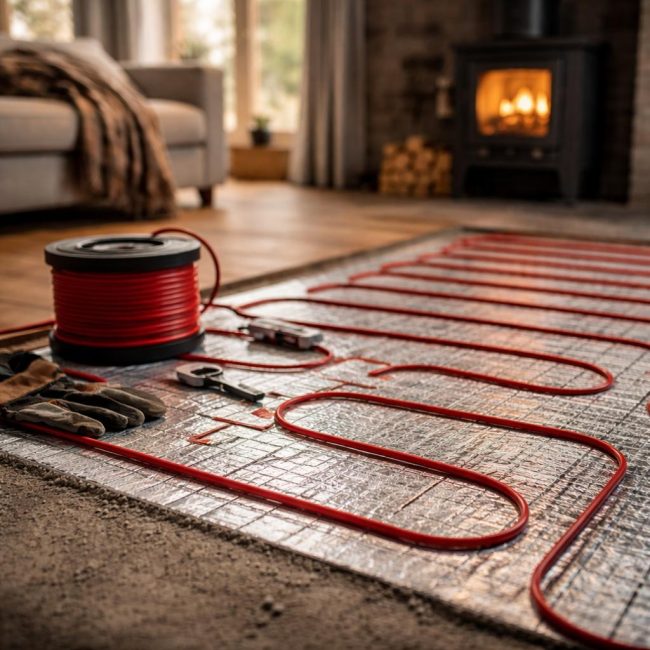
A heating cable as a heat source is not a single system or a turnkey solution. It's a class of electric heating elements that convert supplied electrical energy into heat directly at the point of installation. Unlike boiler systems, there's no coolant, circulation, or distribution through radiators: heat is generated locally, where the cable is installed, and then spreads through the heat transfer of the materials.
This is why heating cables are rarely considered a universal replacement for traditional whole-house heating. They are much more often used as part of an overall thermal solution: in floors, in specific zones, in rooms with unusual geometries, or in buildings where traditional systems are impossible or economically unfeasible. Understanding this immediately alleviates some of the inflated expectations and explains why different owners' operating experiences can be diametrically opposed.
Operating principle without technical details
Heating cables operate on simple physics: electric current passing through a conductor with a given resistance generates heat. The cable's design ensures stable, predictable, and safe heating under normal operating conditions. The heat is not stored in a separate device, but is distributed along the length of the cable, creating the effect of an "extended heat source."
From a home's perspective, this means gentle, diffuse heating of surfaces rather than a localized hot spot. The floor, wall, or utility area begins to release heat into the room gradually, without sudden changes in air temperature. This type of heating is often perceived as more comfortable, especially in spaces where a uniform microclimate is more important than rapid heating.
Where cable actually works as heating
In practice, heating cables are most effective in scenarios requiring either background heat or heat loss compensation, rather than full-scale "all-in-one heating." One typical example is seasonal homes. When a building isn't heated continuously, traditional systems can create more problems than they're worth: they pose a risk of freezing, are difficult to maintain, and require constant monitoring. Cable solutions in such cases are perceived as more tolerant of downtime and downtime.
Another common scenario is small homes or individual areas within them. Cable heating is often used where installing radiators would disrupt the layout or visual integrity of the space. A built-in heat source doesn't "eat up" usable space or dictate furniture arrangement. This is especially noticeable in attics, studios, extensions, and renovated spaces, where standard solutions don't fit well with existing structures.
Comfort and warmth: not just numbers
One of the reasons homeowners are returning to the topic of heating cables is the subjective perception of heat. With cable heating, people often feel warm surfaces rather than hot air. Floors, lower wall areas, and technical elements begin to act like large radiators with low surface temperatures. This creates a feeling of consistent, "calm" warmth without drafts or harsh convective currents.
However, there's also a limitation: if the building's enclosing structures are poor at retaining heat, the cable will compensate for the loss but not eliminate the source. Under these conditions, the system may run continuously, creating the illusion of heating but failing to provide the expected comfort. Therefore, discussions about heating cables almost always hinge on the overall condition of the home, even if this isn't explicitly stated.
Energy consumption as a consequence, not a cause
The issue of electricity inevitably arises first. Heating cables are directly dependent on the power supply, and this is a fundamental property, not a drawback. In homes with limited power, an unstable grid, or high electricity costs, this factor becomes crucial. It's important to understand that the cable itself is neither "gluttonous" nor "efficient"—it simply converts electricity into heat without any intermediate losses.
Actual differences in consumption arise from the usage scenario: where exactly the cable is installed, how well the house retains heat, how often and in what modes the system operates. Therefore, comparisons such as "cable is more expensive than a boiler" or "cable is more cost-effective than radiators" rarely have practical value without considering the context of a specific home.
Limitations that are often forgotten
Heating cables have physical and operational limitations that cannot be ignored, even if the system appears simple. They are not designed to instantly heat a cold, frozen building. The thermal inertia of the structure makes this scenario ineffective and creates a gap between expectations and reality. The cable performs better in temperature maintenance mode than in "saving the house overnight" mode.
Furthermore, cable heating leaves virtually no room for improvisation after installation. If the heat source is hidden within the structure, it cannot be quickly moved or replaced without affecting the finish. This isn't a disadvantage, but a feature that's important to consider when choosing, especially in homes with a changing layout or undefined usage patterns.
Common misconceptions surrounding the topic
One of the most common misconceptions is the idea of heating cables as a temporary or "non-serious" solution. In practice, they have been used in utility systems for decades, just not always as the primary heating source. The opposite extreme is the expectation that the cable will solve all a home's heating problems without additional measures. In this case, disappointment is almost inevitable.
Another mistake is to view cables solely as analogous to underfloor heating. While these concepts overlap, they are not identical. Cables can perform different functions depending on the zone and design, and reducing everything to a single image is oversimplifying the topic to the point of meaninglessness.
Why do people keep coming back to this technology?
Despite limitations and controversial issues, heating cables remain a popular choice precisely because they address specific but real needs. Where one-size-fits-all solutions don't exist, flexibility and predictability are valued. Cables don't require complex infrastructure, aren't fuel-dependent, and don't impose rigid operating scenarios. They don't replace all heating systems, but they confidently occupy their niche.
Ultimately, a discussion about heating cables isn't about "good" or "bad," but about the technology's suitability for a specific home, lifestyle, and the owner's expectations. This is why the topic remains relevant and resurfaces with every non-standard project or limited initial conditions, where conventional solutions no longer work as expected.