Heating and hot water supply issues often become a major concern when building or renovating a private home. Choosing the right system affects not only the comfort of residents but also resource efficiency, equipment durability, and overall cost effectiveness. This article will examine key aspects of heating and hot water supply systems in detail and discuss practical solutions that can be used in private homes.
Why is it important to choose the right heating system?
In practice, heating and hot water supply issues are a concern for many private homeowners. This is due to the need to create comfortable living conditions while minimizing expenses. While city apartments are centrally heated, in private homes, all matters related to heating and hot water are handled by the owner. Sometimes, a lack of awareness can lead to mistakes that result in additional costs and, occasionally, technical malfunctions.
Heating in a private home should provide consistent comfort year-round. It's important to note that with advances in technology, a wide variety of system options are available, and the optimal solution can be selected for any type of home, its location, and operating conditions.
Main types of heating systems
Heating systems for private homes can vary significantly in their operating principles. First and foremost, they can be divided into several types based on the energy source:
- Gas heating— the most popular and economical option for homes located in areas with access to natural gas. A gas boiler can provide a home with reliable heat and hot water at relatively low energy costs.
- Electric heating— is often used in homes without a gas connection. In this case, electric boilers or various systems, such as infrared heaters or underfloor heating, are used. Electric heating is easier to install, but its operating costs can sometimes be higher.
- Solid fuel heating— ideal for country houses and cottages located far from gas lines. Using wood or coal eliminates dependence on external energy supplies, but requires the appropriate equipment and regular fuel loading.
- Geothermal heating— a modern solution that uses geothermal heat to heat rooms. This system is more expensive to install, but extremely economical to operate and is suitable for homes located in regions with cold winters.
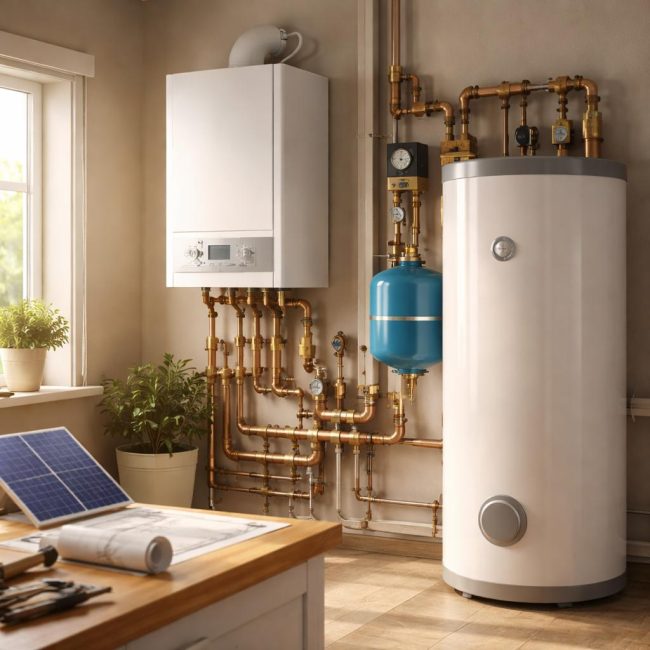
It's also worth considering systems that combine multiple energy sources, such as solar collectors or heat pumps paired with a central heating system. These solutions significantly reduce heating costs during the summer months, when solar energy can be used for heating.
Principles of hot water supply organization
Hot water supply is an essential component of comfort in a private home. Various systems can be used to provide hot water, either connected to the heating system or operating independently.
- Centralized water supply— Suitable if the home has access to central water and sewer systems. In this case, hot water can be supplied through water heaters, boilers, or water heaters.
- Autonomous hot water supply— used in homes without central water supply. In such cases, boilers are installed, which can be gas, electric, or solid fuel. Gas boilers are generally more energy-efficient but require an appropriate ventilation system and chimney.
- Solar collectors— an effective solution for heating water using solar energy. Solar collectors are especially useful in regions with good sunlight during the warmer months. In winter, they can be used in conjunction with other heating systems.
How to choose the right solution for your home
When choosing a heating and hot water supply system for a private home, it is important to consider several key factors:
- Type of house— for single-family houses, summer cottages, or cottages, various solutions can be selected depending on the area and operating conditions.
- Availability of resources— the presence of a connection to gas pipes or the presence of an electrical network significantly influence the choice of a heating system.
- Economic and environmental considerations— It is important to consider not only the initial installation costs, but also the operating costs and the environmental impact.
- General operating conditions— climate conditions, home insulation, and the family's hot water needs—all of this must be taken into account when designing the system.
Problems and limitations
Regardless of the choice of heating and hot water system, certain problems can always arise. These can range from technical malfunctions to operational difficulties, requiring careful attention and regular maintenance. For example, using stand-alone boilers requires knowledge of their maintenance procedures and periodic safety checks. Installation errors, improper equipment selection, or improper system configuration can lead to overloads, breakdowns, or even emergency situations.
There are also restrictions on equipment placement that are important to consider at the design stage. For example, installing a gas boiler requires adherence to strict ventilation and chimney placement standards, which can be challenging in homes with limited space.
Misconceptions when choosing systems
Several common misconceptions stand out. For example, many believe that gas heating is always cheaper than electric heating, but in some regions where gas is expensive, this may not be the case. There's also a belief that solar collectors are only suitable for country houses, while they can be effective in more northern regions if properly configured.
Conclusion
Choosing a heating and hot water system for a private home is not only a matter of convenience but also long-term savings. It's important to approach this process carefully, considering not only economic factors but also operational features and the long-term consequences of your choice. A proper understanding of the operating principles of each system and its practical application will help avoid unnecessary expenses and ensure comfort for years to come.