When building and equipping a house, special attention is paid to thermal and waterproofing, but no less important isvapor barrierIt's especially important when installing interfloor or attic floors. If it's not provided for or installed incorrectly, moisture can accumulate in the structure, leading to mold, mildew, and the deterioration of insulation and wood. In this article, we'll take a detailed look at why vapor barriers are necessary for floors, what materials are used, how to install them correctly, and what to avoid.
- Why is vapor barrier for ceilings necessary?
- Where exactly is a vapor barrier needed in the ceiling?
- What materials are used for vapor barrier of ceilings?
- Polyethylene film
- Polypropylene film
- Membranes
- Foil materials
- Bituminous roll materials
- Rules for laying vapor barrier on the ceiling
- Laying side
- Seam tightness
- Overlap when laying
- Mounting to structures
- Gluing of passages
- Protection from damage
- Features of installation for different types of floors
- Wooden floor with insulation
- Concrete floor
- Attic floor with insulation
- Common installation mistakes
- Tips for choosing a vapor barrier material
- Conclusion
Why is vapor barrier for ceilings necessary?
A vapor barrier is a barrier that protects building structures from water vapor penetration. Moisture from the air inside a home, especially in kitchens, bathrooms, and living spaces, tends to migrate to cooler areas—exterior walls, roofing, attics, or interfloor spaces. Along this path, water vapor can condense, accumulating in insulation, beams, or other structural elements.
If you do not use a vapor barrier, then moisture:
- Reduces the thermal insulation properties of the insulation;
- Promotes the growth of mold and mildew;
- Damages wood and metal elements;
- Reduces the service life of the entire building structure.
This is especially critical for wooden houses and when insulating floors, for example, between a heated floor and a cold attic. A vapor barrier is essential in this case.
Where exactly is a vapor barrier needed in the ceiling?
Depending on the design of the house, a vapor barrier may be needed in different areas:
- Attic floors
The most vulnerable area in a home for moisture penetration. The heated space below and the cold attic above create ideal conditions for condensation to form without proper protection.
- Interfloor ceilings
If both floors are heated, moisture does not penetrate upwards as aggressively, but having a bathroom or kitchen on the ground floor requires a vapor barrier.
- Ceilings between living spaces and the basement
The main goal here is to protect the insulation from moisture rising from the basement.
What materials are used for vapor barrier of ceilings?
The construction market offers a wide range of materials suitable for vapor barrier installation. Below, we'll look at the most popular.
Polyethylene film
- The most accessible and cheapest option.
- Easy to install.
- However, it is easily damaged and is not resistant to UV radiation.
- It does not allow steam to pass through at all, which is not always desirable in “breathing” structures.
Polypropylene film
- More durable, resistant to mechanical damage.
- It may have an anti-condensation side - rough, which retains moisture.
- Requires a ventilation gap between the insulation and the film.
Membranes
- Modern vapor barrier materials.
- Vapor-impermeable membranescompletely block moisture (used with insulation).
- Diffusion membranesThey may allow some steam to pass through, but protect against moisture – important for complex structures.
Foil materials
- Films with aluminum coating.
- Combines vapor barrier and heat reflection.
- Ideal for bathrooms, saunas, kitchens.
Bituminous roll materials
- They are used mainly in industrial construction.
- They can also be used for vapor barrier of floors when laid on joists.
Rules for laying vapor barrier on the ceiling
Installation errors can ruin all your efforts. Therefore, when installing a vapor barrier, it's important to follow these key rules.
Laying side
Vapor barrier films are always installedsmooth side towards the warm room, and the rough one - to the insulation (if there is any). Foil-clad ones - with the foil facing inside the house.
Seam tightness
All panel joints are sealed with special construction tape. This prevents steam leaks through the gaps.
Overlap when laying
Adjacent panels overlap each other by at least 10–15 cm. The overlapping areas must be glued.
Mounting to structures
The film is attached to beams, joists, and rafters with a stapler, with a pitch of no more than 30 cm. A sealing tape is laid over the attachment points.
Gluing of passages
Pipe, ventilation, and wiring exits require particularly careful sealing. Butyl rubber tape or rubber seals are used for this purpose.
Protection from damage
After installation, it's important not to damage the material. Avoid walking on it or leaving sharp objects on it.
Features of installation for different types of floors
Wooden floor with insulation
- The vapor barrier is laid underneath, above the finishing (if the ceiling is between floors) or under the insulation (if it is an attic).
- The material is fixed to the joists or beams, overlapping the walls.
- On top is insulation, and then waterproofing (if it’s an attic).
Concrete floor
- If insulation is laid on top (for example, under laminate or underfloor heating), a vapor barrier is needed underneath it.
- In bathrooms, it is advisable to use foil material.
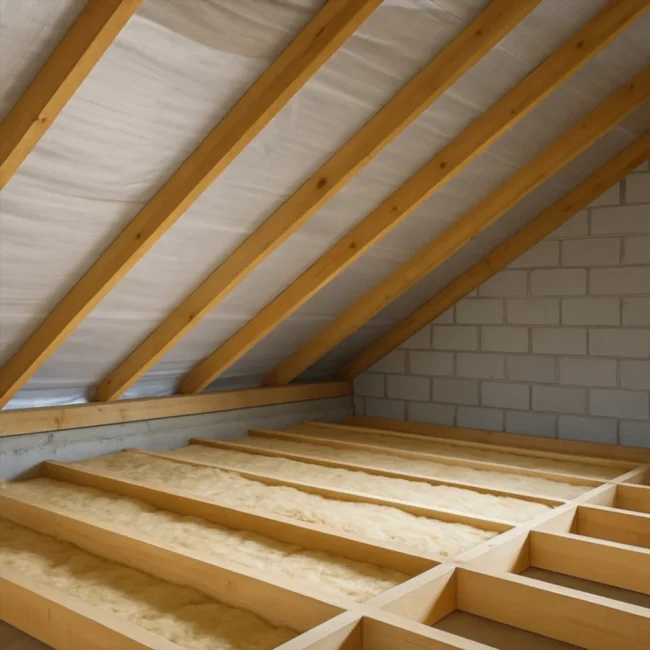
Attic floor with insulation
- The insulation is placed between the joists.
- Vapor barrier - from below the insulation (from the side of the warm room).
- On top of the insulation there is a windproof membrane.
Common installation mistakes
- Laying on the wrong side.This happens often - as a result, the steam is not retained, and moisture gets into the insulation.
- Lack of sealing of joints.Even if the film is laid correctly, unsealed joints reduce the effectiveness of the entire system.
- Violation of the integrity of the canvas.Cuts, punctures, and uneven laying lead to steam penetration.
- Lack of vapor barrier in damp areas.It is especially often forgotten when insulating the floor of a bathroom or kitchen.
- Using unsuitable material.For example, using a simple film where foil or membrane protection is needed.
Tips for choosing a vapor barrier material
- For wooden floors between floors, a polypropylene film with an anti-condensation layer is suitable.
- For ceilings above a bathroom or kitchen, a foil vapor barrier is preferable.
- For attics and basements, thick polyethylene films or vapor-impermeable membranes work well.
- It is important to take the climate into account: in regions with high humidity, it is better to use two-layer materials.
Conclusion
A ceiling vapor barrier is an element that's invisible in the finished interior, yet critical to the durability, thermal insulation, and indoor climate. Incorrect material selection or improper installation will lead to moisture accumulation, insulation damage, mold growth, and even structural collapse. Therefore, this stage of construction must be approached with due care and understanding of all the nuances. Only a properly installed vapor barrier will guarantee the comfort, warmth, and reliability of your home for years to come.