Heating a home is a key task, especially in cold climates. For private homeowners and cottage owners, autonomy, energy efficiency, and savings on heating costs are crucial. In this context, pyrolysis boilers are becoming increasingly popular. They are an advanced version of solid fuel units that utilize a special combustion technology called pyrolysis. The heart of the system is a specialized pyrolysis boiler furnace, ensuring high efficiency and long-lasting combustion. Let's look at its design, operating features, and important considerations before installation.
- What is pyrolysis and how does it differ from conventional combustion?
- Pyrolysis furnace design
- The operating principle of a pyrolysis boiler
- Advantages of a pyrolysis furnace
- Disadvantages and limitations
- What fuel to use
- Installing a pyrolysis boiler: what is important to consider
- Operating tips
- Features of winter operation
- DIY Pyrolysis Boiler Furnace: Is It Worth It?
- Conclusion
What is pyrolysis and how does it differ from conventional combustion?
Pyrolysis is the thermal decomposition of organic materials at high temperatures (200 to 800°C) in a limited oxygen supply. Unlike traditional combustion, where the fuel burns quickly with an active supply of air, pyrolysis first breaks down wood or other solid fuel into volatile gases and a solid fraction (charcoal). These gases, in turn, burn at high temperatures in a second chamber, generating maximum heat with minimal waste.
Pyrolysis furnace design
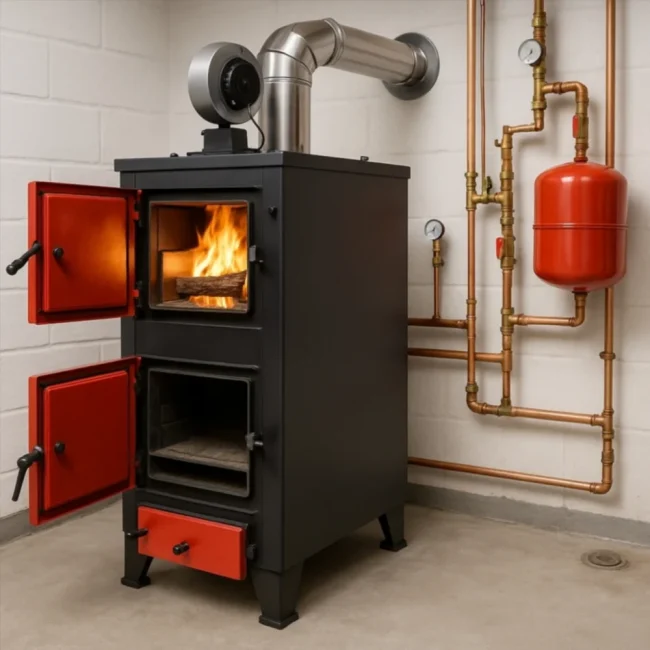
The pyrolysis boiler furnace consists of two main chambers:
- Loading chamber (first chamber):
Fuel (wood, briquettes, or coal) is loaded into the furnace. This is where the initial heating and decomposition of the fuel into pyrolysis gas and carbon residue occurs. A very small amount of air is supplied—just enough to heat the wood to decomposition temperature.
- Afterburning chamber (second chamber):
Secondary air is supplied to this zone, where pyrolysis gases ignite and burn at temperatures up to 1200°C. This is where the bulk of the heat is released and transferred to the heat exchanger.
Additionally, the boiler may include:
- Grate (often replaced with ceramic or fireclay blocks);
- Ash pan;
- Exhaust fan or blower;
- Heat exchanger (water circuit);
- Air supply control system;
- Automatic temperature control.
The operating principle of a pyrolysis boiler
- Dry fuel is placed into the loading chamber.
- Primary ignition causes the fuel to heat up and the release of pyrolysis gas to begin.
- The gases rise or fall into the secondary chamber (depending on the design), where they ignite when secondary air is supplied.
- The released heat is transferred to the heat exchanger and then to the heating system.
- The residues (in the form of ash) are removed after a complete combustion cycle.
Advantages of a pyrolysis furnace
1. High efficiency (up to 85–90%)
Due to two-stage combustion and efficient use of fuel energy, pyrolysis boilers are considered to be among the most economical.
2. Long burning
On one load of firewood, the boiler can operate from 6 to 12 hours, and in some models - up to a day, without the need to add fuel.
3. Low emissions
The gases are burned almost completely, reducing emissions of carbon monoxide, soot, and other harmful substances. This makes pyrolysis heating more environmentally friendly.
4. Less ash and soot
The stoves require cleaning less frequently than conventional solid fuel units.
5. Possibility of automation
Many modern pyrolysis boilers are equipped with electronic controllers that automatically regulate air supply, temperature, and operate pumps.
Disadvantages and limitations
1. Fuel requirements
The stove requires dry fuel with a moisture content of no more than 20%. Wet wood decomposes poorly and does not produce the required amount of gas.
2. High cost
Pyrolysis boilers are more expensive than conventional ones, especially those with automatic controls and a protection system.
3. Complexity of design
Installation, adjustment and maintenance require a qualified approach.
4. Chimney requirements
A chimney with good draft and heat-resistant insulation that can withstand high temperatures is required.
What fuel to use
The ideal fuels are:
- Dry firewood (deciduous trees - oak, hornbeam, ash);
- Fuel briquettes;
- Pellets (if provided by the design);
- Large charcoal (in some models).
The use of waste, plastics, raw wood, and construction debris can lead to clogging of the afterburner chamber, reduced efficiency, and even accidents.
Installing a pyrolysis boiler: what is important to consider
1. Installation location
The boiler must be installed in a separate room - a boiler room with ventilation and compliance with all fire safety requirements.
2. Foundation
The base under the boiler must be made of non-combustible materials (concrete slab, tiles).
3. Connection to the heating system
Typically, a pyrolysis boiler operates in conjunction with a buffer tank (heat accumulator), which accumulates heat and allows for more flexible regulation of the temperature in the system.
4. Chimney
The material is stainless steel or ceramic. The height and diameter are individually selected based on the boiler model and draft requirements.
5. Security system
A check valve, safety group, thermostatic mixing valve (to protect against cold return), and expansion tank are required.
Operating tips
- Load only well-dried firewood.
- Do not overload the firebox to avoid disrupting the pyrolysis process.
- Clean the afterburner chamber and chimney at least once a month during the heating season.
- Monitor the operation of the automation, especially if there is a heat accumulator.
- Check the tightness of the doors and seals.
Features of winter operation
In winter, the boiler should operate continuously using a heat accumulator. This allows:
- Avoid sudden temperature changes;
- Increase the time between downloads;
- Reduce the amount of condensate in the chimney;
- Maintain uniform heat in all rooms.
It's important to keep in mind that if the system stops (for example, during a power outage), freezing may occur. Therefore, it is recommended to use backup power sources (for example, a UPS for the circulation pump).
DIY Pyrolysis Boiler Furnace: Is It Worth It?
Some DIYers try to build their own pyrolysis oven. It's possible, but it requires:
- Experimental welding;
- Understanding the thermodynamics of processes;
- Ability to accurately calculate camera geometry;
- Use of heat-resistant materials.
Without these factors, a homemade boiler can be ineffective, dangerous, and short-lived. Building a stove without an adequate air supply and exhaust system is especially dangerous.
Conclusion
A pyrolysis boiler furnace is a modern solution for economical and efficient heating of a private home. Thanks to two-stage fuel combustion, it provides high heat output with minimal costs and environmental impact. Despite its higher cost and some limitations, a pyrolysis boiler is an investment in comfort, reliability, and durability.
With proper installation, equipment selection, and compliance with operating conditions, a pyrolysis furnace can become an excellent alternative to gas or electric heating, especially in areas without a centralized energy supply.