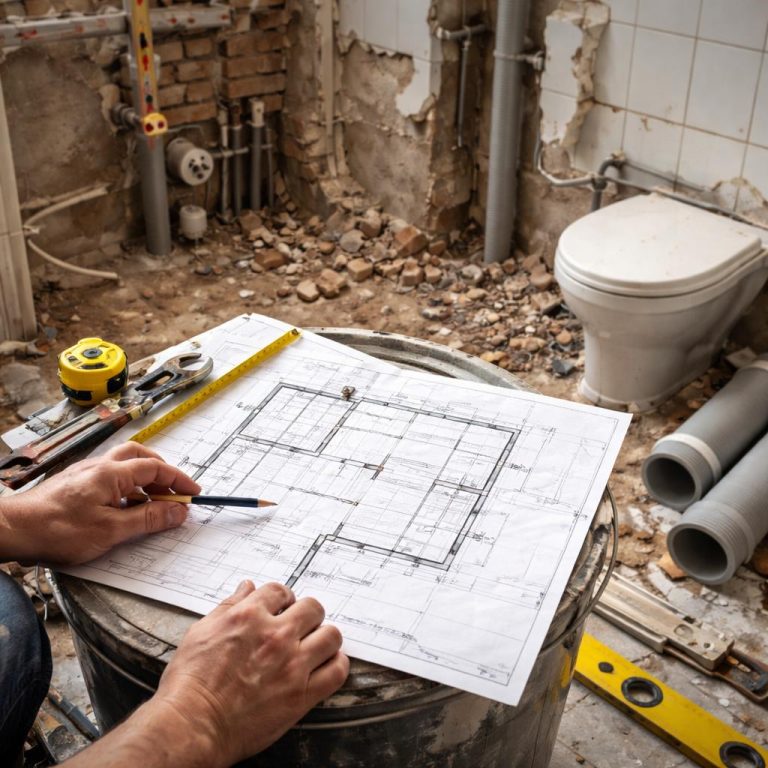
Bathroom remodeling almost always begins with a desire to make the space more convenient: eliminate cramped spaces, logically arrange plumbing fixtures, add a shower, storage space, or a washing machine. At this stage, ideas seem simple and obvious, especially if you look at modern interiors and successful examples of other renovations.
In practice, most difficulties arise even before work begins. That's why turnkey bathroom renovations begin with an analysis of the layout and engineering constraints. This approach allows for an immediate understanding of which solutions are truly feasible, and which will require significant compromises or prove impossible.
Let's take a look further, What bathroom remodeling ideas most often run into limitations?, why this happens and what is important to consider even at the stage of discussing future repairs.
- Why bathroom remodeling is a high-risk area
- Idea #1: Expand the bathroom by using the hallway or kitchen
- Why does it arise?
- What is the limitation?
- What is often overlooked
- Idea #2: Completely relocate the toilet or riser
- Why does it arise?
- What is the limitation?
- Reality
- Idea #3: A shower anywhere in the room
- Why does it arise?
- What is the limitation?
- Typical mistake
- Idea #4: A combined bathroom without compromise
- Why does it arise?
- What is the limitation?
- Pitfall
- Idea #5: Remove all boxes and hide the utilities
- Why does it arise?
- What is the limitation?
- Result
- Idea #6: Moving the washing machine to a more convenient location
- Why does it arise?
- What is the limitation?
- A common problem
- Idea #7: Completely eliminate thresholds and drops
- Why does it arise?
- What is the limitation?
- Possible solutions
- Idea #8: Move the door for beauty's sake
- Why does it arise?
- What is the limitation?
- Idea #9: Maximize the space in a small bathroom
- Why does it arise?
- What is the limitation?
- Reality
- Idea #10: Create a "new building" look in an older building
- Why does it arise?
- What is the limitation?
- Why remodeling requires planning before starting renovations
- How to approach remodeling wisely
- Result
Why bathroom remodeling is a high-risk area
Unlike living rooms, bathrooms are tightly connected to utility systems. Here, the following converge:
- water and sewer risers;
- ventilation ducts;
- wet area requirements;
- access to communications.
Any relocation of plumbing fixtures automatically affects not only comfort, but also technical feasibility, safety, and legality.
Idea #1: Expand the bathroom by using the hallway or kitchen
Why does it arise?
The hallway seems "empty" and not as valuable in terms of space, and the kitchen sometimes looks too big compared to the bathroom.
What is the limitation?
- The bathroom cannot be expanded at the expense of living spaces.
- Expansion into the kitchen is only possible under certain conditions and not in all homes.
- A threshold or floor difference between the dry and wet zones (or alternative solutions) must be maintained.
What is often overlooked
Even if the area formally allows, problems arise with ventilation, sewer slopes, and door placement.
Idea #2: Completely relocate the toilet or riser
Why does it arise?
I would like to change the layout, free up a wall, or create a symmetrical interior.
What is the limitation?
- The sewer system operates by gravity, and the slope cannot be “cheated”.
- The further the toilet is from the riser, the higher the floor rises and the higher the risk of blockages.
- Risers cannot be moved arbitrarily.
Reality
Most often, small shifts are acceptable, but not radical transfers “to another corner.”
Idea #3: A shower anywhere in the room
Why does it arise?
A floor-level shower seems like a versatile and compact solution.
What is the limitation?
- Space is required for the ramp and ramps.
- The ceiling height is not sufficient everywhere.
- Sometimes it is impossible to ensure proper drainage without raising the floor.
Typical mistake
The decision is made based on the picture, and the technical conditions are determined after dismantling.
Idea #4: A combined bathroom without compromise
Why does it arise?
Combining the toilet and bathroom seems like a logical way to increase space.
What is the limitation?
- After unification, the space needs to be zoned correctly.
- The load on ventilation increases.
- It is not always possible to conveniently place all the plumbing fixtures without conflicts along the passages.
Pitfall
Formally, the area became larger, but it became less convenient to use due to poor layout.
Idea #5: Remove all boxes and hide the utilities
Why does it arise?
The boxes visually “eat up” the space and spoil the minimalist interior.
What is the limitation?
- Access to risers and connections is required.
- Inspection hatches cannot be completely ruled out.
- Some pipes cannot be sealed tightly.
Result
Boxes can be optimized, but not always removed completely.
Idea #6: Moving the washing machine to a more convenient location
Why does it arise?
You want to free up your kitchen or integrate appliances into your bathroom interior.
What is the limitation?
- Water, sewerage and electricity are needed.
- Maintenance clearances are important.
- The hatch must open freely.
A common problem
The car technically fits, but it's inconvenient to use.
Idea #7: Completely eliminate thresholds and drops
Why does it arise?
A level floor looks modern and neat.
What is the limitation?
- Leak protection requirements.
- The need to localize water in an emergency.
- Structural features of ceilings.
Possible solutions
Alternative technologies are used, but they must be thought out in advance.
Idea #8: Move the door for beauty's sake
Why does it arise?
You want symmetry, a beautiful axis or convenient opening.
What is the limitation?
- Load-bearing walls.
- Ventilation shafts.
- Conflicts with furniture and plumbing.
Idea #9: Maximize the space in a small bathroom
Why does it arise?
There is a desire to place everything: a shower, a bath, a washing machine, a dryer, cabinets.
What is the limitation?
- Minimal passages.
- Ease of use.
- Equipment maintenance requirements.
Reality
Some functions have to be removed or simplified.
Idea #10: Create a "new building" look in an older building
Why does it arise?
The reference point is taken from modern interiors.
What is the limitation?
- Old ceilings.
- Worn out communications.
- Limited load capacity.
Why remodeling requires planning before starting renovations
The main mistake is to start dismantling without understanding the final scheme.
Redevelopment:
- affects the cost;
- determines the sequence of works;
- sets the boundaries for all other decisions.
Making changes on the fly is almost always more expensive and complicated.
How to approach remodeling wisely
- Lock in the current layout.
- Formulate desires without a filter.
- Check each idea for technical feasibility.
- Cut off what creates more problems than benefits.
- Fix the final version before the start of work.
Result
Remodeling a bathroom isn't a matter of "I want it or I don't want it," but rather a balance between desires, design, and engineering. Most restrictions arise not because "it's not allowed," but because there are physical and technical limits, which cannot be ignored without consequences.
The sooner these limits become clear, the smoother the renovation process will be and the closer the outcome will be to expectations, rather than forced compromises at the last minute.