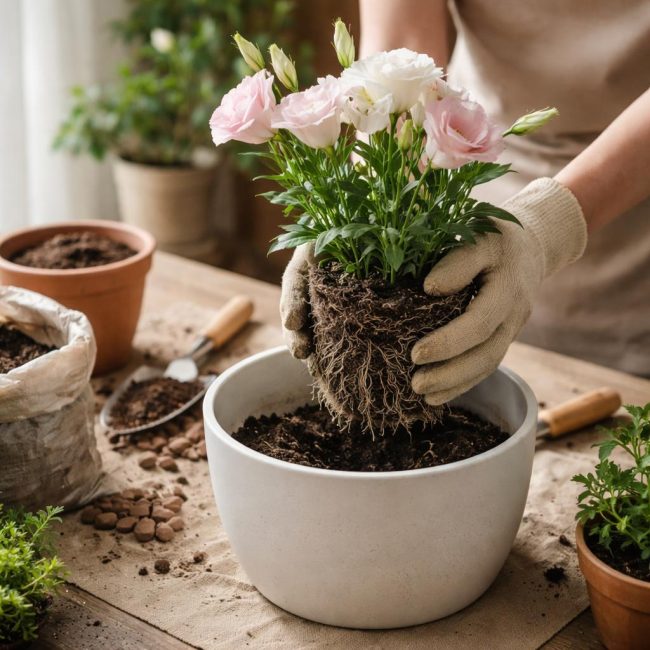
Lisianthus (Eustoma) is a plant with a reputation for being capricious, and in many ways, it's deserved. The main difficulties arise not from overall care, but rather at stages when the balance between the roots, the substrate, and the microclimate is disrupted. Repotting is precisely such a moment: if handled incorrectly, the plant will suffer for a long time or even stop growing altogether; if handled carefully, it will barely respond to changing conditions. Understanding what happens to Lisianthus during repotting allows you to avoid common mistakes and create conditions for stable growth in advance.
- Features of the root system of eustoma
- When a transplant is really necessary
- Optimal timing for replanting into a pot
- Choosing a pot: volume, shape and material
- Substrate requirements
- Preparing a plant for transplantation
- Technique for transplanting without damaging the roots
- Watering after transplantation and the first days of adaptation
- Microclimate after transplantation
- Fertilizing: When and Why to Resume Feeding
- Common mistakes when transplanting eustoma
- How does replanting affect flowering?
- Transplantation as an element of long-term care
Features of the root system of eustoma
The eustoma's root system is superficial and relatively fragile. The majority of the fine, absorbing roots are located in the upper soil layer, and the central root is weakly developed. This makes the plant sensitive to any mechanical damage and sudden changes in the substrate structure.
Unlike many ornamental plants, eustoma does not tolerate soil disruption well. Even partial root exposure leads to a temporary loss of turgor, delayed flowering, or bud drop. For this reason, repotting is not so much a "soil change" as a careful transfer of the plant to a larger space while maintaining the familiar environment around the roots.
When a transplant is really necessary
Eustoma doesn't like frequent interventions, so repotting is only performed when absolutely necessary. There are several common situations.
The first is overgrowing the pot. If the roots have filled the entire space and begun to form a dense ring around the walls, the plant stops growing foliage, dries out more quickly, and absorbs nutrients less effectively. The second is substrate depletion. Even with regular fertilizing, the soil structure deteriorates over time, compacting and impairing aeration. The third is repotting after purchase or after growing seedlings, when the plant was initially in transport or temporary soil.
In all other cases, eustoma develops more stably without transplantation than with it.
Optimal timing for replanting into a pot
The most favorable period is the phase of active vegetative growth, before the plant enters full bloom. For seedlings, this is when 3–4 true leaves have formed; for mature plants, it's when growth begins after a period of relative dormancy.
Repotting during budding or flowering is only permitted if absolutely necessary. During this period, the plant redistributes resources toward reproductive organs, and any intervention is perceived as stress, potentially halting the development of flower stalks.
Choosing a pot: volume, shape and material
Pot size plays a key role. Too small a pot restricts root growth, while too large a pot causes the soil to become waterlogged. The ideal size is 2–3 cm larger than the previous container. Eustoma prefers gradual increases in volume rather than sudden increases.
The pot should be stable and have a clear drainage hole. Depth is more important than width: for the same volume, it's better to choose a taller container than a wider one. This reduces the risk of overwatering the bottom layer.
The material is a secondary consideration. Plastic retains moisture longer and is more forgiving of minor watering errors, while ceramic provides better aeration but requires more precise humidity control. Both options are acceptable for eustoma, provided the substrate is selected correctly.
Substrate requirements
The soil for eustoma should be light, breathable, and moisture-retentive. Mixtures that are too dense retain water at the roots, while those that are too loose dry out quickly, which is critical for the shallow root system.
In practice, slightly acidic substrates based on high-moor peat with the addition of perlite or vermiculite work well. The presence of drainage components is important not so much for water drainage as for maintaining a stable structure during watering.
Using heavy garden soils without structural additives is not recommended: when replanting eustoma into such a substrate, the plant often stops growing for several weeks.
Preparing a plant for transplantation
Water the eustoma moderately the day before repotting. A moist, but not over-watered, root ball is easier to remove and less likely to crumble. Dry soil will crumble, damaging the delicate roots, while wet soil will deform and deprive the root system of air.
Immediately before repotting, inspect the plant. Remove dried leaves and assess the condition of the root collar. Any signs of rot or an unpleasant odor should be considered before proceeding and adjusting the growing conditions first.
Technique for transplanting without damaging the roots
Transplanting eustoma is done by transshipment. The plant is carefully lifted, holding the base of the stem, and transferred to a prepared pot with a layer of drainage and a small amount of fresh potting soil.
The root ball is not loosened or cleared of old soil. The space between the root ball and the sides of the new pot is filled with fresh soil, lightly compacting it with your fingers but without applying pressure. The root collar should remain at the same level as before; planting too deep often leads to rot at the base of the stem.
Watering after transplantation and the first days of adaptation
Immediately after repotting, water the eustoma moderately, around the edge of the pot. The purpose of this first watering is to bind the new soil to the root ball, not to completely saturate it with moisture. Excessive watering at this point increases the risk of fungal problems.
For the first 5–7 days, keep the plant in diffused light, avoiding direct sunlight and sudden temperature changes. During this period, the root system adapts to its new volume, and any additional stress will slow down the process.
Microclimate after transplantation
Eustoma is sensitive to the combination of high temperatures and wet soil. After repotting, it's especially important to ensure good ventilation without drafts. The optimal temperature is moderate, without overheating the windowsill.
High air humidity is better tolerated than excess soil moisture. In dry air, short-term ambient humidification is acceptable, but foliar spraying is not recommended while the plant is adapting.
Fertilizing: When and Why to Resume Feeding
After repotting, fertilizing is temporarily stopped. The fresh substrate contains sufficient nutrients, but the roots are not yet ready to actively absorb them. Resuming feeding is usually justified after 10–14 days, when new growth becomes visible.
Use weak solutions of complex fertilizers, avoiding high nitrogen concentrations. Abrupt stimulation of green mass at this time often leads to shoot elongation and reduced plant stability.
Common mistakes when transplanting eustoma
In practice, problems most often arise from over-sized pots, damaged soil, and improper watering. Another common mistake is choosing a potting medium that's too heavy or, conversely, one that's sterile and lacking structure.
Another risk factor is transplanting "just in case," without real need. Eustoma values stability, and any intervention must have a clear rationale.
How does replanting affect flowering?
With proper technique, repotting has virtually no effect on flowering time. In some cases, a brief pause in bud growth is observed, but this is compensated for by more vigorous plant development later on.
If the repotting is performed incorrectly, flowering may shift or become less abundant. This is not due to the procedure itself, but to an imbalance between the roots and the above-ground part.
Transplantation as an element of long-term care
When grown in pots, repotting eustoma isn't a one-time event, but rather part of an overall growing strategy. It allows you to monitor the development of the root system, the quality of the substrate, and the overall health of the plant without resorting to drastic measures.
With careful handling, repotting becomes almost unnoticeable for the eustoma itself. The plant retains its decorative appeal, grows steadily, and responds predictably to subsequent care, which is especially important in residential settings or enclosed spaces.