Protecting foundations from moisture is a key task in the construction of any building, from private homes to industrial facilities. Waterproofing failures lead to dampness in rooms, corrosion of reinforcement, deterioration of the concrete structure, and costly repairs. Therefore, it is essential to consider a comprehensive set of water protection measures at the design stage. Plastic sheet piling, a modern material that helps ensure long-lasting foundation waterproofing and improves the structure's resistance to moisture and groundwater, is increasingly being used today.
- Why does a foundation need reliable waterproofing?
- What is plastic sheet piling and how does it differ from other materials?
- The use of plastic sheet piles in waterproofing foundations
- Forming a protective contour around the foundation
- Protection against erosion and undermining of the foundation
- Combined solutions for the construction of basements and ground floors
- Technology of installation of sheet pile profiles
- Advantages of using plastic sheet piles for foundations
- When is the best time to use plastic sheet piling?
- Conclusion
Why does a foundation need reliable waterproofing?
Foundations are constantly exposed to external factors: precipitation, groundwater, seasonal soil freezing, and changes in soil density and mobility. Water penetrates the micropores of concrete and expands upon freezing, causing cracking. Even with traditional waterproofing materials (bitumen mastics, rolled membranes), moisture can find a weak spot—for example, at an abutment or when the layer's seal is compromised.
An additional problem is that waterproofing applied to the foundation surface does not protect the soil itself from erosion. This results in voids, subsidence, and damage to the foundation's integrity. Using plastic sheet piles accomplishes two goals simultaneously: it strengthens the soil and creates a physical barrier to water.
What is plastic sheet piling and how does it differ from other materials?
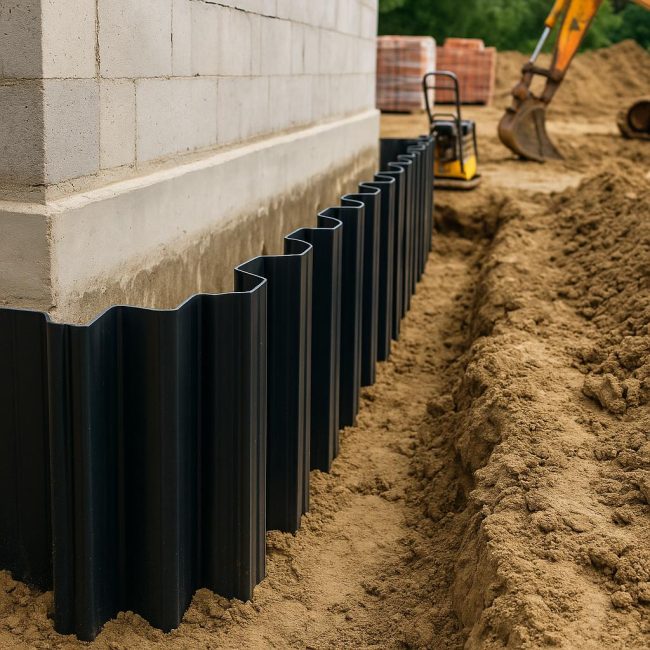
Plastic sheet piles are specially shaped polymer profiles that, when joined, form a watertight sheet pile wall. They are made of PVC or other high-strength polymers. The interlocking connection between the elements creates a durable structure capable of withstanding water and soil pressure.
Compared to metal and wooden tongue and groove systems, plastic has a number of significant advantages:
- High corrosion resistance — does not rust, does not rot, and is not susceptible to aggressive environments.
- Easy and convenient installation - easy to transport, does not require heavy equipment at small sites.
- Tightness of connections - is securely fixed, forming a waterproof wall.
- Durability — service life exceeds 50 years without the need for maintenance.
The use of plastic sheet piles in waterproofing foundations
The use of sheet piles is especially important when constructing a structure on difficult soils, near bodies of water, or in areas with high groundwater levels. In practice, there are several options for using sheet piles:
Forming a protective contour around the foundation
Sheet piles are driven along the perimeter of the future structure, forming a reliable barrier that prevents groundwater from penetrating the foundation walls. This structure acts as a screen and significantly reduces the load on the waterproofing layer.
Protection against erosion and undermining of the foundation
A sheet pile wall prevents soil movement and erosion at the foundation base. This prevents subsidence and distortions in the building's geometry, which is especially important for buildings on slopes and near water.
Combined solutions for the construction of basements and ground floors
When combined with rolled and coated waterproofing membranes, plastic sheet piling creates a multi-layered protection system. It reduces hydrostatic pressure on the walls and prevents capillary water absorption.
Technology of installation of sheet pile profiles
The installation of plastic sheet piles depends on the type of soil and the complexity of the object, but the general principle remains the same:
- Preparing the area — clearing the site, leveling, marking the installation area.
- Sheet piling — the elements are installed into the ground using a vibratory pile driver, hydro-flushing, or manually (on small objects).
- Connecting locks — the profiles are connected to each other, forming a solid wall.
- Strengthening the structure (if necessary) - anchors, spacers or additional elements are used.
- Final sealing and tightness control — the tightness of the joints is checked and sealing is carried out if necessary.
It's important to consider the soil's geological characteristics, groundwater levels, and the load on the sheet pile structure. Installation errors can negate the material's benefits, so it's recommended to engage specialists.
Advantages of using plastic sheet piles for foundations
The use of sheet piles not only provides reliable waterproofing, but also additional benefits:
- Reducing the cost of foundation repair and maintenance
By preventing moisture from coming into contact with the concrete structure, its service life is extended. - Eco-friendliness
Polymer profiles are safe, do not emit harmful substances, and are suitable for use in water protection zones. - Increasing the strength and stability of the structure
Strengthening the soil reduces the risk of deformation and damage. - Versatility of application
Suitable for both new construction and renovation or strengthening of existing buildings.
When is the best time to use plastic sheet piling?
The material is especially recommended in cases of:
- construction on a site prone to flooding;
- proximity to rivers, lakes, marshy areas;
- high groundwater level;
- construction of underground structures: parking lots, basements, technical rooms;
- the need to restore damaged foundations.
Conclusion
Foundation waterproofing is a crucial stage of construction, determining the longevity of the entire building. Plastic sheet piling has proven itself as an effective moisture barrier and soil reinforcement element. It combines resistance to external influences, watertightness, and durability, providing the foundation with reliable protection for years to come. In the face of a changing climate and increasing demands for environmentally friendly materials, such solutions are becoming not only relevant but also essential.