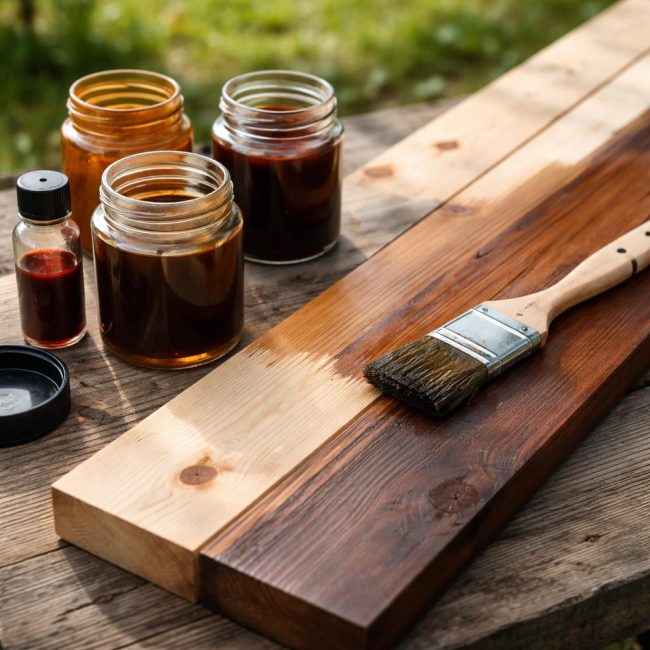
The main practical question that a homeowner faces when working with water-based wood preservatives is simple:Why does the wood finish look different than expected after adding dye, and what does this depend on?It's important to understand this upfront—not for the sake of "theoretical beauty," but to understand what effects are possible and what practical limitations such a solution has.
Water-based wood stains are often perceived as a neutral base into which the desired color can be "mixed." Expectations are logical: there's a colorless or lightly tinted product, and there's a universal colorant—meaning the result should be manageable. But this is where the gap between expectation and reality arises.
- Why are the colors in the can and the colors on the wood different?
- How does the type of dye affect the predictability of the result?
- Why does color saturation increase disproportionately?
- How wood species changes how dye works
- Why are single layers and multiple layers not the same thing?
- Where errors in expectations are especially noticeable
- Typical sources of frustration
- Why there is no universal “correct” shade
- How to look at the result more soberly
Why are the colors in the can and the colors on the wood different?
Water-based stains are not paints in the traditional sense. They don't form a continuous, opaque film, but rather work deep within the material, partially absorbing and partially bonding to the top layer of wood. Therefore, the color, which appears uniform in its liquid state, begins to "interact" with the wood itself after application.
Wood isn't neutral. It has its own tone, density, grain direction, and different absorption rates in the early and late growth rings. When exposed to such a medium, dye ceases to be an abstract pigment and begins to conform to the structure of the substrate. This is why the same dye applied to pine, larch, and spruce produces visually different shades—even with the same colorant concentration.
How does the type of dye affect the predictability of the result?
Not every dye is equally compatible with water-based protective compounds. It's not the color that's important, but rather the way the pigment itself works. Some dyes remain primarily in the surface layer, others penetrate deeper into the pores, and still others tend to spread unevenly when drying.
A water-based dye enhances this effect: as the water evaporates, the pigment concentration changes during the drying process. Visually, this can manifest as a color enhancement, the appearance of darker areas, or, conversely, a washout of the shade in highly absorbent areas. Therefore, even the "right" compatible dye does not guarantee a linear result.
Why does color saturation increase disproportionately?
A common expectation is that the more dye, the darker the final color. In practice, after a certain threshold, a different effect occurs: the color doesn't so much darken as it loses transparency and depth. The wood grain becomes less visible, and the finish begins to look like a weak paint rather than a stain.
This is because water-based protective compounds are designed to strike a certain balance between transparency and protection. Excessive pigment disrupts this balance: some of the dye stops properly bonding to the structure and begins to act as visual "noise." As a result, the surface may appear dirty or uneven, even if the compound was applied carefully.
How wood species changes how dye works
Even within a single section of a house, wood is rarely completely uniform. Variations in humidity, areas with higher resin content, and knots all affect how the stain will perform in the protective coating.
Softwoods typically produce a warmer, richer tone, but they also emphasize unevenness. Denser woods appear more subdued, but can reduce some of the vibrancy. Ultimately, the final color is always the sum of three factors: the composition of the stain, the type of dye, and the specific wood to which it's applied.
Why are single layers and multiple layers not the same thing?
Even without changing the dye concentration, the visual effect of the coating changes with each new layer. The first layer interacts primarily with the wood, while the second layer interacts with the previously impregnated surface. The color begins to layer not only in intensity but also in the way it reflects light.
Because of this, the hue can become cooler or warmer, denser, or, conversely, visually deeper. This effect is often perceived as "unpredictable," although in fact it is predictable: it's not the color itself that changes, but the optical behavior of the surface.
Where errors in expectations are especially noticeable
Color distortions are more visible on vertical surfaces, facades, and fences than on horizontal surfaces. The reason is simple: light falls at a different angle, and the human eye is better at detecting tonal variations in vertical planes.
Furthermore, outdoors there's the added factor of natural light, which changes throughout the day. The same color can appear as three different shades in the morning, afternoon, and evening. This isn't a problem with the dye itself—it's a property of translucent protective coatings in general.
Typical sources of frustration
Most often, a negative result is not due to the dye itself, but to the expectation of a "coloring effect" similar to enamel or opaque paint. Water-based stains work differently: they highlight the material rather than cover it. When this isn't taken into account, any deviation is perceived as a mistake.
Another source of confusion is comparisons with samples on packaging or screens. These images almost always show an average or idealized result that doesn't take into account the specific wood, lighting conditions, or number of layers.
Why there is no universal “correct” shade
Trying to find "the perfect" color for a water-based stain often leads to disappointment precisely because the result cannot be standardized. Even with identical starting components, the final surface appearance is formed on the object, not in the can.
This isn't a flaw in the technology, but rather its peculiarity. Translucent protective coatings are prized for their liveliness and variability, for the fact that wood remains wood, not just a painted surface. The dye in such a composition isn't a tool for strict control, but a way to shift the overall tone in the desired direction.
How to look at the result more soberly
If you view stain not as a means of "getting a precise color," but as a tool for customizing the visual character of the wood, many questions disappear. It's not about matching a sample, but about creating a harmonious shade that works in a specific space of the house or property.
This approach shifts focus: instead of searching for the perfect formula, we gain an understanding of the material's limitations and capabilities. And it is this understanding that ultimately yields a more consistent and predictable result—not based on numbers and color names, but on the actual visual effect on the finished surface.