Organizing an autonomous water supply for a summer cottage or private home increasingly involves the use of a well and pumping equipment. These systems provide a stable water supply and operate automatically—until a failure occurs. One common problem is when the well pump fails to shut off. This can lead to serious consequences: equipment failure, excessive energy consumption, automation failure, and, in the worst case, the complete collapse of the water supply system.
In this article, we'll take a detailed look at the possible reasons why a pump won't shut off, how to identify the source of the problem, the potential consequences of ignoring the symptoms, and what to do to fix the situation.
- How does a well pump work?
- The main reasons why the pump does not turn off
- Pressure relay malfunction
- The hydraulic accumulator is damaged or leaking.
- Water leak in the system
- The check valve is broken or stuck
- Electrical faults
- The water treatment system creates excess flow
- Consequences of continuous pump operation
- Diagnostic procedure
- How to avoid problems in the future
- When to contact a specialist
- Conclusion
How does a well pump work?
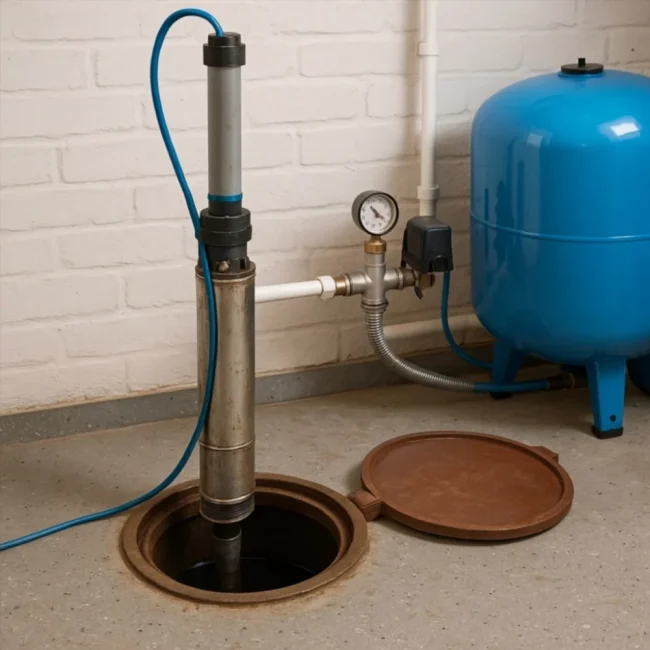
To understand why a pump may not shut off, it's important to understand how it works. Well pumps (usually submersible) are designed to pump water from an underground aquifer into a home. The pump is controlled by an automatic system, including:
- pressure relay;
- hydraulic accumulator;
- water level sensors;
- dry running protection blocks.
When the system pressure drops below a set value, the relay signals the pump to turn on. Once the desired pressure is reached or the storage tank is full, the relay turns the pump off. If this cycle is disrupted, the pump may run continuously.
The main reasons why the pump does not turn off
Pressure relay malfunction
The pressure switch is the main component of the system, responsible for turning the pump on and off. If it sticks, corrodes, becomes dirty, or is improperly adjusted, the pump will not receive the command to turn off.
Signs:
- the pressure in the system is higher than normal, but the pump continues to work;
- there is no relay click when the set pressure is reached.
What to do:
- check and clean the relay contacts;
- adjust the on/off settings;
- replace the relay if it is faulty.
The hydraulic accumulator is damaged or leaking.
The hydraulic accumulator stores water and maintains stable pressure. If the tank's membrane ruptures or the required air pressure is absent, the pump will run continuously because the system cannot reach the required pressure.
Signs:
- frequent operation of the pump with low water flow;
- the air pressure in an empty tank is below normal (less than 1.5 atm);
- there is no water "buffer" when opening the tap.
What to do:
- measure and pump up the pressure in the tank;
- If the membrane is damaged, replace it or the tank itself.
Water leak in the system
Even a minor leak in the system can cause the pump to run constantly. Water drains, the pressure drops, and the pump turns on.
Signs:
- uneven pressure drop on the pressure gauge;
- wet areas or leaks in the pipeline;
- The pump turns on when the taps are closed.
What to do:
- carefully check all connections, fittings, taps and drains;
- eliminate even the slightest leaks;
- check the check valve at the well.
The check valve is broken or stuck
The check valve maintains pressure in the system, preventing water from flowing back into the well. If it is damaged, water flows backward, and the pump turns on again.
Signs:
- noise of water backflow in the pipe after the pump is turned off;
- the pressure drops quickly when the pump is turned off;
- the pump turns on with minimal delay.
What to do:
- remove and check the check valve;
- replace if defective.
Electrical faults
Damaged wiring, stuck contactors, or faulty starters can result in constant power being supplied to the pump.
Signs:
- the pump works even when the relay is disconnected;
- burning smell in the dashboard;
- spontaneous inclusions.
What to do:
- turn off the power;
- check and replace faulty electrical circuit elements.
The water treatment system creates excess flow
Some filters or reverse osmosis systems may create a constant draw of water for flushing or pressure maintenance.
Signs:
- constant small discharge of water;
- The pump switches off only when all lines are completely blocked.
What to do:
- check filters and water purification systems;
- Install shut-off valves if necessary.
Consequences of continuous pump operation
Ignoring the situation can lead to serious consequences:
- overheating and failure of the pump;
- damage to the accumulator membrane;
- increase in energy costs;
- reduction in the service life of automation;
- burning of relay contacts;
- flooding of premises due to pipeline depressurization.
In addition, if the pump runs dry, that is, without water, this can lead to its immediate failure, especially if there is no dry-running protection.
Diagnostic procedure
To find the source of the problem, follow these steps:
- Disconnect the pump from the power supply.
- Check the system pressure on the pressure gauge.
- Inspect the pressure switch and its wires.
- Check the air pressure in the accumulator.
- Look for leaks in the system.
- Check the check valve.
- Analyze the operation of water treatment systems.
- Test the pump in standalone mode.
How to avoid problems in the future
For uninterrupted operation of the pumping system, it is recommended:
- Conductquarterly maintenanceequipment.
- Check and add air to the tank every six months.
- Installdry-running protection relayand overloads.
- Usehigh-quality coarse filtersin front of the automatic machines.
- Monitor the stability of the power supply and install if necessarystabilizer.
When to contact a specialist
If the pump continues to run without stopping after completing all the steps described, it's worth contacting a professional. Some problems require extensive intervention in the electrical system, hydraulics, or the pump itself. This is especially important if:
- the well is deep and requires lifting the pump;
- no experience in handling relays and electrical equipment;
- The equipment is under warranty and any intervention will invalidate it.
Conclusion
A constantly running well pump is a warning sign that shouldn't be ignored. There could be many causes, from a simple water leak to serious problems with the automation or pump. Careful diagnostics, regular maintenance, and a competent approach will not only quickly resolve the issue but also prevent its recurrence. Water supply should be not only efficient but also safe—and it all starts with a properly functioning pump.