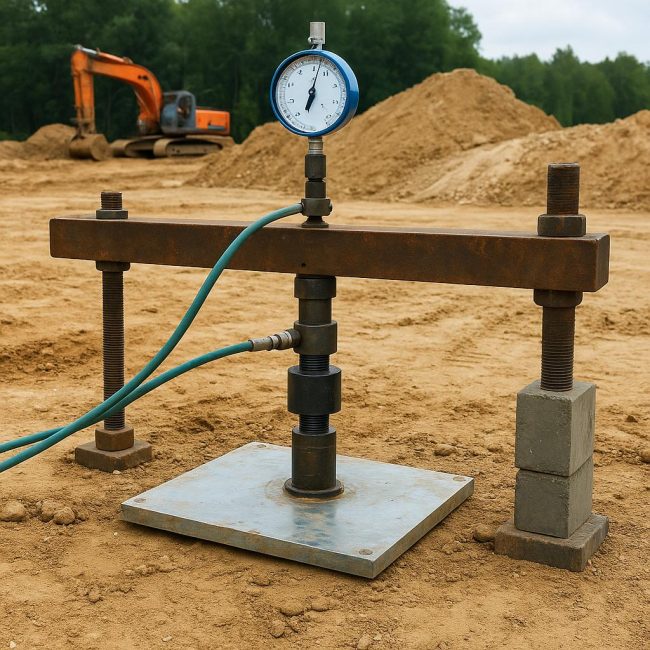
In construction, any structure, whether a residential building, an industrial structure, or a bridge, begins with the foundation. And the stronger the foundation, the longer and safer the structure will stand. Engineers know that laboratory analysis of soil samples alone is not enough, as the actual behavior of soil under load can differ significantly from the calculated one. This is why soil stamp testing, for example here, remains one of the most important methods of field surveys, providing reliable data for design and construction.
The essence of the method and its purpose
Soil stamp testing involves placing a special metal stamp of a specific area on the test site. A load simulating the pressure of the future structure is gradually applied to it. During the measurements, soil settlement is recorded, and a load-deformation relationship is then plotted.
The main goal of the method is to determine the actual bearing capacity and deformability of the foundation. This allows engineers to:
- calculate the optimal depth and type of foundation;
- predict the settlement of a building during operation;
- assess the homogeneity and stability of the soil massif;
- identify weak layers that may lead to uneven deformations.
Why laboratory data is insufficient
At first glance, it might seem that laboratory analysis of soil samples provides sufficient information. Indeed, it can determine moisture content, density, particle size distribution, internal friction angle, and other characteristics. However, there's a significant caveat: laboratory tests are always performed on samples extracted from the ground, meaning their natural structure and stress-strain state are compromised.
A pressure test, on the other hand, simulates the actual conditions under which a foundation operates under load. It reveals not only its strength properties but also how the soil behaves as a whole: how quickly and evenly it settles, how pressure is distributed across the layers, and whether critical subsidence occurs.
Types of stamp tests
In practice, several methods are used, differing both in the size of the stamp and in the nature of the loading:
- Static tests — the load is increased in stages, and the settlement is recorded at each stage. This method is the most accurate and widely used.
- Dynamic tests — the load is applied by impacts or vibrations. Used less frequently, in specific conditions.
- Large-scale testing - when the stamp has a large area (for example, 1 m²), which allows studying the behavior of the soil under heavy structures.
- Small-scale testing — useful for preliminary surveys, in limited areas, or for comparing the properties of different soils.
Significance for foundation design
The foundation is the most critical part of any building, and design errors are especially costly. Failure to take into account the actual soil properties can lead to:
- uneven settlement — leads to cracks in the walls and distortions;
- excessive drawdown - makes the operation of the building unsafe;
- destruction of load-bearing elements - if the bearing capacity of the foundation is insufficient.
Stamp testing avoids these problems. Engineers obtain data that is impossible to "guess" or derive solely from calculations. As a result, the most suitable foundation type—strip, slab, pile, or a combination—is selected, and its parameters are tailored to the actual site conditions.
Application in various construction industries
The method is in demand not only in housing and industrial construction, but also in infrastructure projects:
- Highways and airfields. Here it is important to know whether the foundation can withstand repeated dynamic loads from transport.
- Bridges and overpasses. The supports require reliable fastening, and any subsidence is unacceptable.
- Hydraulic structures. Dams and levees exert enormous pressure on the ground, and accurate calculations are critical to safety.
- Private construction. Even for a small cottage, testing can be beneficial—it helps avoid costly mistakes at the foundation stage.
Regulatory requirements
In Russia, stamp testing is regulated by SP (Standard Construction Standards) and GOST (State Standards). These documents define:
- the size and shape of the stamps (most often round or square);
- loading and settlement recording methods;
- permissible load application rates;
- procedure for processing results.
Compliance with standards ensures the accuracy and comparability of data, and therefore the reliability of future calculations.
Practical examples
History knows many cases where ignoring field tests resulted in serious problems:
- In residential areas built on loess soils without proper surveys, cracks and distortions began to appear after several years.
- At one industrial site, foundation settlement led to damage to columns and required costly reinforcement work.
- During road construction in swampy areas, the lack of stamping tests led to rapid failure of the pavement.
In all these cases, preliminary stamp tests would have avoided significant financial losses.
Modern trends
Automated settlement recording systems are being actively implemented today, making the method more accurate and convenient. The use of sensors, electronic levels, and digital recorders allows for the production of highly accurate graphs in real time. Furthermore, mobile systems are being developed to simplify work in confined spaces.
Conclusion
Soil pressure testing is not a formality, but a crucial stage of engineering surveys. It allows us to understand how the foundation will perform under load and ensure the foundation's reliability. Laboratory studies only provide part of the picture, while pressure testing complements it with real-world data, without which it is impossible to guarantee the safety and durability of a building.
Thus, it is safe to say that the strength and stability of any structure begins not with concrete slabs or piles, but with a thorough inspection of what it stands on—with competent and timely stamp testing.