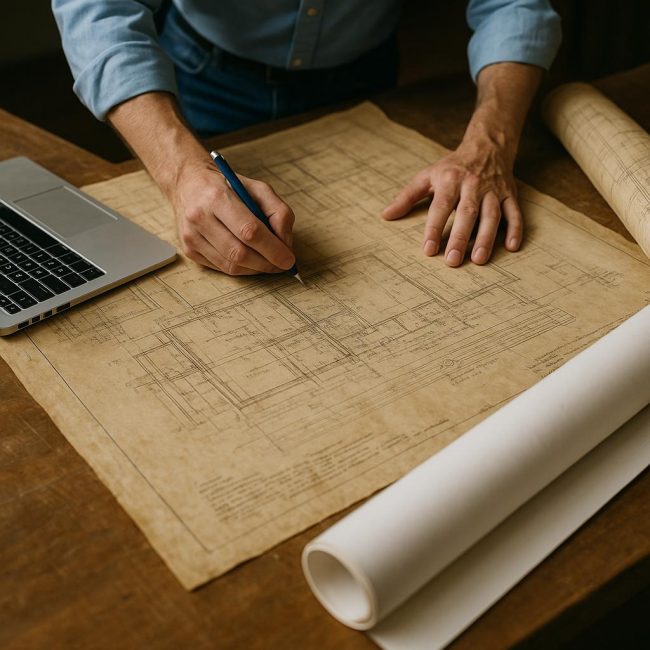
Many engineers and architects today work exclusively in a digital environment, where all drawings are stored in the cloud and changes are recorded automatically. Old paper plans seem like a relic of the past. However, these yellowed sheets of paper, often handwritten, still contain unique knowledge, precise data, and the experience of generations. They are not just a piece of history—they are a tool that can influence modern decisions, from building renovations to the implementation of new engineering systems.
This is why scanning projects in Moscow is becoming not only a technical but also a cultural undertaking. Hundreds of archives, design institutes, and private firms are digitizing old engineering materials to preserve accumulated experience and maintain the continuity of professional traditions. This process helps revive forgotten projects and use them as the basis for modern solutions.
- The historical value of engineering drawings
- Legal and technical significance of old projects
- The Threat of Loss: How Paper Ages
- Scanning as a form of preserving engineering heritage
- Integrating legacy data into modern projects
- Archives as part of intellectual capital
- How to avoid loss and errors during digitization
- When paper still matters
- Conclusion: Value that cannot be measured
The historical value of engineering drawings
Every old drawing is a witness to an era. It reveals how construction technologies evolved, what materials were used, and what solutions were considered progressive. For example, drawings from the mid-20th century can contain unique structural components that are now forgotten but could be useful in the restoration of historic buildings.
In some cases, such documents become indispensable sources of data for scientific research. Architects who restore buildings often seek out original plans to restore their appearance after losses or reconstructions. Without these old drawings, this becomes a nearly impossible task.
Legal and technical significance of old projects
Engineering documentation has not only historical but also legal value. Drawings of buildings, utilities, electrical systems, or ventilation systems may be needed decades later—for reconstruction, redevelopment, or expert assessments.
If the originals are lost, restoring precise dimensions, routes, and components becomes a costly and labor-intensive process. Such data is often used in legal disputes, copyright confirmation, or verification of an object's compliance with regulations.
Furthermore, during major renovations of 20th-century buildings, old plans often become the only source of information on load-bearing structures, which cannot be studied without destruction. In such cases, having digital copies of the plans is not just convenient, but also a guarantee of safety.
The Threat of Loss: How Paper Ages
The problem with preserving engineering archives is that paper doesn't last forever. Even under ideal conditions, drawings fade over time, break at the folds, lose contrast, and become illegible.
Moreover, the old inks and copying agents used in the 20th century are often unstable to light and humidity. The archives of design institutes, where rolls of plans have been stored for decades, gradually turn to dust. As a result, not only the specific document is lost, but also a piece of engineering history.
This is where digitalization technologies come to the rescue. Scanning allows for the capture of an exact image of a drawing, including its dimensions, format, and paper texture. Modern scanners provide high resolution, making it possible to see the smallest details—even down to the author's pencil marks.
Scanning as a form of preserving engineering heritage
The digitization process has long since ceased to be a simple copying process. Today, it's a complex process that includes document preparation, equipment calibration, subsequent image processing, and file organization.
First, specialists perform an inspection: they remove dust, smooth the sheet, and remove folds and old staples. Then, they scan it at high resolution to preserve the legibility of text and lines. Afterward, the digital file undergoes color correction, distortions are corrected, and the image is saved in several formats—from TIFF for archiving to PDF for everyday use.
As a result, the drawing is not only saved but also accessible in modern programs such as AutoCAD, Revit, or ArchiCAD. Using scans, you can create precise digital models, perform engineering calculations, or use the drawings as a base for designing new objects.
Integrating legacy data into modern projects
Digitized drawings are becoming an important element in the transition to digital construction. Engineers and architects are increasingly using old plans as the basis for creating BIM models—informational 3D representations of buildings.
For example, during the reconstruction of industrial complexes, old paper plans allow us to determine the initial parameters of supporting structures and networks, significantly simplifying subsequent work. Even if the facility has been modernized, the preserved documentation helps us understand its original logic and the interrelationships between systems.
This helps avoid errors, save time, and maintain engineering continuity—the link between the past and the future.
Archives as part of intellectual capital
A well-organized engineering archive is more than just a data repository; it's a strategic management tool. Companies that systematically digitize their documents gain access to a rich source of information for learning, analysis, and innovation.
Sometimes older projects contain solutions that were ahead of their time. Revisiting these materials helps uncover innovative ideas for modern challenges. Furthermore, archives allow us to track the evolution of project approaches within a company, which is important for shaping corporate culture and methodology.
How to avoid loss and errors during digitization
Despite its apparent simplicity, scanning requires precision and professionalism. Errors at this stage can lead to dimensional distortion or loss of information. For example, if the sheet is too large and is being scanned in sections, the fragments must be precisely aligned without any misalignment.
Choosing the right storage format is also important. Uncompressed formats (TIFF, PNG) are used for long-term archiving, while PDF or JPEG are suitable for everyday access. All files should be accompanied by metadata: project title, date, author, page number, and content description.
A good practice is to duplicate archives across multiple drives and store backups in cloud systems. This reduces the risk of data loss in the event of accidents, fires, or technical failures.
When paper still matters
Despite digitalization, it's not worth completely abandoning paper drawings. Paper has advantages for archival storage: under the right conditions, its lifespan can exceed a hundred years. Furthermore, the physical original always remains the primary source, confirming the document's authenticity.
The optimal approach is to create hybrid archives, where originals are preserved in special conditions and digital copies are used for everyday work. This balance ensures both preservation and ease of access.
Conclusion: Value that cannot be measured
Old engineering drawings are more than just paper. They are the result of human labor, intellect, and experience accumulated over decades. They help us understand the logic of technological development, serve as a foundation for new solutions, and ensure continuity in engineering culture.
Scanning and digitizing such documents isn't a one-time technical operation, but an act of respect for the profession and its history. After all, by preserving the past, we strengthen the foundation of the future—where precision, knowledge, and responsibility always remain relevant.