When the drum stops with a full bowl of water, your nerves are on edge. The good news: in most cases, the problem can be solved without expensive replacement parts—it's important to methodically check the obvious. If you don't have time to search or don't want to risk it, they can quickly diagnose the problem and get your appliance back on track.
Below is a detailed breakdown: how to identify the source of the problem, what to check first, and when it's best to call a specialist. These step-by-step instructions are suitable for popular models from Bosch, Samsung, LG, Indesit, Beko, Electrolux, Candy, and others.
- Quick Signs and First Checks: Eliminating the Obvious
- What does the car's behavior say?
- What to do first to be safe
- Top Reasons Why Water Won't Drain: From Simple to Complex
- Clogged filter or pump volute
- Kink/blockage in the drain hose or a clog in the siphon
- The pump is not working
- Pressure switch (level sensor) or pressure switch hose
- Control unit and wiring errors
- Blockage in the sewer
- DIY Diagnostics: Step-by-Step and No Panic
- Preparation and tools
- Step-by-step verification scheme
- What else to see
- What you can do yourself, and when exactly to call a professional
- DIY solutions that actually help
- When it's better not to take risks
- Prevention for the future
Quick Signs and First Checks: Eliminating the Obvious
What does the car's behavior say?
Symptoms can be revealing. Please note:
- The machine gets stuck at the "Drain" stage and does not move on to the "Spin" stage.
- The timer stops in place or slowly “ticks” backwards, but the water level does not decrease.
- You can hear the pump humming (a characteristic buzzing sound), but the water is still standing - there is probably a blockage.
- Complete silence in drain mode - the pump may not be receiving power or may have burned out.
- "Error" indicators or codes dE, OE, E21, F05, E2 (depending on the brand) are almost always related to drainage.
What to do first to be safe
Start with the basic steps—they often solve the problem in 5–10 minutes:
- Stop the cycle and unplug from the wall outlet for at least 5 minutes.
- Turn off the water supply.
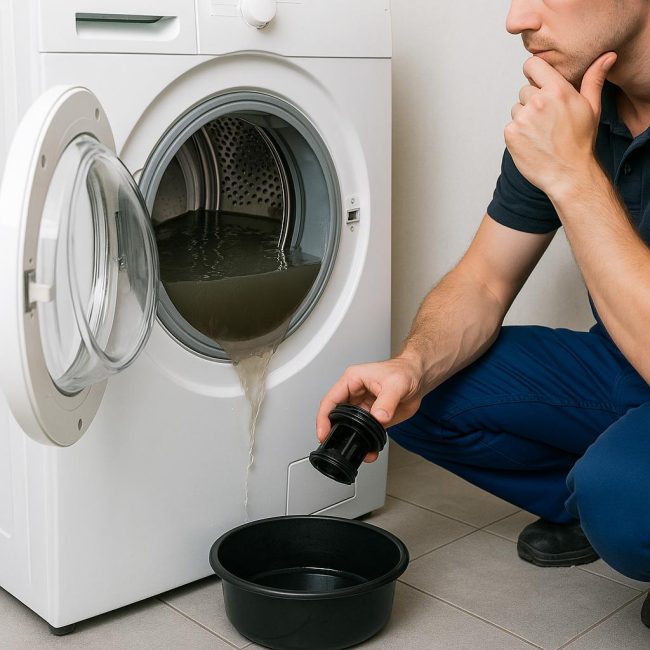
- Open the lower service cover and carefully drain the water through the emergency hose (if available) or through the pump filter, placing a low basin underneath and laying out towels.
- Remove and wash the pump filter: coins, buttons, wool, pieces of bags, and bra bones tend to get stuck there.
- Check the drain hose: it should not be pinched by furniture, bent into an elbow, or frozen (relevant for summer cottages).
- If the machine is connected to a siphon under the sink, remove the hose and check the siphon fitting for blockage.
These steps often restore the drain. If, after cleaning the filter and checking the hose, the water still won't drain, proceed to advanced diagnostics.
Top Reasons Why Water Won't Drain: From Simple to Complex
Clogged filter or pump volute
A common problem: small particles and lint clog the filter or the volute (pump body). The pump hums, but the impeller rotates with difficulty or becomes blocked. After removing the filter plug, you'll see the debris. It's important to clean not only the filter bowl itself but also the space behind it: shine a flashlight through the filter and check the impeller—it should turn freely with your finger (with a slight resistance from the magnets).
Kink/blockage in the drain hose or a clog in the siphon
If the hose is pinched, the pump physically won't be able to pump the water out. Sometimes the problem is caused by a hose that's too long: weak pressure + excess length = water "clogging." Another possibility is that grease and food debris have accumulated in the drain trap under the sink; the machine simply won't drain properly. Remove the hose, blow it out, rinse it, and clean the drain trap fitting with a brush.
The pump is not working
Sometimes the pump is silent or hums, but doesn't pump. Causes:
- Worn bearings and impeller play.
- Burnt motor winding or oxidized contacts.
- The clog has penetrated deep and jammed the shaft. Check: When the "Drain" mode is engaged, a characteristic operating sound should be heard. If there is no sound, there may be a problem with the pump itself or its power supply. A visual inspection of the terminals for oxidation and melting is also helpful.
Pressure switch (level sensor) or pressure switch hose
The machine "thinks" there's still water in the drum and doesn't spin, or, conversely, doesn't drain. Often, the culprit isn't the electronics, but a clogged, thin pressure switch hose or a detached rubber tube. Check the hose for scale, water, cracks, or a loose clamp. Gently blow through it. The level sensor clicks when gently injecting air (don't overinflate).
Control unit and wiring errors
Less commonly, the cause is the control module: a burnt-out circuit, a worn-out pump relay, or a corroded connector. Also common are broken wires leading to the pump near the bottom due to vibration. This is a specialist's job: diagnostics are needed, including continuity testing, sometimes soldering, or replacing the relay or module.
Blockage in the sewer
Don't forget about the drain pipe. If the sink drains poorly and gurgles, and the washing machine drain is connected to the same pipe, there's likely a general blockage. In this case, the machine is fine: clear the trap/pipe with a cable or chemicals, ensuring proper drainage.
DIY Diagnostics: Step-by-Step and No Panic
Preparation and tools
You will find the following useful:
- Flat head screwdriver, pliers, Phillips head screwdriver.
- Flashlight, rags, low basin.
- Gloves. A multimeter, if necessary. Always start by unplugging the machine. Safety first.
Step-by-step verification scheme
- Drain the water and clean the filter. Inspect the impeller: does it spin freely? Is there anything loose or broken?
- Remove the drain hose from the trap. Blow it out gently with your mouth or a compressor. If it's difficult to blow out, flush it with a pressure washer.
- Check the hose connection height: the entry point into the siphon/pipe should be 50–70 cm above the floor. Too low and the system may drain and the level may fluctuate; too high and the pump will be strained.
- Run the short "Drain" program with the bottom panel open. Listen to the pump. If it hums, it means power is coming in. If it's silent, check the terminals, wiring, and connectors.
- Remove the pump (usually a pair of screws around the perimeter of the volute) and inspect the shaft for threads, play, or signs of overheating. Clean everything thoroughly.
- Check the pressure switch hose: remove the top cover, locate the thin hose from the tank to the sensor, and make sure it's clean and intact. Gently blow through it.
- If you have a multimeter, test the pump winding for resistance and check for a short to the housing. If there's continuity, that's good; if there's an open circuit, the pump needs replacing.
What else to see
- Test without laundry: Run the Drain/Spin cycle without a load. If the machine pumps an empty drum but fails to remove the water after washing, the problem may be with the pump's performance, a partial blockage, or an excessively long hose.
- Foam: Excessive powder or liquid detergents form a thick foam, which "fools" the level sensor and slows down pumping. Use detergents labeled "for automatic machines" and dose according to the instructions.
- Extraneous sounds: grinding, wheezing, periodic jerks indicate mechanical obstructions in the cochlea or wear of the pump.
What you can do yourself, and when exactly to call a professional
DIY solutions that actually help
- Clean the pump filter regularly: once every 1–2 months, especially if there is animal hair or small items present.
- Make sure the connection is correct: the height is correct, there are no kinks, and the clamp on the fitting is tight.
- Use mesh bra nets for smaller bras. They hold bra wires and fittings, which often clog the bra.
- Clean the siphon under the sink: remove the fitting every six months and remove any deposits.
- Measure your detergents. Too much will cause foaming and false alarms.
List of quick actions:
- Cleaning the filter and snail.
- Checking and cleaning the drain hose and siphon fitting.
- Check the connection height and absence of bends.
- Blowing out the pressure switch hose.
- Drainage test without laundry.
When it's better not to take risks
- The machine shows no signs of life in the "Drain" mode, but the socket and cable are in good working order.
- The pump hums but does not pump after cleaning - it is likely worn out or jammed.
- The panel is showing errors related to the water level, and cleaning has not helped.
- Traces of burning are visible on the terminals/wires, melted plastic.
- There is a visible leak inside, water near the pump or pipes.
In these cases, it's more cost-effective to call a specialist. A technician will check the pump's power supply under load, test the circuits, assess the condition of the pressure switch and module, and replace worn components without unnecessary disassembly. Professional diagnostics often cost less than a series of blindly purchased spare parts.
Prevention for the future
- Place a dirt trap in the kitchen drain system if it is connected to a common siphon - it will trap grease and debris.
- Once every 2–3 months, run a hot program at 60–90 °C without laundry using washing machine cleaner: this dissolves plaque and slime in the pipes.
- Check pockets and zippers, use bags for small items.
- Every six months, remove the bottom cover and clean the snail as a preventative measure—this saves 10 minutes of time, saving a visit to the technician.
- If the machine is located in a summer house or in a cool room, insulate the hose and siphon area in winter to prevent freezing.
The bottom line is simple: in 7 out of 10 cases, clogs in the filter, spigot, hose, or trap are to blame. The rest are the pump, pressure switch, wiring, and rare module malfunctions. Follow these steps, don't ignore safety, and maintain the drain regularly—then the question "why isn't it draining" will arise much less often.