When water from a private well suddenly disappears, it almost always takes you by surprise. Just yesterday, the system was functioning normally and unnoticed, but today, silence or the occasional puff of air comes from the tap. For homeowners, this isn't an abstract problem, but a real disruption: it's impossible to wash, cook, run the washing machine, or simply use the house as usual. The question "Why did the well run out of water" arises precisely at such moments—not as a theoretical curiosity, but as an attempt to understand what's happening and what to expect next.
This topic often seems simple, but in practice it turns out to be more complex than it initially appears. A well is not a reservoir with a fixed volume, but rather part of a natural system that operates according to its own laws. The fact that the water has "disappeared" doesn't always mean the same thing. Sometimes it's a temporary phenomenon, sometimes it's a sign of lingering problems, and in some cases, it signals fundamental changes in the site's water supply conditions.
- What does "out of water" really mean?
- Natural causes of water level decline
- Technical and operational reasons
- How does this manifest itself in everyday life?
- Possible scenarios for the development of the situation
- Limitations and hidden nuances
- Common misconceptions and false expectations
- A broader view of the problem
What does "out of water" really mean?
In everyday language, the phrase "the well has run out of water" sounds unambiguous, but technically it can describe several different situations. In one case, the water level has indeed dropped below the intake point. In another, there is water, but the system is unable to replenish it. In a third, the water flow has become so weak that it cannot be replenished with normal consumption.
A well operates from an aquifer—a layer of rock saturated with water. This aquifer isn't a bottomless source: it has a certain volume, flow rate, and sensitivity to external factors. When demand exceeds natural replenishment, the water level temporarily or permanently declines. This manifests itself on the surface in the same way: water disappears or flows intermittently.
It's important to understand that water loss is rarely instantaneous and "permanent" without cause. More often, it's the result of a chain of processes that developed gradually and remained unnoticed until a certain point.
Natural causes of water level decline
One of the most common causes is seasonal fluctuations in groundwater levels. In the spring, after the snow melts, aquifers are usually at their fullest. In the summer and early fall, especially during dry years, water levels naturally drop. Wells drilled close to the minimum permissible level are the first at risk during these periods.
In practice, it works like this: in winter and spring, the system operates flawlessly, but by midsummer, the pressure weakens, interruptions occur, and then the water supply may disappear altogether. However, in the fall or after prolonged rains, the situation partially or completely recovers. Such fluctuations are often perceived as a malfunction, although in fact, they are a response to natural cycles.
Another factor is environmental changes. Active development, the addition of new wells nearby, the drainage of land, or changes to drainage patterns can all impact groundwater distribution. Even if your property hasn't changed, the aquifer's behavior may change due to activities in neighboring areas.
Technical and operational reasons
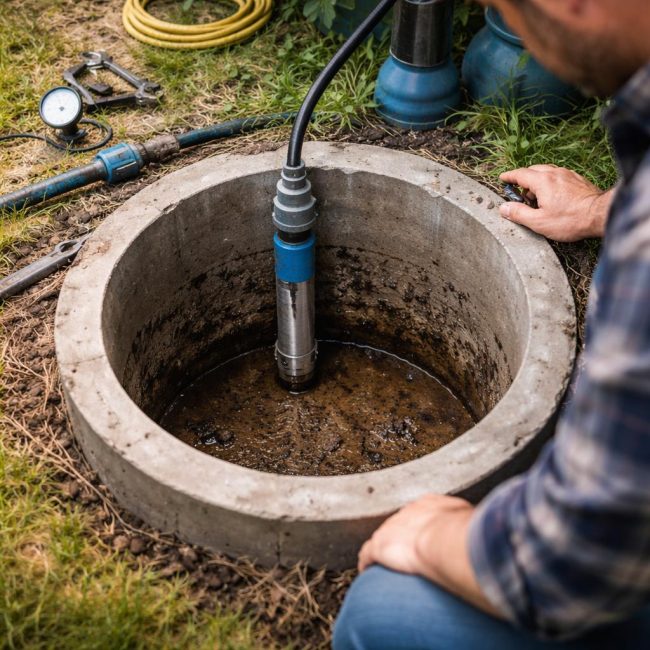
The problem isn't always rooted in nature. Sometimes water "runs out" because the well or equipment stops working as intended. Over time, filters become clogged, the casing walls become encrusted with sediment, and water flow slows. As a result, the well begins to produce less water than before, even though the aquifer itself remains intact.
A separate category is changes in usage patterns. A house previously used as a summer residence becomes a permanent residence. Washing machines and dishwashers, irrigation systems, and multiple bathrooms appear. The load on the source increases, while its capacity remains the same. At some point, the balance is disrupted, and the water supply can no longer be replenished.
Sometimes the problem is disguised as "lack of water," when in fact it's related to equipment operation. The system may be unable to cope with current conditions, visually appearing as an empty well. For the owner, there's little difference—the result is the same, but the causes and consequences are fundamentally different.
How does this manifest itself in everyday life?
It's rare for the water to disappear instantly and without warning. More often, the system's operation changes first. The pressure becomes unstable, there are surges, the pump starts running longer than usual or starts running more frequently. The water may leak air, become cloudy, and then disappear completely.
At the sensory level, this resembles system fatigue. It still functions, but not as reliably as before. Many ignore these signals, attributing them to temporary glitches. As a result, the moment when the water completely disappears is perceived as a surprise, although in fact, it was prepared for by previous changes.
It's also important to note that different water intake points react differently. Water may still appear on the first floor, but not on the second. This creates the illusion of partial functionality and makes it difficult to understand the real situation.
Possible scenarios for the development of the situation
If water in a well has disappeared, the further course of events depends on the cause. Seasonal fluctuations can cause the water level to recover on its own, but this doesn't always happen quickly. Sometimes it takes several weeks or even months for the aquifer to return to its normal state.
When problems with siltation or declining flow rate occur, the situation usually doesn't improve on its own. On the contrary, without intervention, it can gradually worsen. The well becomes less stable, and periods without water become longer.
When the well is overloaded due to increased consumption, various scenarios are possible. Sometimes, simply changing the usage mode is enough to bring the system back to life. In other cases, it becomes clear that the well's current capacity doesn't meet the home's actual needs.
The most complex scenario involves irreversible changes to the aquifer. This is less common, but cannot be completely ruled out. In these cases, the well loses its usefulness as a source of stable water supply, and the approach to providing the home with water must be reconsidered.
Limitations and hidden nuances
One of the main misconceptions is the idea that a well is a guaranteed source of water for decades. In reality, its reliability depends on a multitude of factors, many of which are beyond the owner's control. Even a well-maintained well can deteriorate over time.
Another nuance is the difference between a well's depth and its water level. These concepts are often confused, with the assumption that a "deep" well is automatically protected from problems. In reality, it's not the total well length that matters, but the location of the aquifer and its replenishment capacity.
It's also worth considering that water behavior in a well isn't always linear. Sometimes a small change in conditions leads to a sharp deterioration in performance, while other times, serious external factors have little or no effect on the results. This makes diagnosing the situation without analyzing the underlying causes particularly difficult.
Common misconceptions and false expectations
It's a common misconception that if the water disappears, the well is "dead." In practice, this isn't always the case. In some cases, it's a temporary drop in water levels or problems that have been building up for years and have simply reached a critical point.
Another misconception is the expectation that the problem will resolve itself if you "wait." Sometimes waiting is truly justified, but often it only leads to a worsening of the situation. Without understanding the underlying causes, it's difficult to assess what to expect and when.
Finally, many believe that such problems are only typical of old or poorly constructed wells. However, even relatively new wells can experience water shortages if operating conditions or the environment change.
A broader view of the problem
A disappearing well isn't just a technical failure, but also a reminder that autonomous water supply always requires attention. It's closely tied to natural processes and human decisions that aren't always obvious at first glance.
Understanding why water may disappear helps you approach the situation more calmly and realistically. This allows you to view the well not as a "black box," but as a system with specific capabilities and limitations. This perspective doesn't provide instant answers, but it does create the basis for informed decisions and a more sustainable approach to home improvement.