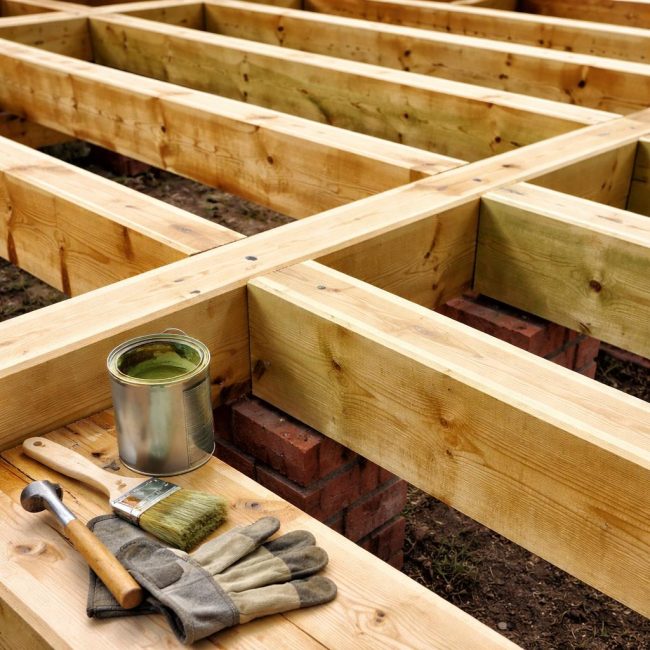
When building a house or undertaking a major renovation, the focus is usually on the visible elements: walls, floors, ceilings, and finishing materials. However, it is the hidden structures—floor joists, subfloors, sheathing, beams, and supporting elements—that play a key role in the longevity of the entire building. Their condition directly impacts the strength, safety, and service life of the house, even if everything appears perfect on the outside.
Even at the initial stages of construction or renovation, many people wonder whether wood preservatives are needed in areas where elements will be hidden under finishes and inaccessible to direct environmental exposure. In practice, these areas are often the most vulnerable, as they often create conditions conducive to wood deterioration.
- What is included in rough designs?
- Major threats to hidden wood
- High humidity
- Fungus and mold
- Insect pests
- Lack of visual control
- Why is processing necessary at the construction stage?
- Access to all surfaces
- Formation of a protective layer
- Long-term savings
- Consequences of refusal to process
- Features of processing logs and ceilings
- Absorption and depth of protection
- terms of Use
- Compatibility with further work
- Common mistakes when working with rough designs
- The longevity of a home begins with the invisible
What is included in rough designs?
Rough timber elements include all supporting and auxiliary structures that are closed after completion of the work:
- floor and ceiling joists;
- floor beams;
- subfloor;
- lathing for roofing or finishing;
- frame elements of walls;
- underground and attic structures.
These elements are rarely inspected after construction is completed, and their replacement or repair in case of damage requires significant costs and dismantling of the finish.
Major threats to hidden wood
High humidity
Subfloors, interfloor ceilings, and foundation junction areas are often subject to humidity fluctuations. Condensation, capillary moisture, and seasonal temperature fluctuations create conditions in which wood slowly but steadily absorbs moisture.
Fungus and mold
Fungal infections thrive especially rapidly in confined spaces with limited ventilation. While initially unnoticeable, they eventually destroy the wood's structure, reducing its strength.
Insect pests
Wood-boring beetle larvae can develop for years inside beams and joists, destroying the material from the inside. Often, the problem is only discovered when the structure has already been seriously weakened.
Lack of visual control
Unlike finished surfaces, subfloors cannot be regularly inspected. This means any deterioration goes unnoticed until serious consequences arise: creaking, floor sagging, deformation, and even accidents.
Why is processing necessary at the construction stage?
Access to all surfaces
Before installing joists and floor joists, it's possible to treat the wood on all sides, including ends, joints, and hard-to-reach areas. After installation, this is virtually impossible to do properly.
Formation of a protective layer
Protective treatment creates a barrier that prevents moisture penetration and biological damage. This is especially important for elements located near the ground or in cold areas.
Long-term savings
The cost of preventative treatment is incomparably lower than the costs of dismantling floors, replacing joists, or restoring load-bearing structures after several years of use.
Consequences of refusal to process
Ignoring the protection of rough structures can lead to a number of serious problems:
- accelerated rotting of wood;
- loss of load-bearing capacity of logs and beams;
- the appearance of an unpleasant damp smell in the house;
- growth of mold, affecting the indoor microclimate;
- the need for major repairs after 5–7 years instead of decades of operation.
It is important to understand that even dry and high-quality wood, without protection, will lose its properties over time under the influence of the environment.
Features of processing logs and ceilings
Absorption and depth of protection
Joists and beams are often made from solid wood, so it's important that the protective compound penetrates into the upper layers of the material rather than remaining only on the surface.
terms of Use
Underfloor structures are subject to different loads than, for example, decorative elements. Resistance to moisture, biological attack, and temperature fluctuations is critical here.
Compatibility with further work
Treated timber must be ready for installation of insulation, vapor barrier and flooring without deterioration of adhesion and other performance characteristics.
Common mistakes when working with rough designs
- treatment of visible areas only;
- ignoring the ends and cut areas;
- use of unsuitable compositions for high humidity conditions;
- installation of damp or untreated wood "at random";
- confidence that the closed structure does not need protection.
Each of these mistakes increases the risk of hidden problems that will manifest themselves years later.
The longevity of a home begins with the invisible
Substructures are the foundation upon which the comfort and safety of a home rest. They bear the brunt of the load and ensure the stability of all the building's elements. Protecting them is not a formality or an optional extra, but a mandatory step in proper construction.
Treating joists and floor joists is an investment in the building's longevity, peace of mind for owners, and the avoidance of costly repairs in the future. What's hidden from view must be especially carefully protected, as correcting errors at this level is always more difficult than preventing them in the first place.