The idea of a "DIY, permanent septic tank without pumping" stems from a perfectly understandable desire: to install a sewer system once and never have to deal with it again—without odors, calls to the sewer cleaner, or regular expenses. The main practical question that inevitably arises here is:Is it even possible for an autonomous sewage system to exist, one that operates for years without maintenance, or is this a case of a successful start that eventually wears off?The rest of the conversation is about this contradiction between expectation and physical reality.
- Where does the feeling of “eternity” come from in the first years of operation?
- Where does waste actually go if it is not “pumped out”?
- Why does the soil stop absorbing water?
- Constructions that are most often called "eternal"
- Why is the lack of pumping perceived as an advantage?
- Where is the line between myth and working concept?
- Why the term "DIY" reinforces the illusion of reliability
- Typical Expectation Distortions
- What happens when "eternity" ends?
- How the view of the system changes over time
- A Expanding View: What's Really Behind the Word "Eternal"
Where does the feeling of “eternity” come from in the first years of operation?
Almost every story about a "perpetual" septic tank begins the same way: the system operates quietly, the water level doesn't rise, there are no odors, and the water drains away. In the first few years, this may indeed seem like proof of concept. The reason is simple: at the beginning, any tank has some reserve capacity and the filtering capacity of the surrounding soil. The sediment at the bottom is still fine, the pores of the surrounding soil are not clogged, and biological processes are active.
At this point, a logical error arises: stability is perceived as permanence. It seems that if the system copes now, it will continue to cope. But it is precisely at this point that the future problem is conceived—the imperceptible accumulation of something that never goes away.
Where does waste actually go if it is not “pumped out”?
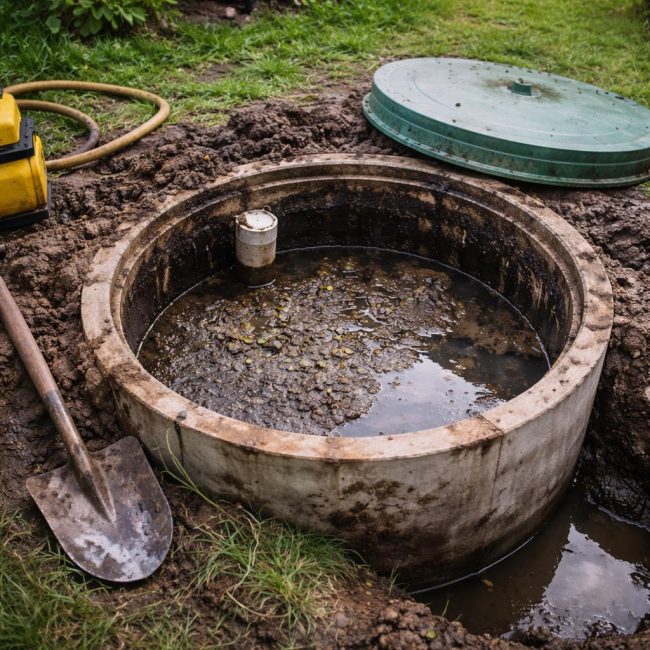
A common misconception is that waste is "completely processed." In practice, any septic tank operates on the principle of separation. The liquid phase is released into the ground or into the next chamber, while the solid phase remains. It may become compacted, partially decompose, and change structure, but it never completely disappears.
Even with active biology, a mineral residue remains—dense, heavy, and almost inert. It cannot be dissolved, accelerated, or "burned" by natural processes. It simply slowly grows as a layer at the bottom. It is this layer that determines the finite duration of "eternity."
Why does the soil stop absorbing water?
The second reason why systems lose efficiency without maintenance is the degradation of the soil's filtration capacity. Water leaving a septic tank is never perfectly clean. It always contains fine suspended solids, fats, and colloidal particles. Over time, these settle in the soil pores, forming a dense biofilm.
From the outside, it looks like a "sudden" problem: yesterday everything was draining, today the level is stagnant. In reality, the process has been going on for years, it just wasn't visible. That's why stories about "twenty years without pumping" almost always end with a sudden system failure, rather than a gradual deterioration.
Constructions that are most often called "eternal"
This term covers a variety of solutions, but they all share one thing in common: a focus on large volumes and passive filtration. These can include bottomless wells, multi-chamber homemade systems, or tanks designed with ample capacity. As long as the capacity is sufficient, maintenance seems unnecessary.
It's important to understand: a reserve capacity doesn't mean a service cancellation, but a deferral. The larger the reserve, the later the need for intervention will become apparent. But this doesn't change the physics of sediment accumulation.
Why is the lack of pumping perceived as an advantage?
People evaluate a system based on costs and inconvenience. If they don't have to call anyone or spend money for several years, the solution seems a good one. Compared to neighbors who regularly maintain their sewer system, the "permanent" option looks better.
The problem is that the cost of refusing service often becomes apparent immediately and dramatically. When a system stops working, restoration is more expensive than regular maintenance. But by that point, the initial savings have already psychologically justified the chosen path.
Where is the line between myth and working concept?
A completely "eternal" autonomous sewage system doesn't exist—not because it's a poorly designed system, but because waste has mass and volume. However, there are systems that can operate for a very long time with minimal intervention. The difference between myth and reality lies in the word "minimal," not "zero."
Understanding from the outset that any system will eventually require attention makes design more honest. Then, decisions are made not based on promises of perpetuity, but on predictability of behavior over time.
Why the term "DIY" reinforces the illusion of reliability
Homemade systems are often perceived as more intuitive and therefore more reliable. People have seen every step, know where everything is, and feel in control. This creates confidence that the problem can always be solved.
But it's precisely in DIY solutions that long-term effects are most often ignored—not because of error, but because of a lack of visible signs. Sediment accumulation and soil siltation are slow processes that provide no feedback for years.
Typical Expectation Distortions
The most common distortion is the transfer of someone else's experience without context. If someone's system "hasn't been pumped for ten years," this is perceived as a universal result. However, the usage pattern, the composition of the effluent, the soil properties, and the actual volume of accumulation are rarely taken into account.
The second distortion is the belief in "self-purification" as an endless process. Biology does help, but it doesn't negate the law of conservation of matter. Anything that doesn't leave with the water remains within the system.
What happens when "eternity" ends?
The end of the illusion usually looks the same: a slow rise in water level, odors, and unstable operation. At this point, it becomes clear that access to the system is difficult, the sediment is thick, and restoring filtration requires extensive excavation. It's then that it becomes clear that the lack of maintenance was not an advantage, but a deferred problem.
How the view of the system changes over time
Interestingly, owners who have gone through the full cycle almost always formulate the same conclusion: rare and predictable interventions are better than believing they won't happen at all. "Eternity" turns out to be not a property of the structure, but a stage in its life.
This understanding changes the very approach to home improvement. The sewer system ceases to be a magical object that should "disappear from life" and becomes an engineering system with understandable behavior.
A Expanding View: What's Really Behind the Word "Eternal"
In everyday usage, "eternal" often means "not requiring attention for a long time." If the term is interpreted this way, it ceases to be a deception. But when it's embedded with the promise of a complete lack of maintenance, a conflict with reality arises.
Perhaps the main practical conclusion here is not that the idea is wrong, but thatWhat expectations are associated with it?The more realistic these expectations are, the longer and more reliably the system functions. In this sense, an "eternal septic tank" exists—not as a never-ending structure, but as a system whose behavior is clear in advance and doesn't become an unpleasant surprise years later.