Creating an accessible environment isn't just a formality in design documentation or a mere obedience to legal requirements. It's a real opportunity for people to move freely, work, study, visit healthcare facilities, and participate in public life. Lifts for the disabled occupy a special place in this system, as they solve the problem of vertical differences in places where a ramp or elevator is impossible or ineffective.
The question is not whether such devices are needed, but where they are vitally important and why, without them, full accessibility remains unattainable.
Why ramps alone aren't enough
A ramp is traditionally considered a symbol of accessible access. However, in practice, it often proves ineffective. The main problem is the slope. Ensuring a safe angle of ascent requires a significant length. In dense urban environments, narrow entrance areas, or older buildings, it is simply not physically possible to install a ramp of the required length.
Furthermore, in winter, ramps become slippery and require constant clearing of snow and ice. Narrow or improperly installed structures create additional hazards. As a result, while an accessible environment may exist, it's difficult or impossible to use in practice.
In such situations, a lifting platform becomes not an alternative, but the only rational solution.
Old-style apartment buildings
One of the most pressing issues is housing accessibility. Much of the housing stock was built decades ago, when barrier-free accessibility requirements were nonexistent. High porches, narrow stairwells, and the lack of elevators in buildings up to five stories high—all of this makes leaving your apartment a serious challenge.
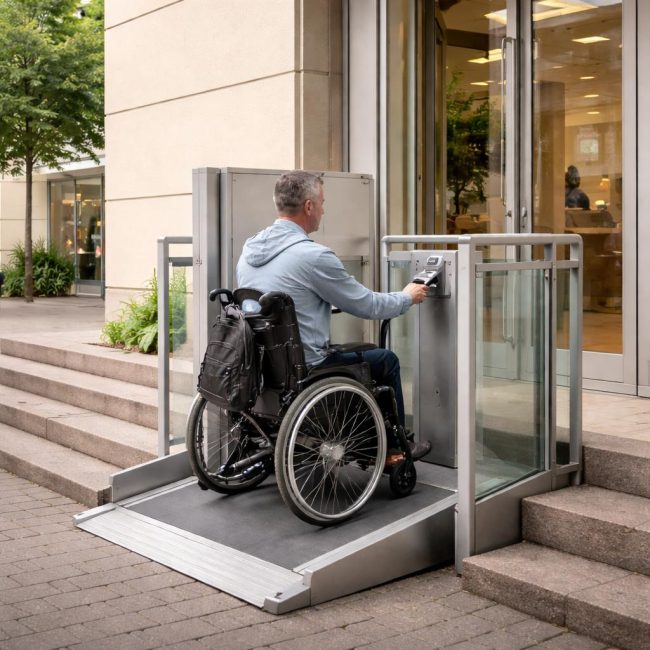
A vertical lifting platform solves the problem of multiple steps before entering. Inclined models are installed along the existing staircase, eliminating the need for extensive remodeling. This is especially useful in homes where structural modifications are limited.
It's important to understand that for a person in a wheelchair, the inability to leave the building on their own means de facto isolation. In such projects, the installation of lifting platforms becomes a matter of social justice and basic rights.
In practice, implementing such solutions requires a competent technical approach: site surveys, load calculations, and dimensioning. This is handled by specialized organizations, such as "Podyom," which work with the architectural features of a specific building and current regulations in mind.
Medical institutions
Hospitals, clinics, and diagnostic centers are places where accessibility must be guaranteed. However, many medical facilities are located in Soviet-era buildings with high entrances and complex interior layouts.
If there are even a few steps at the entrance without an alternative ascent, a person with limited mobility finds themselves in a dependent position. This is especially critical for elderly patients and those who have undergone surgery.
Lifting platforms are necessary in medical institutions:
- at the entrance groups,
- when there are differences in levels inside the building,
- in the absence of a passenger elevator,
- in rehabilitation centers.
Unlike domestic use, higher requirements for reliability, load-bearing capacity and intensity of use are important here.
Educational institutions
Inclusive education is impossible without physically accessible buildings. Schools, colleges, and universities are obligated to provide equal conditions for all students.
Lifting platforms are necessary:
- at the entrance to the building,
- for access to assembly halls and sports halls,
- when transitioning between levels,
- in libraries and laboratories.
It's important to consider that educational environments require regular use of equipment. Therefore, the design focuses not only on safety but also on ease of use—the buttons should be intuitive, and the platform should be spacious enough.
Administrative and public buildings
Government offices, multifunctional centers, courts, banks, and post offices are spaces visited by thousands of people every day. Inaccessible entrances effectively restrict civil rights.
In historic buildings, installing an elevator is often impossible for structural or preservation reasons. In such cases, compact lifting platforms allow for the preservation of the architectural appearance while ensuring accessibility.
Shopping centers and business spaces
For businesses, accessibility is not only a social responsibility but also an economic factor. People with disabilities, senior citizens, and parents with strollers make up a significant portion of their audience.
Lifting platforms are especially relevant:
- in small stores with a difference in level,
- in a cafe with a high porch,
- in office centers without a modern elevator,
- in sports clubs.
Lack of availability means loss of customers and reputational risks.
Private houses
In private homes, lifting platforms help maintain independence. Even a few steps on a porch can become a significant obstacle.
Vertical compact solutions are installed:
- at the entrance group,
- inside the house if there is a second floor,
- on terraces and verandas.
Moreover, the equipment can be integrated into the existing architectural style without disturbing the building’s appearance.
When a lifting platform is the only way out
There are a number of situations where installing a platform is not only justified, but necessary:
- failure to comply with the standard ramp slope,
- limited space,
- historical buildings,
- high intensity of use,
- the need for year-round operation in difficult climatic conditions.
In such cases, it is important to consider not only the technical characteristics of the equipment, but also professional installation, regular maintenance, and compliance with safety standards.
Social significance
A lifting platform is more than just a mechanism. It's an integration tool. Its presence means the ability to:
- leave the house on your own,
- visit a doctor,
- get an education,
- get a job,
- participate in public life.
Without an accessible environment, talk of equal opportunity remains empty words. That's why the installation of lifting platforms goes beyond a technical issue and becomes part of social policy.
Result
Lifting platforms for the disabled are essential in older residential buildings, medical and educational institutions, administrative buildings, commercial spaces, and private homes. Their installation is especially important where ramps are ineffective or impossible.
Creating an accessible environment is a systemic process that requires technical expertise and an understanding of the building's architectural features. Only a comprehensive approach can ensure not just formal accessibility, but real accessibility that changes people's lives for the better.