Potatoes in the garden begin not with a shovel or even a bed, but with the condition of the seed tuber. It is during the preparation of seed potatoes that the future germination rate, uniform growth, and resistance to adverse conditions are established. This work is rarely perceived as a separate technological process, but in practice, it determines whether the planting will develop predictably or become a series of accidents.
Preparing seed potatoes isn't a single operation, but a sequence of steps that transition the tuber from storage to active growth. Each stage is tied to the plant's physiology and the conditions it will experience in the soil.
- Why seed potatoes shouldn't be considered a regular storage product
- Selection of seed tubers as the basis for the future harvest
- Temperature adaptation before germination
- Germination as a controlled start of growth
- Tuber surface treatment and its importance
- Physiological significance of vernalization
- Preparation of cut tubers and associated restrictions
- Relationship of preparation to soil type and site conditions
- Common misconceptions about preparation
- Preparation as an element of the overall growing system
Why seed potatoes shouldn't be considered a regular storage product
A potato tuber is more than just a nutrient reserve. It remains a living organ, responding to light, temperature, and moisture. During storage, its task is to maintain viability and prevent premature growth. Before planting, the task is reversed: growth must begin quickly and consistently.
If tubers are placed in the soil in a dormant state, they require time to awaken. During this period, they are vulnerable to rot, damage by soil-borne fungi, and uneven germination. Preparation is necessary to ensure this transition is controlled rather than haphazard.
Selection of seed tubers as the basis for the future harvest
Preparation begins long before any treatments—with selection. Medium-sized tubers, free of signs of rot, mechanical damage, or viral deformations, are used for planting. Visual defects are important not in themselves, but as indicators of disrupted processes within the plant.
Overly large tubers often produce vigorous tops at the expense of tuber formation, while small tubers lack sufficient nutrients. The shape and color of the skin should be typical for the variety; any deviations may indicate degeneration or disease.
Selection is a filter through which only the tubers with the greatest potential pass. Errors at this stage are not compensated for by any subsequent measures.
Temperature adaptation before germination
Tubers stored at low temperatures are not immediately ready for active growth. A sudden transfer from a cold cellar to a warm environment causes tissue stress and disrupts metabolic processes. Therefore, seed potato preparation begins with a gradual increase in temperature.
For several days, the tubers are kept at moderate heat, allowing the internal processes to adjust. This reduces the risk of weak, watery sprouts and ensures more uniform germination. In practice, this step is often skipped, although it directly impacts the quality of the sprouts.
Germination as a controlled start of growth
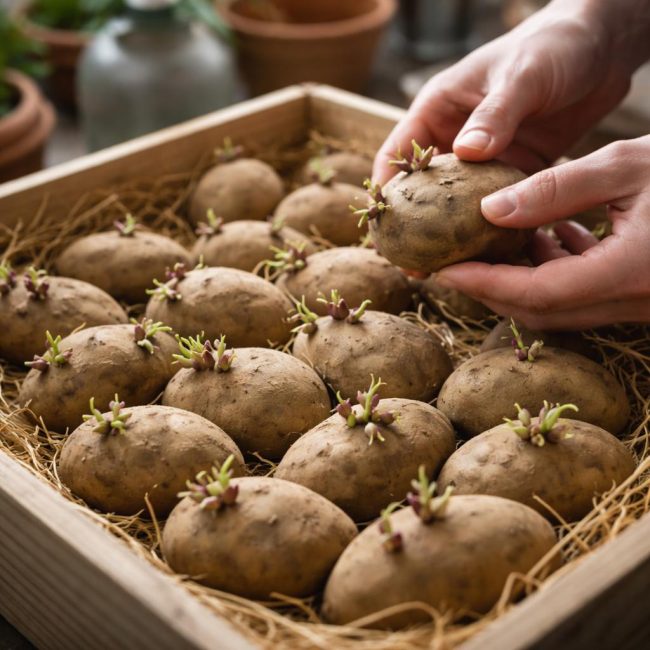
Germination is a central element of preparation. Its goal is not to produce long shoots, but to form short, dense, and viable seedlings. Such seedlings are resistant to damage and develop roots more quickly after planting.
Light plays a key role. In the dark, sprouts stretch, become brittle, and lose their ability to root quickly. Diffused light, on the other hand, inhibits stretching and promotes the formation of strong shoot buds. Temperature should remain moderate, without sudden fluctuations.
The duration of germination depends on the condition of the tubers and the conditions, but the guideline is not the time period, but the result - the appearance of healthy, clearly visible sprouts.
Tuber surface treatment and its importance
Potato skins are the first barrier between the plant and the soil. During storage, they can harbor fungal spores and bacteria, which become active with increased humidity and temperature. Seed potato preparation includes measures aimed at reducing this burden.
This isn't about radical sterilization, but rather about creating conditions that prevent pathogens from gaining an advantage during the initial growth period. This is especially important in areas with heavy soils or those prone to waterlogging, where the risk of rot is higher.
Physiological significance of vernalization
In practice, the term "vernalization" is often used to refer to the combination of conditions under which a tuber transitions from dormancy to active growth. For potatoes, this primarily involves a combination of light, temperature, and time.
Vernalization doesn't mechanically accelerate growth, but rather makes it more coordinated. As a result, seedlings emerge evenly, plants develop at roughly the same pace, and yield crops at similar times. This simplifies care and reduces losses associated with unevenly aged crops.
Preparation of cut tubers and associated restrictions
In some cases, planting material is divided into sections. This practice requires a particularly careful approach, as each cut section becomes vulnerable. Preparing seed potatoes involves not only germination but also the necessary healing of the cuts.
The purpose of this step is to allow the tissue to form a protective layer before contact with the soil. Without it, the risk of infection and rot increases. It's important to understand that pruning isn't suitable for all conditions and varieties: it's only justified when planting material is scarce and dry, warm soil can be provided.
Relationship of preparation to soil type and site conditions
Seed potato preparation is inseparable from the planting site. For light, well-warmed soils, earlier planting dates and a minimal delay between germination and planting are acceptable. Heavy and cold soils, on the other hand, require especially carefully prepared planting material that can adapt quickly.
If a tuber is placed in an unfavorable environment without developed sprouts, it devotes resources to survival rather than development. Preparation reduces this burden and makes the start of growth less dependent on random factors.
Common misconceptions about preparation
It's a common belief that any sprouts are a good thing. In practice, long, pale shoots are more often a problem than an advantage. They break easily when planting and don't handle temperature fluctuations well.
Another misconception is that preparation is optional for a "good" variety. Variety determines potential, but it doesn't replace the conditions under which that potential is realized. Even the most resilient potatoes respond to the quality of their planting material.
Preparation as an element of the overall growing system
Preparing seed potatoes doesn't produce immediate visual results, but its effects are felt throughout the season. Uniform emergence, synchronized flowering, and predictable tuber formation are the result of processes that began even before planting.
In the context of site preparation and work planning, this stage allows for better workload distribution, reduced losses, and reduced vulnerability to weather fluctuations. Ultimately, preparation is the key to transforming potato growing from a matter of luck to a controlled process, where every action has a clear rationale and expected outcome.