Connecting a water supply to a private home is an engineering process that connects an external water source with the building's internal systems. The way it's organized determines not only ease of use but also the longevity of the pipelines, pressure stability, sanitary safety, and the ability to upgrade the system in the future. Despite its apparent simplicity, connecting a water supply involves several critical decisions, each of which impacts the final result.
- What is meant by water supply?
- Water sources and their impact on the supply scheme
- Route of external water supply system and its depth
- Materials for water supply pipes
- Water inlet unit into the house
- Freeze protection and temperature risks
- Pressure and hydraulic limitations
- Common misconceptions when organizing water supply
- Water supply as part of the overall engineering system
What is meant by water supply?
A water supply connection is the section of the system from the connection point to the water source to the pipeline's entry into the house. The source may be a centralized network, an individual well, or a borehole. Regardless of the source, the connection includes external pipelines, protection elements, entry points, and the transition to the internal distribution system.
This section operates under the most challenging conditions: it is subject to freezing, seasonal ground movements, moisture, and mechanical stress. Errors made during the water supply stage often become apparent only after several years of operation.
Water sources and their impact on the supply scheme
The source type directly determines the supply configuration. When connecting to a centralized network, the key factors are the connection point and the water utility's requirements: installation depth, availability of shutoff valves, and metering devices. The system typically operates under constant pressure, which places increased demands on the tightness of connections.
When using an autonomous water supply from a well or borehole, the supply line is supplemented with pumping equipment, check valves, and dry-running protection elements. Pressure in the system is generated artificially, so the role of hydraulic accumulators and automatic controls increases. In this case, the water supply is not just a pipe, but part of a more complex engineering system.
Route of external water supply system and its depth
One of the key issues when installing water is choosing the route and installation depth of the pipeline. The installation depth is determined by the soil freezing depth in the region. Placing the pipe above this level requires additional protection measures, otherwise the risk of freezing becomes systemic.
The route is designed to be as straight as possible, avoiding unnecessary turns and connections in the ground. Every joint is a potential leak zone, which is virtually inaccessible after backfilling. Furthermore, it's important to consider intersections with other utilities, foundations, and drainage systems to prevent interference.
Materials for water supply pipes
For outdoor water supply systems, materials resistant to corrosion and temperature fluctuations are used. Low-pressure polyethylene pipes are most commonly used. They allow for installation without numerous joints, are flexible, and withstand soil movement well.
Metal pipes are less commonly used in modern systems due to the complexity of installation and their susceptibility to corrosion. However, in certain cases, they can be used in areas subject to high mechanical loads, provided they are adequately protected against corrosion.
The choice of material determines not only the service life, but also the acceptable connection methods, as well as the requirements for compensating for temperature deformations.
Water inlet unit into the house
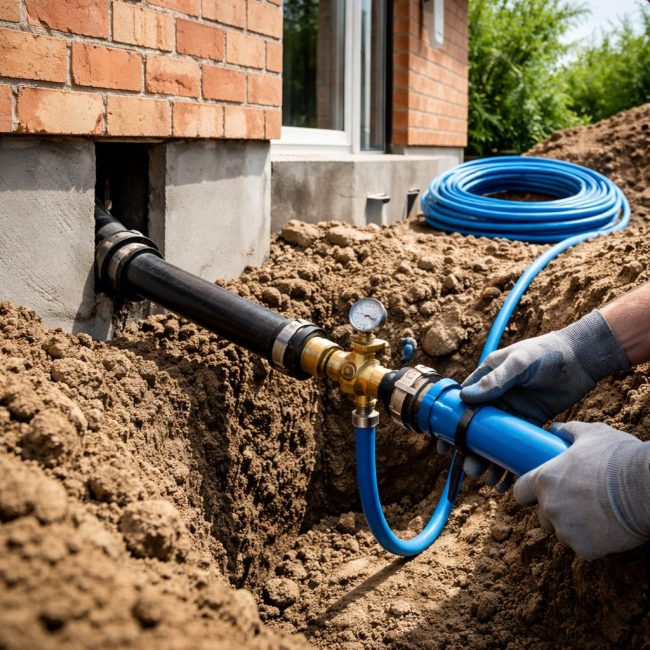
The pipeline entry point into a house is one of the most vulnerable areas of the system. Here, the pipe passes through the foundation or wall, requiring sealing and freeze protection. An improperly installed entry point can cause heat loss, condensation, and structural damage.
The inlet unit typically houses shutoff valves, coarse filters, and, if necessary, meters. This arrangement allows for shutting off the water supply without accessing the site and simplifies maintenance. It is also important that all components remain accessible for inspection and replacement.
Freeze protection and temperature risks
Freezing of water in pipes is one of the most common problems in outdoor water supply systems. In addition to proper installation depth, thermal insulation materials and heating cables are used. The latter are especially important for entry points and areas with unstable temperature conditions.
However, relying excessively on electric heating without considering basic engineering principles often leads to failures. A power outage during freezing temperatures can negate the entire protection system. Therefore, thermal insulation and design solutions should always be the primary focus, with active heating a secondary element.
Pressure and hydraulic limitations
The water supply must ensure stable pressure at the entrance to the house. With a centralized water supply, pressure can fluctuate depending on the time of day and the network conditions. With independent systems, pressure is determined by the pumping equipment settings.
Incorrectly calculating the pipe diameter or route length leads to pressure losses that cannot be compensated for without system intervention. This is especially noticeable when multiple water points are used simultaneously. Therefore, water supply systems are not considered in isolation, but rather in conjunction with the internal wiring and expected loads.
Common misconceptions when organizing water supply
One common misconception is that water supply is a secondary construction step. In reality, this section is the most difficult to upgrade after completion. Another mistake is trying to save on foundation depth or materials, counting on mild winters or infrequent use.
The importance of the entry point is also often underestimated: it is installed perfunctorily, without regard for thermal and operational aspects. As a result, problems arise not along the pipeline, but directly in the building, where they are most difficult to resolve.
Water supply as part of the overall engineering system
Water supply cannot be considered separately from other utilities. It interacts with sewerage, heating, drainage, and foundation structures. A well-designed layout takes these connections into account and minimizes mutual risks.
A properly organized water supply system ensures not only water supply but also predictable operation of the entire system for decades. It lays the foundation for future home improvements and helps avoid situations where a local error leads to widespread consequences.