In modern construction, foundation blocks have become a key element in constructing reliable building foundations. These concrete structures allow for the quick and efficient creation of strip foundations, basements, and other structures. Truncated FBS blocks are particularly popular, as their shape simplifies installation in challenging conditions. If you're building or planning a renovation, understanding the advantages and disadvantages of these blocks will help you make an informed decision. In this article, we'll explore the popularity of foundation blocks, their strengths and weaknesses, and provide recommendations for their use.
- What are foundation blocks and their role in construction?
- Advantages of foundation blocks in modern construction
- Disadvantages of foundation blocks and how to minimize them
- How to Choose Foundation Blocks: Key Criteria and Expert Advice
- Foundation Block Installation Stages: A Step-by-Step Guide
- Frequently Asked Questions
- Is it possible to install foundation blocks yourself without a crane?
- How to calculate the number of foundation blocks for a project?
- Are foundation blocks suitable for wooden houses?
- How long do foundation blocks last in operation?
- Is reinforcement necessary when using foundation blocks?
- How to protect foundation blocks from frost heaving?
- About the author
- Victor Sokolov, civil engineer
- Conclusion
What are foundation blocks and their role in construction?
Foundation blocks, or FBS (solid foundation blocks), are precast concrete elements designed to form the foundations of structures. They are manufactured in factories to strict standards, ensuring high quality and consistency. Basic types include solid, hollow, and truncated blocks, each suited to specific applications. For example, solid blocks are used for load-bearing structures, while hollow blocks are used to reduce weight and conserve material.
Foundation blocks are not just a building material, but a ready-made foundation for a durable building that minimizes the risk of soil deformation.
These blocks play a vital role in construction: they distribute the building's load onto the ground, prevent subsidence, and provide waterproofing. Unlike traditional concrete pouring, these blocks reduce construction time by 30–50%, which is especially important for large projects. According to construction associations, the use of precast concrete blocks in the residential sector increased by 15% in 2024 due to their reliability in Russia's diverse climates.
The production of foundation blocks goes through several stages: preparing a mixture of cement, sand, and crushed stone, vibrocompressing for compaction, and curing in molds. This guarantees compressive strength of up to 20 MPa and frost resistance of F 100–F 200, making them suitable for regions with harsh winters. Importantly, the blocks comply with GOST 13580-85, which regulates their dimensions and characteristics.
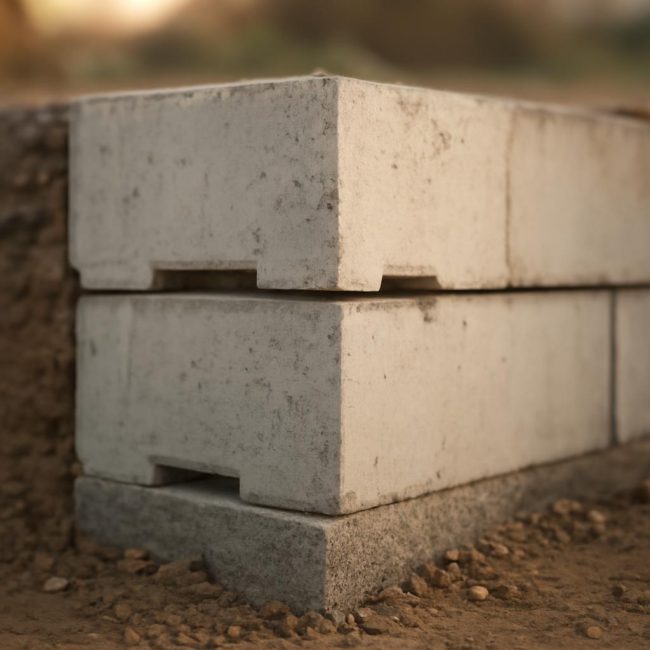
The use of foundation blocks is particularly advantageous in individual residential construction and commercial properties. They allow for the construction of foundations of any depth, from shallow to deep, and are easily integrated with other elements, such as utility pipes. However, before purchasing, it's important to assess the soil: soft soils may require additional reinforcement.
Choosing the right block type is key to success: truncated options are ideal for turns and joints, reducing waste by 20%.
In the context of building construction, where precision and speed are essential, foundation blocks are superior to monolithic methods. They don't require complex formwork, and installation can be done using a crane, simplifying on-site logistics. For engineers and builders, this means lower labor and equipment costs.
Advantages of foundation blocks in modern construction
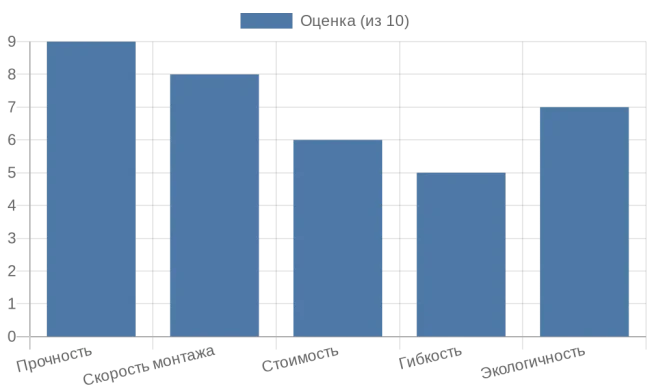
The use of foundation blocks opens up numerous opportunities for optimizing construction processes. One of their main advantages is their high strength and durability. Concrete blocks can withstand significant loads, making them an ideal choice for multi-story buildings and industrial facilities. Thanks to the steel reinforcement within the structure, they are resistant to tension and shear, minimizing the risk of cracks even with uneven ground settlement.
- Speed of construction: block installation takes only a few minutes, as opposed to the multi-day pouring of concrete.
- Resource saving: no need for constant monitoring of the curing process, which reduces energy and material costs.
- Dimensional accuracy: standard dimensions (from 580 x 280 x 240 mm to 2380 x 1200 x 580 mm) ensure a flat surface without additional adjustment.
- Environmentally friendly: production uses recycled materials, and the process itself does not emit harmful substances on the construction site.
Foundation blocks allow for a 40% reduction in construction time, which is critical for projects with tight deadlines.
Another significant advantage is ease of transportation and storage. The blocks are compact, easy to load onto vehicles, and easy to store without risk of deformation. This is especially valuable in urban areas, as it reduces downtime due to logistics. Furthermore, they integrate well with utility systems: the voids in the blocks can be used to install water supply or sewer pipes, simplifying integration with utility networks.
In terms of cost-effectiveness, foundation blocks pay for themselves through reduced labor costs. For a team of four to five people, assembling a 50-meter strip foundation takes no more than two days, including joining and waterproofing. This is especially true in regions with a short construction season, where the weather dictates the pace of work.
Equally important is the fact that the blocks provide excellent thermal and sound insulation. Internal voids are filled with insulation, helping maintain a comfortable microclimate in basements and ground floors. This is a plus for builders working on energy-efficient projects, as it complies with modern SNiP (Building Codes and Regulations) for heat conservation.
Integration with communications is not only convenient, but also saves up to 15% on overall project costs.
Compared to other methods, such as screw piles or slab foundations, blocks offer versatility: they are suitable for sandy, clayey, and even peaty soils when properly designed. Experts recommend them for seismically active zones where increased structural rigidity is required.
Disadvantages of foundation blocks and how to minimize them
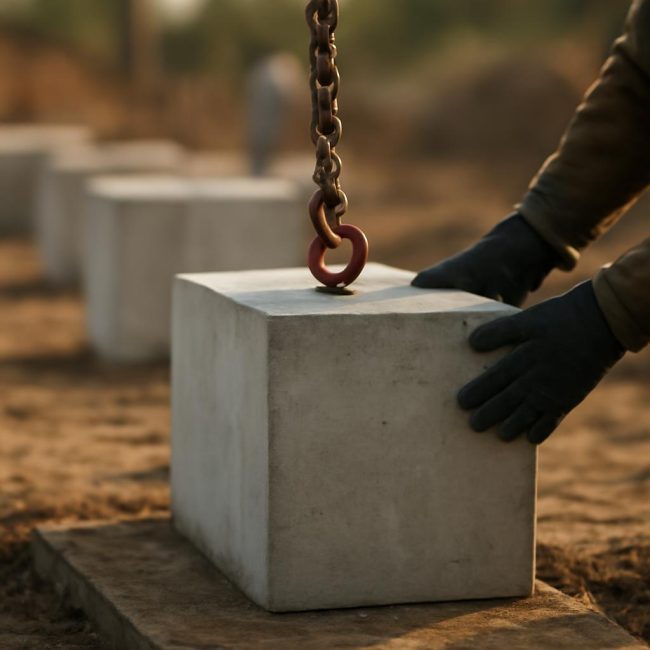
Despite their obvious advantages, foundation blocks also have their limitations, which are important to consider at the design stage. One of the key disadvantages is their reliance on heavy equipment. Installing blocks weighing between 500 kg and 5 tons requires a crane, which increases costs in hard-to-reach areas, such as suburban areas with limited access. If equipment can't access the site, logistics become more complex, and deadlines are missed.
- High initial cost: the price of one block starts at 2,000 rubles, which for large volumes can exceed the budget for a monolithic foundation.
- Limited flexibility: Standard shapes are not always suitable for curved or irregular surfaces, requiring on-site modification.
- Risk of joint corrosion: Without high-quality waterproofing, seams can allow moisture to pass through, leading to destruction over time.
Crane dependency is a challenge, but with the use of mobile mini cranes, the problem can be solved in 80% of cases.
Another drawback is sensitivity to soil quality. In heaving soils, blocks may shift if drainage is not provided. Furthermore, installation requires precise alignment: the slightest misalignment will result in uneven loads on the walls. To minimize this, it is recommended to conduct geological surveys before purchasing materials.
From an environmental perspective, block production is energy-intensive: firing cement emits CO2, although modern factories are implementing green technologies to reduce their carbon footprint. Another issue is the weight of the structure: heavy blocks complicate dismantling if the design changes, making them less suitable for temporary structures.
| Aspect | Advantages | Flaws | Recommendations |
|---|---|---|---|
| Price | Long-term savings on installation | High unit price | Calculate the volume in advance |
| Installation | Quick assembly | Equipment is needed | Select mobile cranes |
| Durability | High strength | Risk in the seams | Provide waterproofing |
| Flexibility | Standard sizes | Limitations of forms | Use truncated blocks |
To overcome these disadvantages, builders often combine blocks with other materials: for example, adding a sand bed for stabilization or using polymer membranes for moisture protection. This reduces overall risks and increases reliability.
Ultimately, weighing the pros and cons, foundation blocks remain the optimal solution for most projects where reliability and efficiency are essential. For engineers and business owners, understanding these aspects helps avoid cost overruns and achieve high-quality results.
How to Choose Foundation Blocks: Key Criteria and Expert Advice
Selecting suitable foundation blocks is a crucial step, determining the success of the entire project. It's worth starting with an analysis of the soil conditions: lightweight, hollow-core options are suitable for sandy soils, while solid, reinforced concrete blocks are best for clay soils. Experts recommend paying attention to the concrete grade: M 100–M 200 will support standard loads, but for seismic zones, M 300 or higher is recommended to withstand dynamic loads.
- Check the GOST certificates of conformity: this guarantees the absence of defects and the correct composition.
- Estimate the dimensions: length from 880 to 2380 mm, width 200–1200 mm and height 220–580 mm should correspond to the foundation drawings.
- Consider the voids: blocks with holes reduce the weight by 20-30%, but require filling with mortar for strength.
- Measure frost resistance: F 150–F 300 is suitable for a moderate climate, F 500 for northern regions with frequent frosts.
Choosing the right block reduces risks by 50%, turning potential problems into a reliable foundation.
When purchasing, it's important to inspect the product for cracks, chips, or unevenness. High-quality blocks have a smooth surface and uniform color, with no signs of fading. For truncated models that are convenient for corner joints, check the accuracy of the angles; a deviation of more than 2 mm can complicate the jointing. If purchasing in bulk, request a sample batch for a test installation on-site.
Factors affecting price include the type of production: vibro-pressed blocks are cheaper than vibro-cast blocks, but the latter are more resistant to fracture. On average, the cost ranges from 1,500 to 5,000 rubles per block, depending on the region and volume. To save money, look for suppliers that offer delivery to avoid additional transportation costs. Expert advice: combine standard and cut-to-length blocks to minimize waste, which can save up to 10% of your budget.
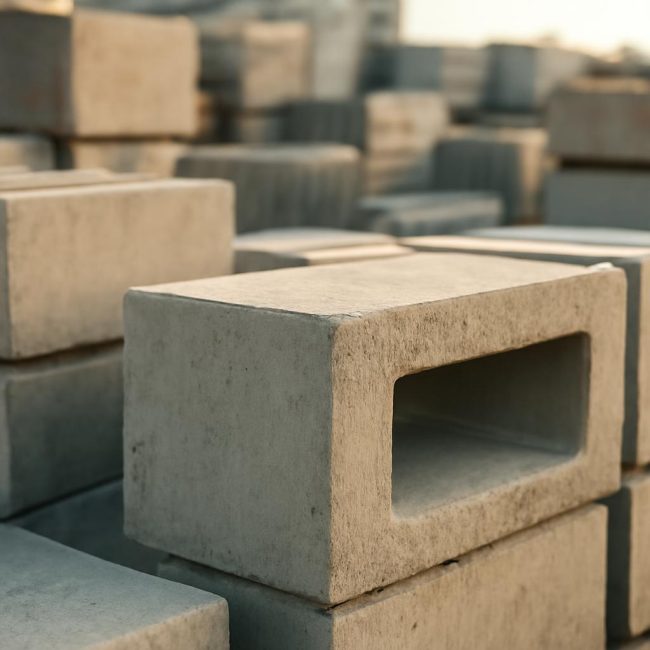
Don't skimp on quality: cheap blocks with low-grade concrete can require repairs in 5–7 years.
When choosing, consider compatibility with other materials. Blocks should be compatible with anchor reinforcement and waterproofing materials, such as bituminous mastics or roll coatings. For projects with utility lines, choose models with pre-cut channels. Engineers recommend using load calculation software to avoid overloading individual elements.
In conclusion, a careful approach to selection will not only optimize costs but also ensure the durability of the structure for decades. If you're new to construction, consult with a geologist or designer—this is an investment in the safety of your facility.
Expert advice: Always leave a 5-10% reserve for unexpected losses during installation.
Next, we'll walk you through the installation steps so you can put your knowledge into practice.
Foundation Block Installation Stages: A Step-by-Step Guide
Installing foundation blocks requires careful preparation and consistent execution. First, prepare the site: clear the area of debris, level the surface, and mark the ground according to the design. Next, lay a 20-30 cm thick sand and gravel bed, compacting it with a vibrating plate to evenly distribute the load. This will prevent subsidence and ensure the stability of the entire structure.
- Install a waterproofing layer: apply bitumen mastic or lay roofing felt to protect the blocks from capillary rise of moisture from the ground.
- Position the first row: Using a crane, lower the blocks onto the pad, align them with the level and axes, using wooden wedges for adjustment.
- Join the elements: fill the seams with cement-sand mortar grade M 200, reinforce the joints with steel rods with a diameter of 10–12 mm to strengthen the connections.
- Check verticality: after laying each row, use a theodolite or laser level to ensure that the deviation does not exceed 5 mm per 3 meters of length.
- Complete the waterproofing: apply a protective layer on top and install formwork for pouring the top chord, if provided for by the project.
The entire process for a typical foundation will take 1-3 days, depending on its length and complexity. It's important to work in dry weather to ensure the mortar sets properly. After installation, allow the structure to settle for 7-14 days before erecting the walls, monitoring settlement using benchmarks.
Accuracy at the installation stage determines the service life of the foundation; errors here lead to repairs in the first years of operation.
For safety, wear personal protective equipment: hard hats, gloves, and steel-toed shoes. If the ground is unstable, add drainage pipes around the perimeter to drain water and prevent flooding.
Frequently Asked Questions
Is it possible to install foundation blocks yourself without a crane?
No, blocks weighing over 200 kg require a crane or lift to avoid injury or damage. Lighter blocks weighing up to 100 kg can be lifted manually, but this is rare for standard structures. It is recommended to use a professional for precise positioning.
How to calculate the number of foundation blocks for a project?
Calculate the foundation perimeter, multiply by the width and height, then divide by the dimensions of one block. Add 5-10% for trimming and loss. Use online calculators or consult an engineer to take into account loads and soil.
Are foundation blocks suitable for wooden houses?
Yes, they are ideal for timber structures on strip foundations, providing uniform support. For frame houses, choose hollow-core blocks with insulating core to minimize heat loss through the foundation.
How long do foundation blocks last in operation?
With proper installation and waterproofing, the service life can reach 50–100 years. Factors that reduce longevity include aggressive soil or lack of drainage, so regularly inspect for cracks.
Is reinforcement necessary when using foundation blocks?
Reinforcement is essential at the joints and for the top row to bind the structure into a monolith. Internal reinforcement in the blocks strengthens them, but additional bars prevent shifting in heaving soils.
How to protect foundation blocks from frost heaving?
Install a drainage system, lay a non-heaving base, and apply waterproofing. In northern regions, use blocks with increased frost resistance (F 300 or higher) to prevent deformation from soil freezing.
About the author
Victor Sokolov, civil engineer

Viktor Sokolov has over 15 years of experience in industrial and civil construction, specializing in the design and construction of foundations for residential and commercial buildings. He has supervised the installation of hundreds of strip foundations in various regions of Russia, from the harsh northern climate to the southern soils, allowing him to thoroughly study the influence of soil and climate on the durability of foundations. In his practice, Sokolov always emphasizes innovative materials, such as reinforced concrete blocks, to improve the reliability of structures without unnecessary costs. His approach combines theoretical knowledge with field testing, helping clients avoid common mistakes. He also conducts seminars for young professionals, sharing best practices for optimizing construction processes.
- Expert in waterproofing and reinforcement of foundation structures.
- Author of technical reports on the stability of foundations in heaving soils.
- Project manager for construction on complex terrain.
- Specialist in the selection of materials for seismically active zones.
- Consultant on environmentally friendly foundation methods.
The recommendations in this article are general in nature and do not replace individual consultation with a specialist for your project.
Conclusion
In this article, we've taken a detailed look at foundation blocks as a reliable element of strip structures, including their production, types, advantages, and selection criteria. We've also focused on the installation stages and answered frequently asked questions to help you avoid common mistakes and ensure the longevity of your foundation. This knowledge will allow you to confidently approach construction, minimizing risks and costs.
In conclusion, always start with professional geological surveys and strict adherence to the design to ensure your foundation will last for decades. Don't forget about waterproofing and reinforcement—they're key to stability. If you're planning a new building, act now: consult with an expert and order high-quality blocks to make your dream of a reliable home a reality. Your construction success starts with a solid foundation!