The construction of a private home or cottage always begins with the selection of a foundation. The building's durability, stability, and safety depend on it. However, in challenging soils—peat bogs, marshy areas, heaving soils, or areas with significant elevation changes—traditional solutions prove ineffective or too costly. In such cases, screw piles are increasingly being used, having proven their reliability and versatility in a wide range of climatic and geological conditions.
- What are screw piles?
- Problems of construction on difficult soils
- Advantages of screw piles on difficult soils
- Versatility of application
- Resistance to seasonal shifts
- Quick installation
- Economy
- Possibility of construction on slopes
- Durability
- Minimal impact on the landscape
- Comparison with traditional foundation types
- Practical examples of application
- Possible limitations
- Conclusion
What are screw piles?
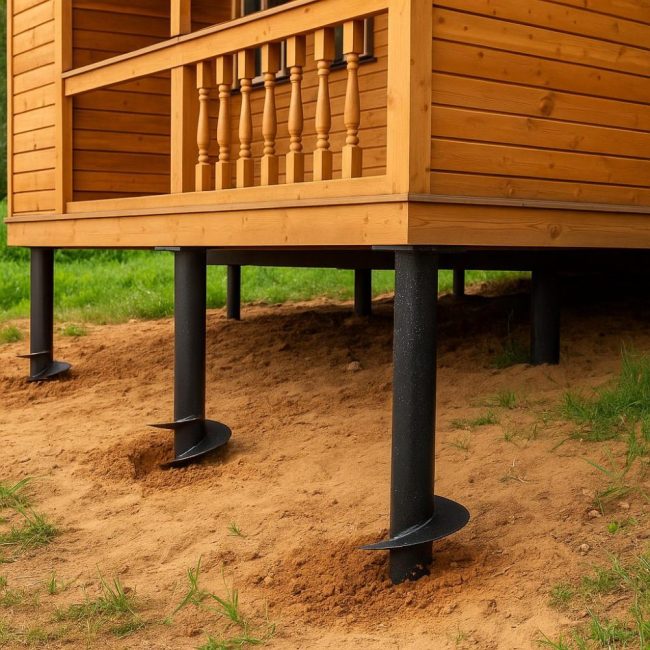
A helical pile is a metal pipe with a pointed tip and a spiral blade. When installed, it is screwed into the ground like a screw, securing it firmly in place. The top portion serves as a support for the grillage or framing, upon which the walls are then erected.
The principle behind these piles is that the building load is evenly distributed through the blade onto dense soil layers. This makes the foundation stable even on soft or uneven soils, where traditional concrete strip foundations can crack or deform.
Problems of construction on difficult soils
Before considering the benefits, it's important to understand the challenges builders face on unstable soils:
- Heaving soils They expand in winter and settle in spring, which leads to deformation of ordinary foundations.
- Peatlands and wetlands They do not hold massive structures well, and under such conditions the concrete strip often sinks into the ground.
- Sandy soils are prone to movement, which requires special strengthening of the foundation.
- Variations in relief create difficulties in leveling the construction site and increase the cost of the work.
All these factors make the use of standard foundation solutions risky and costly. This is why screw piles are becoming the optimal option.
Advantages of screw piles on difficult soils
Versatility of application
Screw piles can be installed in virtually any type of soil, including marshy, sandy, and peaty conditions. The only exception is rocky soils with a high boulder content, where screwing in a pile can be challenging.
Resistance to seasonal shifts
The pile blade is anchored below the frost line. This means seasonal soil fluctuations don't affect the foundation's stability. A house built on these piles is not susceptible to warping or cracking.
Quick installation
Installation doesn't require heavy-duty specialized equipment or extensive excavation work. On average, a screw pile foundation can be installed in 2-3 days, whereas a concrete foundation requires several weeks to pour and cure.
Economy
Using piles is less expensive than constructing a strip or slab foundation. There's no need for large quantities of concrete, rebar, or formwork, nor is there the need to remove large volumes of earth.
Possibility of construction on slopes
If the site has a slope, piles of varying lengths allow you to level the future floor without additional soil leveling. This is especially important in mountainous or hilly areas.
Durability
Modern screw piles are made of durable steel and coated with an anti-corrosion compound. With proper maintenance, their service life can exceed 50 years.
Minimal impact on the landscape
Pile installation doesn't require extensive excavation, preserving the site's natural topography. This is important if the site contains trees or decorative elements that you don't want to damage.
Comparison with traditional foundation types
- Strip foundation It requires significant investment in materials and excavation work. It is not suitable for marshy or peaty soils.
- Monolithic slab provides strength, but is the most expensive and labor-intensive to manufacture.
- Columnar foundation cheaper, but less reliable on soft soils.
Against this backdrop, screw piles occupy the "golden mean" – they provide strength, durability and versatility at a relatively low cost.
Practical examples of application
- Country houses and cottages — the optimal solution for fast construction without waiting for concrete to dry.
- Baths and gazebos - lightweight buildings that can be erected even on peat bogs.
- Warehouses and hangars — the pile foundation can withstand significant loads.
- Fences and terraces — screw piles are often used even for small architectural forms.
Possible limitations
Despite its numerous advantages, the technology also has its own nuances:
- Difficulties when installing on rocky soils.
- The risk of purchasing low-quality piles without a reliable anti-corrosion coating.
- The need for correct load calculation to avoid deformations.
These issues are easily resolved by choosing a reliable manufacturer and conducting geological surveys before construction.
Conclusion
Screw piles are a modern and reliable solution for construction on difficult soils. They ensure building stability, save time and money, and open up opportunities for constructing homes in conditions where traditional foundations are inadequate. Due to their versatility and durability, this type of foundation is increasingly being chosen by both private developers and professional construction companies.