Water under the drawers, a puddle on the floor, and a damp smell are classic signs that your refrigerator drain is clogged. The good news: in most cases, the problem can be resolved in one evening without calling a technician. If you'd like to learn more about the device or the service, you can find out more on our website. Below, I'll tell you how to safely and effectively clear the drain yourself.
- When drainage is to blame: symptoms and causes
- What to prepare and how to safely access the drainage
- Step-by-step cleaning: from the hole to the tray
- Cleaning the inside of the chamber
- Blowing and control from the outside
- If an ice plug has formed
- Prevention, common mistakes, and when to call a professional
When drainage is to blame: symptoms and causes
The drainage system channels meltwater into a special tray above the compressor, where it evaporates. If this path is blocked, the water seeks a way out: it accumulates at the bottom of the chamber, leaks out, and causes an unpleasant odor.
Signs that the problem lies in the drainage channel:
- Puddles at the bottom of the refrigerator compartment or under the vegetable drawers.
- Icing or “fur coat” on the back wall, although this was not the case before.
- Moisture under the housing or a wet compressor tray without water in it.
- Moldy smell when opening the door, especially after overnight.
- The fan is loud in No Frost mode (water/frost flies onto the blades).
There are different reasons for blockages:
- Crumbs, seeds, labels, and pieces of packaging fall into the drain hole.
- Fat deposits and sticky condensate “cement” the canal walls.
- Ice plug after long periods of operation at low temperatures or when the door is not closed tightly.
- Incorrect tilt of the body: water does not go into the hole, but flows into the chamber.
- The rubber seal wears out and there is a constant flow of warm air, resulting in too much condensation.
- In No Frost, the drainage heating may break off or shift, causing the water to freeze at the defrost hole.
Drip systems and No Frost systems behave differently. In a drip system, the back wall "weeps"—the drops should flow into a hole in the middle. In a No Frost system, the drainage is hidden behind the freezer panel: the evaporator defrost water drains into a channel, but if there's ice in there, it "blocks" the path, and the water freezes in layers.
If you see a persistent puddle and the tray above the compressor is empty, it is almost certainly the channel or drain hole that is clogged.
What to prepare and how to safely access the drainage
Start with preparation: the process is shorter and the result is cleaner.
What you will need:
- Rubber bulb or large syringe 50-100 ml (for flushing).
- Flexible silicone tube 5-7 mm, 1-1.5 m long.
- Soft nylon line or blunt mini-rope for gentle cleaning.
- A warm solution of water with a drop of neutral detergent or 1 teaspoon of soda per glass of water.
- Towels/napkins, bowl or tray for water.
- Gloves, flashlight.
- If necessary, use a hair dryer on warm air (not hot) or a bottle of warm water.
Safety and preparation rules:
- Unplug the refrigerator. This is a necessary step—it's damp inside, and we'll be adding water.
- Empty the lower shelves and drawers to access the drain and prevent food from getting wet.
- Thaw the ice. If the wall is covered in frost, let the refrigerator sit for 30–60 minutes with the door open or speed up the process with warm air. Do not use boiling water or sharp objects.
- Protect the floor and the back of the cabinet with towels - some water may escape through the back edge.
- Check that the refrigerator is level. The back should be slightly higher so that water drains toward the wall and into the drain, not onto the shelves.
Where to look for a drain:
- Drip system: Look at the back wall of the refrigerator compartment—there's a small groove and hole roughly in the middle. This is where condensation collects.
- No Frost: Drainage runs from the evaporator behind the freezer panel and down through a channel to the compressor tray. Access from the freezer is usually by removing the inner panel. Work carefully: cables, sensors, and a defrost heater are located behind the panel.
On the outside, at the back of the refrigerator, the drain tube leads to the evaporation tray. Check: the tube isn't pinched or kinked, the rubber washer is in place, and the tray is free of debris or scale. Sometimes a blockage occurs right at the outlet of the tray.
Step-by-step cleaning: from the hole to the tray
There is only one plan: remove debris, melt the ice, flush the channel with warm water, restore the normal slope and check the drain.
Cleaning the inside of the chamber
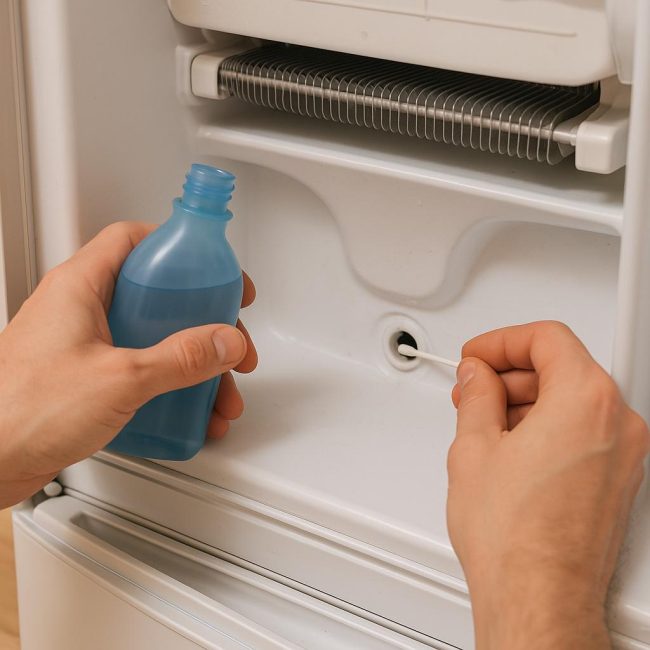
- Locate the drain hole. Carefully remove the plastic cap or decorative cover, if present.
- Inspect the hole with a flashlight. Often, crumbs or debris can be seen stuck to the edge.
- Insert a soft fishing line or flexible brush and very carefully insert 3–5 cm into the root canal. Avoid using metal wire or toothpicks, as they can easily damage the canal or push debris deeper.
- Fill a syringe with warm water with a small amount of baking soda or a drop of detergent. Slowly inject 30–50 ml into the hole. Let the water sit for 2–3 minutes to soften the plaque and ice.
- Repeat 2-3 times, increasing the volume to 100-150 ml. Observe: if the water drains, that's good; if it rises back, the cork is still holding.
Tip: Keep some wipes handy—some water may come back up. This is normal for a severe clog.
Blowing and control from the outside
- Go to the back and find the area where the drain tube enters the tray on the compressor.
- Remove the tube from the tray outlet (usually it's just attached). Check for any slime deposits. Clean with a soft brush and warm water.
- Attach the silicone extension tube to the tube and gently blow with your mouth or a blower toward the refrigerator. Avoid strong, sudden jerks—it's important not to rip the connections inside.
- Return to the chamber and re-inject warm water with the syringe. If the channel has opened, water will begin to flow freely into the tray from the outside.
- Rinse the canal with 2-3 portions of warm water (100-150 ml each) until the outgoing water is clear and odorless.
If an ice plug has formed
Ice can be felt by the “dull” resistance and the complete return of water back.
- Unplug the refrigerator and leave the doors open for 40–60 minutes. At the same time, add 30–50 ml of warm (not hot!) water to the drain hole every 10 minutes. Keep the temperature at around 40–45°C to avoid damaging the plastic.
- You can gently warm the drainage area with a hair dryer, holding it at a distance of 20–30 cm. Do not direct the hot air stream at the plastic or seals.
- Once the ice has melted, flush the channel as described above.
Final check:
- Place the tube back onto the tray outlet, making sure it fits snugly and without any kinks.
- In the chamber, slowly pour 150–200 ml of warm water into the drain hole. Watch the tray: the water should flow evenly. If it does, the drain is open.
- Wipe dry, plug in the refrigerator, and set the usual settings.
Prevention, common mistakes, and when to call a professional
It's best to avoid puddles. A few simple habits can significantly reduce the chances of clogging.
Prevention:
- Every 3-6 months, flush the drain with 100-150 ml of warm water and a drop of neutral detergent. This removes mucus and prevents odor.
- Wipe the back wall of the chamber, remove crumbs in the groove area.
- Make sure the refrigerator is installed level: the front legs are slightly higher so that water flows back.
- Check the door seal. If there's a gap, there's excess condensation inside.
- Cool hot foods before installing them. Steam accelerates drainage ice formation.
- Store small items in containers to reduce the chance of crumbs ending up in the drain.
Common mistakes:
- Piercing the channel with a stiff wire or a knitting needle. The result: a soft insert is punctured or a connection is torn, resulting in a constant leak inside the housing.
- Pour boiling water. The plastic warps, the rubber seals lose their shape, and the adhesive in the sealed units ages much faster.
- Use harsh chemicals like bleach, acetone, or concentrated acids. They corrode plastic and seals, leaving a lingering odor.
- Blow it out with a high-pressure compressor. This forces water and debris deeper into the foam insulation, where mold begins to grow.
- Ignore the evaporator tray. If it's clogged with dirt or scale, water will overflow even if the channel is clean.
When is the best time to call a specialist:
- Recurring blockages within 2-4 weeks. Often, the cause is not dirt, but a misaligned tube, a defective valve, or improperly designed fitting.
- The drain heating in the No Frost unit isn't working, causing a persistent ice plug to form near the evaporator. The heater, thermal fuses, and sensors need to be diagnosed.
- If water appears from under the housing, a “hissing” sound is heard, or the smell of insulation is present, there may be a leak in the thermal insulation and it needs to be opened.
- The display shows a defrost error, the fan is noisy, and the airflow is interrupted. Unexperienced attempts to remove the evaporator panel easily result in damage to the wiring.
- The refrigerator is under warranty. Doing something yourself might remove it—let the service center handle it.
Bottom line: basic drainage system cleaning is a straightforward and safe procedure when done carefully. Keep a syringe, warm water, and a little patience handy, and the problem of puddles under drawers will disappear. Regular maintenance once a season will eliminate odors, excess frost, and unexpected moisture on the kitchen floor.