In recent years, more and more people have been considering exchanging their urban lifestyle for a more peaceful, sustainable, and meaningful life in harmony with nature. One of the most discussed and promising areas in this context is the "My Hectare" project. It offers Russians the opportunity to receive a free one-hectare plot of land in the countryside for farming, building a home, and creating their own eco-friendly space. In this article, we will examine in detail the "My Hectare" project, the opportunities it offers, the challenges it can pose, and how to wisely develop the land they receive.
What is the My Hectare project?
The "My Hectare" project is a private initiative inspired by the state program for distributing hectares in the Far East, but implemented in the European part of Russia—in the Tver, Yaroslavl, Kostroma, Vladimir, and other regions. Its essence lies in the consolidation of one-hectare plots into residential communities with full infrastructure, including roads, electricity, social and commercial facilities.
The main idea is to create a new way of life based on the principles of sustainable development, ecology, and autonomy. Land is leased with an option to purchase. All participants receive not just a plot of land in a field, but a territory within a well-designed community where they can build a house, start a farm, grow food, educate children locally, and live comfortably, independent of the city.
Who can participate?
Any Russian citizen can join the project. Age, social status, and place of residence are irrelevant. The main requirement is awareness and a willingness to move to a rural area to create a personal space for living and working.
Families with children, young professionals, freelancers, and retirees can all find a suitable living model on this hectare. Many participants see this as a path to self-sufficiency, eco-living, creating a family estate, or launching a small business.
How to get a hectare
The procedure for participation in the project is as follows:
- Selecting a locationThe project organizers offer plots of land in various regions, most often within a 100–200 km radius of Moscow. Participants can choose a specific settlement.
- Conclusion of the contractThe plot is leased for 49 years with the option to purchase it at a nominal price. The terms of the agreement include obligations to develop the land.
- House and infrastructure designAt the next stage, the participant develops a design for the future home, determining locations for a garden, vegetable patch, and outbuildings.
- Start of constructionMost often, houses are built from wood or other environmentally friendly materials. Compliance with the architectural requirements of the community is important.
- Settlement and developmentOnce construction is complete, life on the hectare begins: farming, participating in community life, and implementing personal projects.
Advantages of the "My Hectare" project
1. Freedom and independence.One hectare is a vast area, allowing for self-sufficient living. Here you can grow vegetables and fruits, keep animals, build, and create craft workshops.
2. Natural ecology.All project settlements are located far from large cities and industrial facilities, among forests, meadows, and clean rivers.
3. Community and support.The settlements are formed according to the "new type village" principle. Participants are united by the idea of eco-living, helping each other, sharing resources and experiences.
4. Developed infrastructure.Unlike isolated areas in the wilderness, these sites have roads, electricity, internet, and public amenities (shops, schools, medical centers).
5. Business opportunities.On a hectare, you can open an eco-farm, produce goods, and provide services—all within the village or online.
How to develop a plot: stages
1. Territory planning
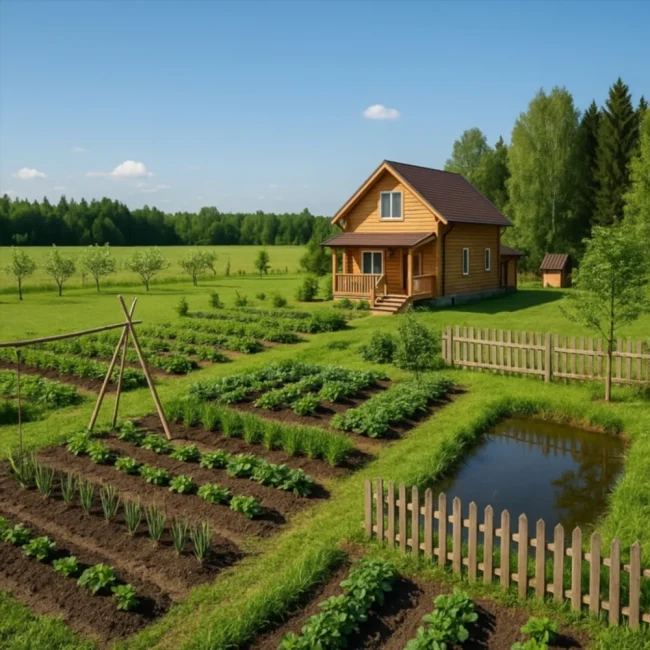
It's important to wisely distribute the space within a hectare. Typically, a plot is zoned as follows:
- Residential area— house, bathhouse, utility room, garden;
- Agricultural zone- greenhouses, beds, orchard;
- Animal area- barn, chicken coop, aviaries;
- Recreational area- pond, recreation area, barbecue area;
- Forest planting- creation of hedges, planting trees.
2. Construction of a house
Many people choose houses made of laminated veneer lumber, frame structures, or log cabins. These are environmentally friendly, cost-effective, and suitable for DIY construction. Key features include energy efficiency and independent heating (stove, solid fuel boiler, solar panels).
3. Water and electricity supply
Water is most often supplied from a well or borehole. Electricity is supplied centrally or through independent power generation (solar panels or generators). Sewage is provided by a septic tank or composting system.
4. Farming and gardening
Even a single hectare can provide enough food for a family—vegetables, fruits, herbs, and berries. Greenhouses, Mittlider or natural farming beds, and waste composting all contribute to sustainable farming.
What difficulties may you encounter?
1. Adaptation to rural life.Moving from the city requires a psychological adjustment. Not everyone is prepared for the workload, lack of entertainment, and lack of urban infrastructure.
2. Financial investments.Building a house, connecting utilities, and landscaping the site require significant investment. Although a hectare is provided free or at a minimal cost, landscaping is expensive.
3. Climatic features.Winters in some regions can be harsh and summers short. This affects the choice of crops and home architecture.
4. Legal issues.It is important to carefully study the lease agreement, monitor the deadlines for registering ownership rights, and comply with land development obligations.
5. Limited transport accessibility.Some settlements are located at a significant distance from cities and require personal transport.
Participants' experiences: real stories
Many families who have moved to their own hectare report profound transformations in their lives. They note improved health, reduced stress, and a real sense of purpose in their daily lives. Some have opened mini-bakeries, others have taken up cheesemaking, and still others are growing medicinal herbs. A single hectare truly can be the beginning of a new life—if you approach it wisely and patiently.
Conclusion
The "My Hectare" project is more than just an opportunity to acquire land. It's a chance to change your lifestyle, return to your roots, and create a space where everything is under your control: food, health, home, and living environment. It's a step toward autonomy, a sustainable future, and true freedom.
For those who dream of a life in nature, want to raise children away from the hustle and bustle of the city, build a home with their own hands, and be the master of their own space, "My Hectare" could be the perfect starting point. The key is to have no fear, plan wisely, and be prepared to put in the work. Then, one hectare will become a true haven of happiness.