It's hard to imagine a modern apartment without an air conditioner, especially in a hot climate or a stuffy city. This device has become an integral part of comfortable living, providing cooling in the summer heat and often heating in the off-season. However, many forget that the high-quality and safe operation of an air conditioner depends largely not only on its capacity and brand, but also on proper electrical wiring. In this article, we'll take a detailed look at the appropriate wiring for an air conditioner in an apartment, what parameters to pay attention to, and how to avoid common installation mistakes.
- Why Air Conditioner Wiring Requires Special Attention
- Basic Wiring Requirements for Air Conditioners
- Dedicated power line
- Suitable cable
- Circuit breaker
- RCD and grounding
- Load calculation and cable selection
- Where to lay the wiring
- Installing a socket or direct connection?
- Taking into account the route length and voltage drop
- Features of connecting the outdoor unit
- Surge protection
- What does the Electrical Installation Code and regulations say?
- Stages of work execution
- Common mistakes when laying wiring
- Conclusion
Why Air Conditioner Wiring Requires Special Attention
An air conditioner is more than just a household appliance. It consumes a significant amount of electricity, especially when heating or at high power settings. Incorrectly designed or installed wiring can lead to overheating, tripping circuit breakers, short circuits, and even fire. Therefore, wiring an air conditioner should be approached with the same care as installing an electrical panel or an electric stove.
Basic Wiring Requirements for Air Conditioners
Dedicated power line
The first and most important rule is that the air conditioner must be connected to a separate circuit from the electrical panel. This prevents network overload and ensures stable operation of the equipment. Connecting the air conditioner to existing outlet groups is not permitted, especially if these groups contain refrigerators, microwaves, or kettles.
Suitable cable
Typically, for a standard household air conditioner with a power rating of up to 2.5 kW, a copper cable with a cross-section of 1.5 mm² is sufficient. However, for more powerful models (3–5 kW), such as multi-split systems, a cable with a cross-section of 2.5 mm² or more is required. The use of aluminum cable is not permitted.
Recommended brands:
- VVGng-LS 3×1.5 – for low-power models;
- VVGng-LS 3×2.5 – for more powerful devices;
- NYM 3×2.5 is a European analogue with additional insulation.
Circuit breaker
A separate circuit breaker must be installed for the air conditioner. Its rating is selected based on the equipment's power. For example, for a 2.5 kW air conditioner, a 10–16 A circuit breaker is optimal. Circuit breakers with a C characteristic are recommended, as they can withstand short-term inrush currents.
RCD and grounding
For safety, it is advisable to install a residual-current device (RCD), especially if the apartment does not have a proper ground. The RCD must be rated for a leakage current of 30 mA.
If your apartment doesn't have a grounding system, consider installing one during a major renovation. Ideally, use a modern TN-S system.
Load calculation and cable selection
Before installing the wiring, it's necessary to perform a load calculation. This will allow you to accurately determine the cable cross-section and circuit breaker rating.
Example:
- The air conditioner capacity is 3.5 kW.
- The mains voltage is 220 V.
- Current = 3500 / 220 ≈ 15.9 A.
According to the table of permissible current loads for copper cable:
- 1.5 mm² - up to 18 A (at the limit).
- 2.5 mm² — up to 25 A (with reserve).
In this case, it is better to choose 2.5 mm² with a 16 A circuit breaker. This will ensure the safety and durability of the system.
Where to lay the wiring
Cable installation can be either open or concealed. Concealed installation under plaster or in chases is most common in apartments.
Placement recommendations:
- The wire must run vertically from the distribution board to the level of the air conditioner;
- Avoid intersections with other engineering systems;
- The minimum distance from gas pipes is 10 cm, from water pipes - 5 cm;
- If an air conditioner with an outdoor unit is used, it is necessary to provide a route for the cable to be routed through the wall.
It's important to avoid kinks and sharp turns in the cable to avoid damaging the insulation. It's recommended to install the cable in a corrugated sleeve or cable duct.
Installing a socket or direct connection?
The air conditioner can be connected in two ways:
- Through a power outlet— used for mobile air conditioners or in cases where installation is carried out without chasing walls.
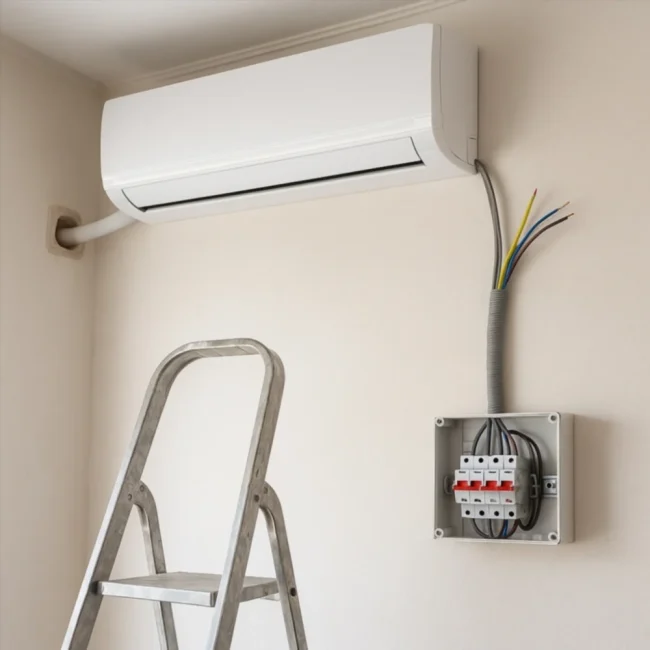
- Direct connection— the preferred option for split systems. The cable is fed directly into the indoor unit's terminal block, and the connection is made through a circuit breaker and RCD.
Please note that a standard outlet (10–16 A) may not be able to handle the load of a powerful air conditioner. Therefore, if you choose an outlet, it should be sized according to the current rating, with some extra capacity.
Taking into account the route length and voltage drop
If the air conditioner is located significantly away from the distribution board, voltage drop must be taken into account. If the distance between the board and the indoor unit exceeds 20 meters, the cable cross-section should be increased to 4 mm² to prevent overheating and unstable operation.
Features of connecting the outdoor unit
For split-type air conditioners, it's important to ensure reliable power supply to both the indoor and outdoor units. Typically, both units are powered from a single source via the indoor unit. However, some models (especially inverter or multi-split systems) may require a separate power supply for the outdoor unit—check the manufacturer's instructions for this.
If the outdoor unit is located far from the indoor unit, an additional power cable and circuit breaker may be required.
Surge protection
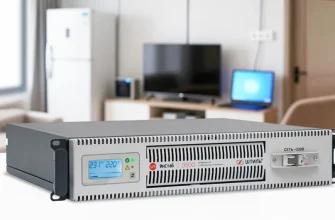
Air conditioners are sensitive to voltage fluctuations. To prevent premature failure of the compressor and control board, it is recommended to install a voltage stabilizer or relay. This is especially important in homes with weak or overloaded electrical systems.
The stabilizer is selected based on the power of the air conditioner, with a reserve of at least 20–30%.
What does the Electrical Installation Code and regulations say?
According to the Electrical Installation Code (EIC), electrical wiring for high-power household appliances must meet the following requirements:
- using copper cable;
- mandatory grounding;
- presence of automatic shutdown;
- correct selection of cross-section and protection ratings;
- compliance with fire safety regulations (non-combustible insulation, hidden installation in residential premises).
It is also necessary to take into account SP 256.1325800.2016, which regulates the design of electrical supply in residential buildings.
Stages of work execution
- Drawing up a diagram and calculating parameters;
- Selecting the right cable and circuit breaker;
- Laying the route and installing socket boxes/terminals;
- Connecting circuit breakers in the panel;
- Insulation resistance testing;
- Connecting the air conditioner;
- Equipment overload and start-up testing.
Common mistakes when laying wiring
- Using a common cable with other sockets;
- Incorrect selection of cable cross-section;
- Connection via a standard socket;
- Lack of grounding;
- Installation without circuit breaker or RCD;
- Bends, twists, poor contact;
- Wiring on old aluminum wiring.
These errors can not only lead to air conditioner failure, but also cause a fire.
Conclusion
Properly installed air conditioner wiring is the key to its safe and efficient operation. Approach this task carefully and adhere to all technical standards. Don't skimp on cables, automation, and protection—after all, not only the lifespan of the unit but also the safety of the entire apartment depend on these.
If you're unsure of your skills, entrust the installation to a professional electrician. Even then, understanding the basic principles will help you oversee the process and ensure everything is done correctly.